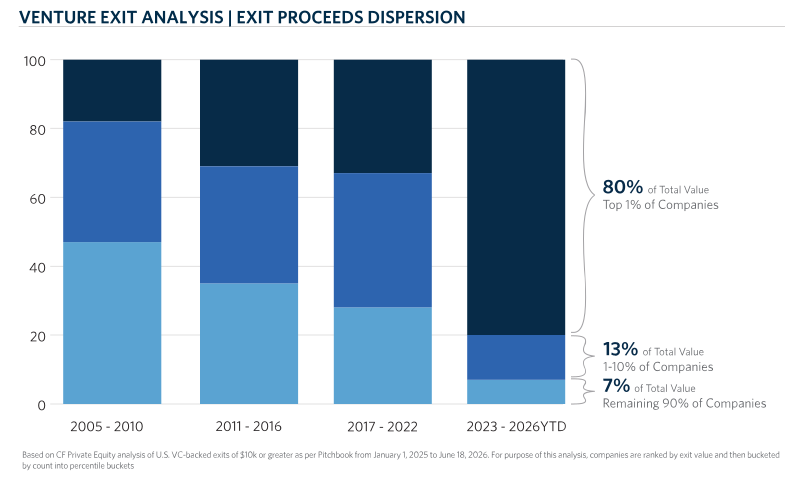
The power law is a principle where a small number of outlier investments yield returns larger than all other investments combined, often by orders of magnitude. It is the organizing principle of venture capital. The firms that built Silicon Valley chased the rare grand slam rather than avoiding the frequent strikeout. None of this is new. The question is whether AI is steepening the curve, and we think it is. The math bears it out: in looking at venture exit events since 2023, the top 1% of companies represent 80% of total venture capital exit value (or 45% excluding the $1.77 trillion SpaceX IPO), up from 17% from 2005-2010 and 34% from 2017-2022.1 This persistent and widening divergence reflects an increasingly bifurcated market where a small number of standout companies are pulling averages dramatically above the rest. And the pipeline points the same way: potential IPOs of OpenAI and Anthropic would concentrate exit value even further in the top few companies.
AI now absorbs most U.S. venture dollars, north of 80% by early 2026, up from 64% in H1 20252. A few companies are attracting the majority of investment dollars and commanding the steepest valuations: OpenAI was recently valued at $852 billion, Anthropic at $965 billion, and SpaceX at $1.25 trillion while private. That scale dwarfs prior cycles, when such companies had long gone public. The average top-five private company was worth about $25 billion in 2015 and $35 billion in 2020, then jumped to $473 billion as of June 18, 2026, about 17 times the 2015 level3.
The winners are also arriving faster: Stripe data shows AI companies reaching $30 million in annualized revenue in a median of 20 months, versus five-plus years for the prior software generation. At the top, revenue scales even faster: Anthropic reported a $47 billion run rate in late May4, up from $30 billion earlier in the year and $10 billion last year5. Some are projecting Anthropic to reach $80 to $100 billion in run-rate revenue by the end of 20265.
According to PitchBook, U.S. venture-backed public listings over the decade since 2015 created roughly $1.44 trillion in exit value combined, a total SpaceX exceeded with its June IPO alone, which raised about $75 billion at a $1.77 trillion valuation. With OpenAI and Anthropic expected to follow this year, the three together approach $3.6 trillion, dwarfing the record set in 2021. Because market winners are capturing value at such an accelerated rate, the power law is no longer a slow-moving distribution; it is a winner-take-most environment that is taking shape faster than ever.
If returns are further concentrating in fewer companies, how should LPs adjust their approach? Start with how the winners now raise capital. The best AI companies command larger rounds from the outset and gravitate toward deep-pocketed investors who can keep backing them round after round. In response, a select few platforms have spotted this value proposition early and scaled to meet that demand, assembling the capital base and operating teams founders want and invest across a company’s full life cycle, from seed to pre-IPO. This has the potential to put smaller managers at a sharper disadvantage than before. Fundraising reflects the same dynamic: according to Pitchbook, U.S. venture funds raised about $48 billion in the first quarter of 2026, yet the five largest firms captured roughly 73% of all commitments. The edge shifts to firms that can fund a company the whole way, and it rests on two things: access to the best companies, and the ability to build them into winners.
Nothing in this asset class is scarcer than access. It is both earned and structural, built from founder networks, LP ecosystems, proprietary data, and thought leadership in specific markets. And the most attractive companies are also the most constrained, so reaching them early is what ultimately drives returns. Access only gets a manager into the deal; what can bend a promising company onto the power-law curve is the operating muscle of the largest platforms: recruiting, go-to-market, corporate development, and follow-on firepower. The best managers are also themselves heavily oversubscribed, so identifying them is not the same as being able to invest in their funds.
For LPs, the critical objective, then, is to gain exposure to a wide swath of companies, early, before the outcome is obvious, and then concentrate capital into the category definers as their trajectories inflect. Almost every category-defining company was non-consensus at one point in its journey. Databricks was contested at its Series C. SpaceX was a moonshot until very recently. Defense was deemed uninvestable before Anduril, and large language models were dismissed as future commodities before OpenAI and Anthropic became two of the most valuable private companies. Once consensus forms, the price reflects it, and most of the return has gone to whoever was early. The outcomes are not random: the best VC firms outperform the field, pairing a higher hit rate with larger outcomes when right.
The power law has always governed venture, but AI appears to be steepening it: bigger winners, reached faster, with a wider gap between the outliers and everyone else. The advantages that decide who captures the outliers are familiar: investing early, durable access, and managers with the operating ability to shape outliers, not merely identify them. We believe the opportunity set has never been larger. Capturing it still comes down to selection and access, now with more at stake than ever.
1. Based on CF Private Equity analysis of U.S. VC-backed exits of $10k or greater as per Pitchbook from January 1, 2005 to June 18, 2026.
2. Q1 2026 PitchBook-NVCA Venture Monitor.
3. Based on CF Private Equity analysis of the most valuable U.S.-based private companies, using data from Pitchbook as of June 18, 2026.
4. https://www.reuters.com/business/anthropic-raises-65-billion-now-valued-965-billion-2026-05-28/
5. https://www.theinformation.com/newsletters/dealmaker/anthropic-hit-100-billion-annualized-revenue-year?rc=7pjjlh