When investors think of climate-focused investment and sustainable investing generally, they often envision thematics such as renewable power, electrified transport, and industrial decarbonization, with the broader energy transition drawing the largest share of interest and capital. What is less widely appreciated is that a significant portion of capital deployed under the mitigation theme has gone into adaptation and resilience businesses.
In fact, JP Morgan estimates that climate adaptation finance “has been below $65 billion a year, only 1/6th of expected needs by 2030.”1 While less of a focus today, such businesses are increasingly important to manage a range of climate-driven risks from wildfires to flooding. Those challenges create opportunities for sustainably oriented investment – one which is expected to grow. The JP Morgan report goes on, “By identifying businesses for investment…that are proactively adapting, one can diversify for resilience and capitalize on emerging market shifts. This approach not only hedges potential risks but also positions to leverage new growth opportunities shifting in response to a changing climate.”1 Before turning to where those opportunities sit within private markets, it is worth delineating the risks driving them.
What Risk?
In the United States alone, the cumulative cost of weather and climate disasters has exceeded $3.1 trillion since 1980.2 In 2025, there were 23 separate weather events that caused at least $1 billion in damages in the United States.
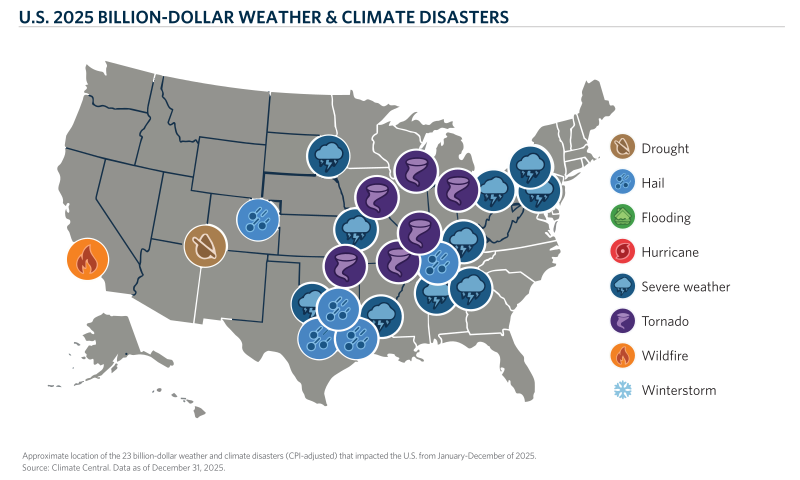
This trend – severe weather events causing significant property damage and often taking lives – is not limited to the United States. As global temperatures continue to rise, the frequency and severity of storms, flooding, drought, and wildfire have accelerated. The geographic footprint of climate exposure has expanded into regions and asset classes not previously considered "at risk," affecting asset values, insurance markets, agricultural output, and supply chain reliability.
Defining Terms - Are Adaptation and Resilience Fundamentally the Same?
Distinguishing between adaptation and resilience is important, as they are related but distinct value propositions. The Grantham Research Institute on Climate Change and the Environment at the London School of Economics provided a helpful guide to distinguishing these two related concepts, noting “In the context of climate change, the Intergovernmental Panel on Climate Change (IPCC) defines adaptation as the process taken to “adjust to the actual or expected climate and its effects.”... On the other hand, resilience to climate change is defined as the capacity to prepare for, respond to, and recover from the impacts of hazardous climatic events while incurring minimal damage to societal wellbeing, the economy and the environment.”3 Simply put, Climate Adaptation is about mitigating disruptions and damage Climate Resilience is preparing the services and tools to recover from such disruptions.
What distinguishes the climate adaptation and resilience theme from much of the broader sustainability conversation is the nature of the demand driver. The need to manage physical climate risk is increasingly not optional, nor is it driven by shifting consumer preferences, or political priorities. The demand driver is the physical environment itself and the financial consequences of ignoring it. That makes the underlying commercial demand structurally durable. The universe is broad and not all of it will be commercially viable, but the climate classification is growing, and investors are finding more interesting opportunities within it.
Defining the Investment Opportunities
Using the definitions provided above, the investment thematics that underly them come into focus. For Climate Adaptation, this can include investments in water management systems (to mitigate flooding risk), weather intelligence businesses (to predict and potentially limit the cost of weather events) or even vegetation management businesses (to reduce fire risk to assets like transmission lines). For Climate Resilience, the opportunity could focus on disaster recovery and remediation businesses. Importantly, these are all examples of businesses with clear financial strategies that are aligned with the broader climate theme. The World Resources Institute released a study in June 2025 “…which analyzed 320 adaptation and resilience investments across 12 countries totaling $133 billion, [finding] that every $1 invested in adaptation and resilience generates more than $10 in benefits over ten years.”4
Defining the Sustainable Benefits
The sustainable benefit of these businesses can take many forms and while many of these benefits are social (accruing to the community in the form of reduced risk of lost lives and improved health outcomes), the WRI’s analysis found that “nearly half of the analyzed adaptation investments are also expected to cut greenhouse gas emissions, showing that adaptation and mitigation often go hand in hand.”4 As measurement frameworks for adaptation outcomes continue to mature, these benefits are becoming increasingly quantifiable, offering metrics that institutional investors, strategics, and downstream acquirers already evaluate.
Concluding Thoughts
Investment opportunities where demand drivers are not dependent on policy machinations or fluctuating market sentiment can be compelling. The climate is changing, and the businesses helping the world navigate that change have such demand profiles, providing independent and potentially countercyclical opportunities. Not every business under the adaptation and resilience banner will meet a commercial return threshold, so deep diligence and diversification are helpful when considering such exposures in a broader portfolio. The work is in finding those businesses that do offer that compelling blend of return potential and countercyclicality, where commercial viability and sustainable benefit reinforce each other rather than compete.

1. JP Morgan: “Building Resilience Through Climate Adaptation.” Accessed June 23, 2026.
2. Climate Central: “U.S. Billion-Dollar Weather and Climate Disasters.” https://www.climatecentral.org/climate-services/billion-dollar-disasters. Accessed June 23, 2026.
3. London School of Economics Grantham Institute: “What is the Difference Between Climate Change Adaptation and Resilience?” (September 12, 2022) https://www.lse.ac.uk/granthaminstitute/explainers/what-is-the-difference-between-climate-change-adaptation-and-resilience/
4. World Resources Institute: “WRI Study Finds Climate Adaptation Investments Yield Massive Returns — Over $10 for Every $1 Spent.” (June 3, 2025)