Water ranks as one of the global community’s most crucial natural resources – and presents pernicious problems as it is often too scarce, too abundant or too polluted. Water infrastructure and related systems used to capture, purify and distribute drinking water or manage storm water represent an area of dramatic underinvestment. What are the challenges – and how can investors potentially find opportunity in them?
Drinking Water as A Global Challenge –
Developed and Developing World Alike
The World Bank estimated in 2024 that roughly $7 trillion was needed for water infrastructure investments by 2030.1 The scale of the investment challenge isn’t shocking considering estimates like those from the European Commission, which estimates global demand for freshwater will outstrip supply by 40 percent in the same timeframe.2 While some of these estimates are made with an eye toward the developing world3, developed economies face myriad water infrastructure challenges.
In 2021, McKinsey noted that “the average US water-network pipe is 45 years old, with some cast-iron pipes more than a century old.”4 The result systems with such age and complexity is intuitive – line losses are staggering. The US Environmental Protection Agency (“EPA”) estimates 14 percent of treated water is lost to leaks in distribution systems with some systems experiencing loss rates of over 60 percent.5 The age and decay of these systems is not uniquely American. The European Commission estimates 23 percent loss rates on European systems.6
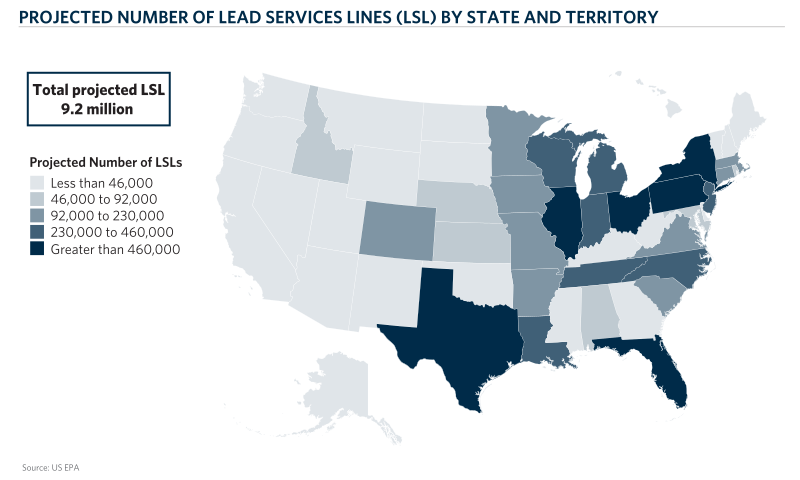
Age isn’t the only issue for these systems – the composition of the system often undermines its utility. Lead piping, a source of significant health problems, remain prevalent. In 2023 the US EPA estimated 9.2 million lead service lines to be still be in use as depicted below.
Mitigation and Adaptation – Addressing Climate Challenges
Water infrastructure issues are not limited to the distribution of drinking water. Managing stormwater, sea level rise and emergency sanitation for natural disasters also require significant infrastructure. Consider Miami-Dade County in southern Florida. The County notes that it relies on a 2020 study from the Southeast Florida Regional Climate Change Compact for planning purposes that projects 10 to 17 inches of sea level rise relative to 2000 levels.8 To address impacts already being felt there, the County government is focused on infrastructure improvements including “raising roads, installing pump stations, protecting existing buildings with temporary flood panels, and building new infrastructure higher.”9 Up the coast from Florida, New York is similarly grappling with how to better manage inundation from storms and sea level. In 2022, the US Army Corps of Engineers completed a study estimating a need for $52.7 billion of investment “to comprehensively address the region’s coastal storm risk.”10
Challenges Abound – As Do Opportunities in Private Markets?
The challenges around water infrastructure are significant. Private markets offer a range of opportunities – and risk-reward – around water infrastructure. Starting with the obvious, there are the physical assets themselves. Some of these assets are held by private entities, offering traditional infrastructure opportunities. But the opportunities don’t stop there. At the early stage, there may be venture capital type opportunities to invest in businesses aimed at making water systems more efficient or offering improved monitoring over and management of those systems. There are also a growing number of early-stage climate-oriented businesses seeking to offer climate resiliency solutions. In our view, early-stage opportunities in the water space can potentially be challenging in part due to the nature of the customers – often utilities – that are viewed by some as slower to adopt. Moving along the maturity curve, there are also a range of service businesses and solution providers can offer the potential benefit of having navigated this early adoption challenge. From monitoring and testing systems to pipe repair and replacement solutions, these businesses seek to contribute to the ecosystem of solutions required to address the aging water systems in developed markets. In our opinion, such businesses may also benefit from incumbency with those same customers who, while potentially slower to adopt, may in turn also be more “sticky” than the typical private enterprise.
When it comes to water infrastructure, studies from the US EPA, the European Commission and others make clear the need for significant investment. The challenge and opportunity for institutional investors is gauging where to flow capital. Often a sub-theme in infrastructure, venture and private equity strategies, it is our belief that water will increasingly gain attention as a potential contributor in private capital portfolios.
- World Bank: “Closing the $7 Trillion Gap: Three Lessons on Financing Water Investments from World Water Week.” (September 16, 2024).
- European Commission: “Poorly Managed Water.” (Accessed October 22, 2025).
- World Bank: “Closing the $7 Trillion Gap: Three Lessons on Financing Water Investments from World Water Week.” (September 16, 2024).
- McKinsey & Company: “US Water Infrastructure: Making Funding Count.” (November 2021).
- US EPA: “Water Efficiency for Water Suppliers.” (Accessed October 22, 2025).
- European Commission: “Poorly Managed Water.” (Accessed October 22, 2025).
- US EPA: “7th Drinking Water Infrastructure Needs Survey and Assessment.” (September 2023).
- Miami-Dade County: “Sea Level Rise and Flooding.” (Accessed October 22, 2025).
- Ibid.
- US Army Corps of Engineers: “New York-New Jersey Harbor and Tributaries Coastal Storm Risk Management Feasibility Study.” (June 2025).