Mission-Aligned Investing

As a non-profit organization, Commonfund is proud to partner with our clients to help them meet their missions. These partnerships can take many forms, traditional endowment model portfolios or more focused efforts that underscore the client's mission. Increasingly, we are engaging actively with those clients wishing to incorporate their underlying missions within their endowment portfolios or helping clients to navigate local impact projects in their home regions. To meet the differentiated needs and levels of engagement in these processes, we work with clients to articulate the depth and breadth they wish to take and then help them put those objectives into action.

responsible-investing-1

Direct Client Support

For clients and prospective clients with mission-aligned investment objectives, Commonfund has developed several tools to work alongside, or as a supplement to their Investment Policy Statement (IPS).

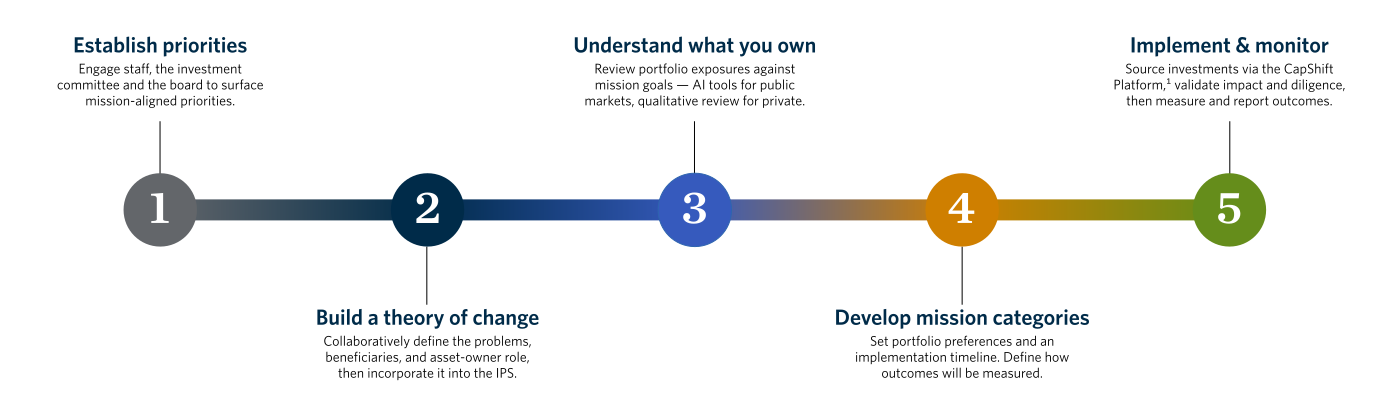
Drawing on the international standard Impact Management Project (IMP) and the Operating Principles for Impact Management (OPIM), Commonfund uses a proprietary process with clients seeking to integrate mission-aligned investing (MAI) into their investment portfolio and broader organization. The process assists boards of trustees and investment committees to articulate the manner and objectives underlying their mission-aligned investment, the scope and role of different asset classes in the endowment portfolio, the parameters for measurement of those objectives, and the process for validating impact and measuring and reporting outcomes. Progressing in lockstep with the growth in interest in impact or mission-aligned investing, we have refined our mission-aligned investing framework into a five-step process, as outlined below. The objective is to meet the individualized interests and concerns of each philanthropic client, while also meeting their return and long-term intergenerational objectives.

Importantly, clients determine the depth and breadth of implementation for their mission-aligned investments.

Mission-Aligned Investing Process

 How we work with your institution to implement mission-aligned investing across your portfolio. 

mission-aligned-investing-process

 1.  Commonfund engages CapShift to help source and conduct due diligence on impact and mission-aligned investments. 

The Investing Continuum

Mission-aligned investing sits along a spectrum of approaches to portfolio construction, ranging from purely financial objectives to purely mission-driven ones. Understanding where your institution's goals fall on this continuum helps clarify expected financial returns, measurement approaches, and the role mission plays in investment decisions. 

  • img-IC1
    Classic Investing
    Financial Return Only
  • img-IC2
    Mission-Related (MRI)
    Market-rate; measured
  • img-IC3
    Program-Related (PRI)
    Concessionary; mission first
  • img-IC4
    Philanthropy
    No financial return expected

Dedication to Risk Management

Truly responsible investing is impossible without an effective risk management strategy. Learn more about our approach to risk management and the ways we strive to create a secure investment plan for your organization. 

Frequently Asked Questions

What is mission-aligned investing?
Mission-aligned investing is the practice of managing an endowment or foundation's investment portfolio so that it actively supports — rather than works against — the organization's mission. For many institutions, this overlaps with what's more commonly called responsible investing, socially responsible investing (SRI), or ESG investing, but mission-aligned investing goes a step further by tying investment decisions directly to an organization's specific mission and values, not just general environmental, social, and governance criteria.
What is the difference between mission-aligned investing, ESG, SRI, and impact investing?

Commonfund Institute defines mission-aligned investing (MAI) as the umbrella term for the full spectrum of approaches by which institutions deliberately connect investment portfolios to their values, mission, or desired social and environmental outcomes — with ESG integration, SRI screening, and impact investing sitting inside that umbrella as tools rather than alternatives. These approaches exist on a continuum rather than in rigid categories, and most institutions draw on more than one across the portfolio. For a full breakdown of impact investing vs ESG vs SRI, including where each sits on the spectrum and what belongs in your IPS, see our Commonfund Institute post. 

How do you measure the impact of a mission-aligned portfolio?

Commonfund Institute's Principles of Investment Stewardship guide recommends that nonprofit institutions measure a mission-aligned portfolio on two dimensions simultaneously — financial performance and impact performance — using internationally recognized frameworks rather than relying solely on manager self-reporting, because each dimension answers a question the other cannot.

Impact measurement begins with the Theory of Change established in the Investment Policy Statement, which should define specific outcomes, timeframes, and measurement methods before capital is deployed. Three frameworks provide the standardized tools:

The Impact Management Project (IMP) Five Dimensions of Impact is the analytical framework for data measurement — what outcome occurs, who experiences it, how much, the investor's contribution, and the risk that impact differs from expectation.

The Operating Principles for Impact Management (OPIM) address organizational workflow. Using IMP and OPIM together is optimal, because each addresses what the other does not.

IRIS+, the generally accepted impact accounting system maintained by the GIIN, provides a free catalog of quantitative and qualitative metrics against which outcomes can be benchmarked.

Two practices make the framework credible in use. Manager-reported impact data should be supplemented where possible by independent analytics and third-party verification. And impact reporting should acknowledge failures and shortfalls as well as successes — institutions that report only positive impact outcomes are almost certainly not measuring rigorously.

For clients, Commonfund uses a mission-aligned investing process that assists boards of trustees and investment committees to articulate the parameters for measurement of those objectives.


Mission-Aligned Investing Resources

Mission-Aligned Investing

Impact Investing vs. ESG: Defining Mission-Aligned Investing

Learn More
Mission-Aligned Investing

Applying the Six Ps to Mission-Aligned Investing

Learn More
Mission-Aligned Investing

Responsible Investing in the Age of AI

Learn More