Evolution of Educational Budgets Warrant Changes to the Higher Education Price Index

May 15, 2026 |
3 minute read
|
Evolution of Educational Budgets Warrants HEPI Methodology Update
5:45

Commonfund’s Higher Education Price Index (HEPI), the premier inflation index for the education sector, is used by thousands of practitioners to ensure their budgeting processes account for real costs, and that their investment management practices and policies use an inflation metric that offer a meaningful benchmark for achieving intergenerational equity. HEPI tracks the changes in a set bundle of goods and services purchased by educational institutions each year. 

The weights that determine the contribution of each HEPI component (and hundreds of subcomponents) to the overall measure are typically held static. Like the Consumer Price Index (CPI), this allows the measure to gauge the year-over-year change in prices – comparing apples in year x to apples in year x+1 – so that the inflation rate is not skewed by compositional changes to the underlying factors. 

But what happens when the bundle of goods and services materially changes over time? In higher education, technology budgets have surged while faculty salary budgets have contracted due to the growing reliance on contingent and adjunct faculty. The 2026 HEPI methodology update accounts for this evolution and more, based on a rigorous assessment of how institutional cost structures have changed over time. We believe that periodic assessments and respective methodological updates are necessary to ensure HEPI remains a comprehensive inflation benchmark that reflects the dynamic sector realities of the higher education sector. 

Key 2026 HEPI Methodology Updates 

Below is a summary of key changes described in the 2026 HEPI Methodology Update memo. For a more thorough explanation of changes as well as an impact analysis and project approach, see the full memo here

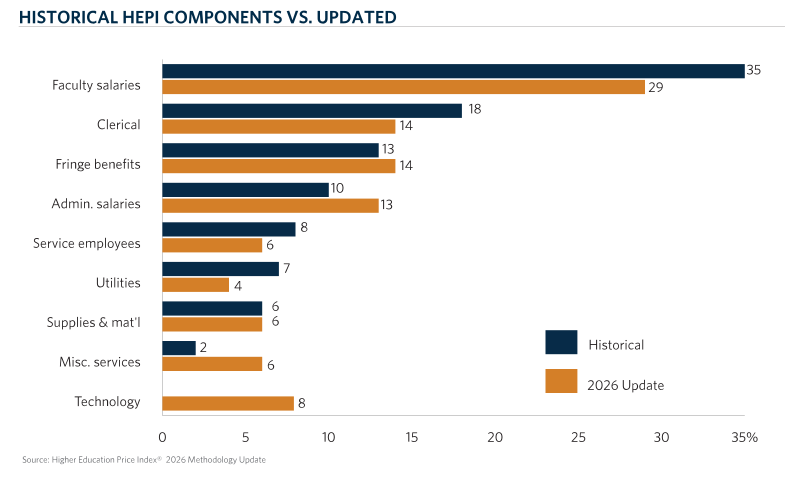
CHT-Historical-HEPI-Components

New Technology Component Added: A new technology component, approxi­mately 8 percent of the overall HEPI measure, brings the total number of core HEPI categories from eight historical components to nine. Technology has become one of the fastest-growing costs in higher education as institutions invest in campus wide systems, digital learning tools, and shared data platforms. Ongoing software, cloud services, and rising cybersecu­rity threats—along with increased IT staffing—have made technology a permanent and strategic operating expense, and all together justify its new place within the HEPI methodology. 

Faculty Salaries Component Reduced: The faculty salaries component—the largest in HEPI—has been reduced from 35 to 29 percent to reflect long-term changes in the academic labor market. Institutions increas­ingly rely on contingent and adjunct faculty, who now make up a large share of the instructional workforce and are generally lower cost than tenure track faculty. At the same time, the growth of online and hybrid learning has enabled more flexible staffing models and reduced reliance on tradi­tional full-time faculty roles. Together, these structural shifts support a lower weighting for faculty salaries that better reflect current instructional cost realities. 

Clerical Employees Component Reduced: The clerical employees component has been reduced from 18 to 14 percent to better reflect current staffing patterns in higher education as institutions employ fewer clerical and administrative support staff as digital workflows, automated systems, and centralized services handle many routine tasks.  


Administrative Salaries Component Increased: The administrative salaries component (which tracks administration and leadership positions) has been increased from 10 to 13 percent to reflect the continued growth in administrative staffing and compensation across higher education.  

Utilities Component Reduced, with Renewable Energy Included: The utilities component of HEPI was reduced from 7 to 4 percent to reflect long term gains in campus energy effi­ciency and changes in how institutions manage energy use. Efficiency improvements, sustainability efforts, and a cleaner energy mix have reduced the overall share of utilities in institutional budgets, supporting a lower HEPI weighting. The utilities component also now includes renewable energy as a subcomponent alongside traditional energy sources to reflect renewable energy’s integration in the energy generation mix across geographic regions. 

Miscellaneous Services Component Increased, with Food and Travel Added: Miscellaneous services has increased from 2 to 6 percent to reflect the portion of expenditures on the newly added subcomponents of food and travel. Educational institutions are facing substantial costs for food and travel, driven by operational demands, rising prices, and the need to support campus activities, events, clubs and sports teams, and conferences.

Impact and Conclusion

The impact analysis described in the memo, comparing the new methodology with the historical findings over the past ten years, demonstrates that the updated methodology preserves the continuity and reliability of the index. The differences between the historical and revised approaches are modest, even in years with the largest methodological effects, indicating that the adjustments to category definitions and weights refine the measure with­out altering its long-term trajectory. Moving forward, periodic assessments will enable potential improvements, and allow HEPI to better reflect contem­porary cost structures while maintaining consistency with its historical trends. 

For any questions you may have, please reference HEPI: What You Need to Know or fill in the form below to reach one of our team members. 



Amanda Novello

Author

Amanda Novello

Senior Policy and Research Analyst

Disclaimer

Certain information contained herein has been obtained from or is based on third-party sources and, although believed to be reliable, has not been independently verified. Such information is as of the date indicated, if indicated, may not be complete, is subject to change and has not necessarily been updated. No representation or warranty, express or implied, is or will be given by The Common Fund for Nonprofit Organizations, any of its affiliates or any of its or their affiliates, trustees, directors, officers, employees or advisers (collectively referred to herein as “Commonfund”) or any other person as to the accuracy or completeness of the information in any third-party materials. Accordingly, Commonfund shall not be liable for any direct, indirect or consequential loss or damage suffered by any person as a result of relying on any statement in, or omission from, such third-party materials, and any such liability is expressly disclaimed.

All rights to the trademarks, copyrights, logos and other intellectual property listed herein belong to their respective owners and the use of such logos hereof does not imply an affiliation with, or endorsement by, the owners of such trademarks, copyrights, logos and other intellectual property.

To the extent views presented forecast market activity, they may be based on many factors in addition to those explicitly stated herein. Forecasts of experts inevitably differ. Views attributed to third-parties are presented to demonstrate the existence of points of view, not as a basis for recommendations or as investment advice. Market and investment views of third-parties presented herein do not necessarily reflect the views of Commonfund, any manager retained by Commonfund to manage any investments for Commonfund (each, a “Manager”) or any fund managed by any Commonfund entity (each, a “Fund”). Accordingly, the views presented herein may not be relied upon as an indication of trading intent on behalf of Commonfund, any Manager or any Fund.

Statements concerning Commonfund’s views of possible future outcomes in any investment asset class or market, or of possible future economic developments, are not intended, and should not be construed, as forecasts or predictions of the future investment performance of any Fund. Such statements are also not intended as recommendations by any Commonfund entity or any Commonfund employee to the recipient of the presentation. It is Commonfund’s policy that investment recommendations to its clients must be based on the investment objectives and risk tolerances of each individual client. All market outlook and similar statements are based upon information reasonably available as of the date of this presentation (unless an earlier date is stated with regard to particular information), and reasonably believed to be accurate by Commonfund. Commonfund disclaims any responsibility to provide the recipient of this presentation with updated or corrected information or statements. Past performance is not indicative of future results. For more information please refer to Important Disclosures.

Stay connected with the Insights Blog

Popular Blog Posts


Investment Strategy | Insights Blog

Determinants of Portfolio Returns – It Depends…

Asset allocation decisions have traditionally been associated with being the major determinant of portfolio returns. The Brinson, Hood, Beebower study of 19861 estimated that nearly 90 percent of...
Perspectives | Insights Blog

In Memoriam: Mamak Shahbazi

It is with great sadness that we announce the passing of Commonfund Board Member, Mamak Shahbazi. Mamak was a dedicated and talented board member and a great friend to the firm, its clients, and...
Perspectives | Insights Blog

Study of Foundations - Key Highlights [Infographic] 2024

In this infographic, we report the key highlights from the 2024 Council on Foundations-Commonfund Study of Foundations. For the year ended December 31, 2024, participating foundations produced...

Disclaimer

Certain information contained herein has been obtained from or is based on third-party sources and, although believed to be reliable, has not been independently verified. Such information is as of the date indicated, if indicated, may not be complete, is subject to change and has not necessarily been updated. No representation or warranty, express or implied, is or will be given by The Common Fund for Nonprofit Organizations, any of its affiliates or any of its or their affiliates, trustees, directors, officers, employees or advisers (collectively referred to herein as “Commonfund”) or any other person as to the accuracy or completeness of the information in any third-party materials. Accordingly, Commonfund shall not be liable for any direct, indirect or consequential loss or damage suffered by any person as a result of relying on any statement in, or omission from, such third-party materials, and any such liability is expressly disclaimed.

All rights to the trademarks, copyrights, logos and other intellectual property listed herein belong to their respective owners and the use of such logos hereof does not imply an affiliation with, or endorsement by, the owners of such trademarks, copyrights, logos and other intellectual property.

To the extent views presented forecast market activity, they may be based on many factors in addition to those explicitly stated herein. Forecasts of experts inevitably differ. Views attributed to third-parties are presented to demonstrate the existence of points of view, not as a basis for recommendations or as investment advice. Market and investment views of third-parties presented herein do not necessarily reflect the views of Commonfund, any manager retained by Commonfund to manage any investments for Commonfund (each, a “Manager”) or any fund managed by any Commonfund entity (each, a “Fund”). Accordingly, the views presented herein may not be relied upon as an indication of trading intent on behalf of Commonfund, any Manager or any Fund.

Statements concerning Commonfund’s views of possible future outcomes in any investment asset class or market, or of possible future economic developments, are not intended, and should not be construed, as forecasts or predictions of the future investment performance of any Fund. Such statements are also not intended as recommendations by any Commonfund entity or any Commonfund employee to the recipient of the presentation. It is Commonfund’s policy that investment recommendations to its clients must be based on the investment objectives and risk tolerances of each individual client. All market outlook and similar statements are based upon information reasonably available as of the date of this presentation (unless an earlier date is stated with regard to particular information), and reasonably believed to be accurate by Commonfund. Commonfund disclaims any responsibility to provide the recipient of this presentation with updated or corrected information or statements. Past performance is not indicative of future results. For more information please refer to Important Disclosures.