Commonfund Forum 2026, held in Hollywood, FL, brought together registrants from some 263 institutions with more than $238 billion in assets representing 38 states, 2 territories, and 3 foreign countries in a 2.5-day conference. The event, themed “Navigate Now,” featured a multifaceted agenda. Sessions explored the global economy, the geopolitical and technology environment, and investment trends and strategies to help institutions support their missions. Over 40 experts from investment firms, academia, business, think tanks and major media outlets convened in general sessions, keynote addresses and breakout sessions.
Navigate what? Below we summarize key takeaways from Forum that addressed investors’ most-cited concerns, according to a survey of attendees.
The economy and capital markets in the balance. Despite the positive returns of recent years, institutional investors are navigating a steady flow of uncertainty related to the factors described below. Geopolitical events, technological change, inflation, and public policy – all discussed at length at Forum – contribute to the awareness that what has gone up could also go down. But attendees were, perhaps, reassured. The prevailing sentiment among presenters was that the U.S. and global markets have faced these challenges but remain resilient. While AI is a key growth segment, diverse sources of growth were highlighted throughout the program, from rebounding private markets to active equities strategies, real assets, hedge funds, mission-aligned investing, and more. Opportunities still abound for the discerning investor, particularly for those with access to top managers. Stable labor markets, lower inflation, and a resilient consumer economy underpin market opportunities and altogether could keep markets afloat for the foreseeable future.
Cybersecurity and technology disruption. Every coin has two sides, and technology is no exception. AI tools hold enormous potential for tackling global challenges, amplifying human productivity, and attracting record investment. The same capabilities that empower can also threaten: fueling sophisticated cyberattacks, displacing workers, and outpacing the adoption needed to justify the hype. Time will tell how AI shapes the economy and society more broadly. But for nonprofits and institutional investors, actionable governance themes arose: teams should tinker with new tools to identify positive and secure use cases; tech/cyber safety is a team sport in which everyone should understand the rules, potential threats, and actively participate; and include AI and cyber risk in due diligence with all managers and tech vendors.
Inflation. Rising prices put pressure on endowment management and nonprofit operations. On the investment front: investment return targets are harder to hit if they incorporate a measure of inflation when inflation has run above the Fed target for a sustained period. Although inflation according to CPI has come down from recent peaks, it has exceeded the Federal Reserve’s target of 2 percent for the past five years and counting. Simultaneously, achieving investment return targets is critical to meeting growing institutional, budgetary, and constituent needs. Other areas where inflation has an impact are asset allocation, spending policy methodology, donor engagement, tuition and enrollment (for educational institutions), and more. Finally, presenters are watching a range of inflation-related risks including tariffs, upcoming Federal Reserve leadership and policy changes, the growing national debt and the cost of repayment, and potential price shocks from geopolitical events.
Geopolitical events. Geopolitics has become one of the most persistent and complex risks institutional investors navigate, and Forum attendees agreed: half of survey respondents selected geopolitical events as their top concern. The timing of Forum coincided with the start of the U.S.-Israeli bombardment of Iran, and recent escalations in Venezuela, Cuba, and the Russia-Ukraine war are ongoing concerns. For institutional investors, these events exacerbate uncertainty on a range of issues, from cyber threats to physical risks; from inflation to commodity markets; and from market volatility to transforming the global economic order more broadly. Institutional investors must account for asset values driven not only by market fundamentals but also by geopolitical decisions. This makes geopolitical awareness and scenario planning an essential part of modern portfolio risk management.
Policy changes. Regulatory and policy shifts across trade, technology, taxation, and monetary policy create a constantly moving backdrop for institutional investors, shaping both portfolio risk and long term strategic planning.
- Tariff policy changes can reshape cost structures, supply chain reliability, and global competitiveness, creating volatility for sectors exposed to international trade and forcing investors to reassess geographic and industry allocations.
- Potential regulations on big tech and crypto introduce uncertainty around business models that have become central to market performance; stricter rules may limit growth or profitability, while looser oversight can increase operational and systemic risk.
- Recent federal actions such as the One Big Beautiful Bill Act’s new tax on a subset of higher education institutions—and the near imposition of a broader tax on nonprofits—signal a willingness to revisit long standing tax exemptions, raising concerns for endowments, foundations, and other institutional investors that rely on policy stability.
- Federal Reserve policy remains a major driver of liquidity, asset valuations, and risk. Shifts in interest rate strategy or the upcoming transition in Fed leadership can alter market conditions quickly, influencing everything from bond yields to equity multiples and long term portfolio construction.
Investment opportunities still abound. Despite the litany of challenges and uncertainty in the world today, investment leaders and managers across multiple sessions continued to cite new and compelling investment ideas that they are excited about. As is often the case, complex challenges can also create opportunities for those who are able to identify the inevitable winners and losers. Institutional investing is a long-term game, so fiduciaries overseeing endowed portfolios must balance their focus on navigating now and keeping an eye on the future to effectively support their organizations.
These Forum highlights underscore the growing complexity of markets and the context in which institutional investors are managing their endowments and operations. It is with these tenuous times in mind that Mark Anson, Chief Executive Officer of Commonfund, aptly concluded the conference with a call for hope, togetherness, and sharing – all foundational principles of Commonfund Forum and across our research and programming.
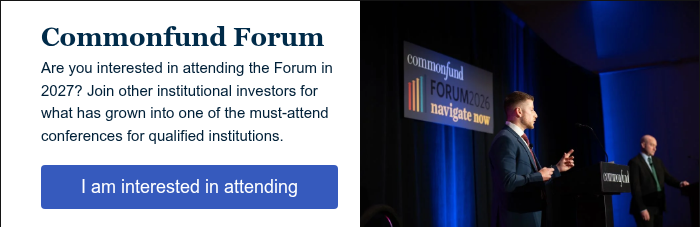
Commonfund Forum is consistently recognized as a premier investment conference designed exclusively for sophisticated institutional investors representing endowments and foundations, pension funds, healthcare systems, charities and other select investors.