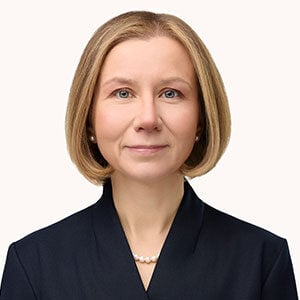
In this episode of Espresso Chats, Commonfund Institute's Amanda Novello, Associate Director, sits down with Julia Mord, Chief Investment Officer at Commonfund OCIO, to close out our AI investment governance series with a conversation on portfolio construction.
Julia shares how AI exposure shows up across a nonprofit institutional portfolio — from venture capital and private equity to public equities and real assets — and where concentration risk is quietly building, particularly as the top ten S&P 500 names now make up 40% of the index's market cap. She also walks through how AI has become a standard line of questioning in private equity due diligence, what separates managers with a durable edge from those chasing a trend, and where she sees real opportunity hiding in this year's "SaaSpocalypse" sell-off.
Everyone. I'm Amanda Novello, Associate Director at Commonfund Institute, and this is Espresso Chats, a podcast by Commonfund Institute where we deliver short, strong shots of governance and leadership insight. Today, we'll wrap up our series on AI investment governance, and I can think of no better guest to bring on to bring it all together than my colleague, Julia Mord, Chief Investment Officer at Commonfund OCIO. Julia, thank you so much for joining me today. Thank you for having me, Amanda. I think listeners probably have heard of Commonfund and know a bit about us at this point, but feel free to tell us about your side of the business and about your role as CIO and about your podcast. Sure. Well, first, thank you for inviting me to be a guest on Espresso Chats. It's actually quite nice to be on the other side of the mic. As you may know, I host the Common Fund Point of View podcast where I discuss our latest thinking on investing in capital markets with my Commonfund colleagues. So Commonfund OCIO is Commonfund's outsourced CIO business. We're a twenty two billion dollars organization serving one hundred and twenty six non discretionary clients, all of them nonprofit institutions, such as endowments, foundations, charitable hospitals, and cultural institutions. As for my role, I'm the Chief Investment Officer of Commonfund OCIO, and I'd like to say that I wear two hats. First, I oversee the firm's investment research function, working with five asset class heads and a market strategist. Together, our job is to select managers across asset classes whom we have high conviction will generate meaningful alpha versus their respective benchmarks. Second, I work closely with our advisory team to support clients on strategic asset allocation and portfolio construction decisions. As CIO, I also chair two committees: the Investment Committee, which approves all new manager recommendations and the asset allocation committee, which makes both strategic and tactical asset allocation decisions. Amazing. So we're excited to wrap up our AI mini series today with a conversation about some of the things you just mentioned, but with a bent towards AI and portfolio construction. So we're excited to get your perspective as you have that thousand foot view of someone who works across asset classes, as you mentioned, and also the technical expertise as a longtime investor and CIO. So, I want to kick us off by asking how AI has come into play in your work. So, when did you start having more in-depth conversations about the role of AI and asset allocation and portfolio construction, and what has that progression looked like at a high level? Good questions. I'd say AI conversations really entered our investment committee and asset allocation committee discussions in earnest about two to three years ago. At first the questions were pretty binary. Is this a bubble? Is this durable? Should we be chasing it at all? Over time that's evolved into much more granular conversation, less, should we have exposure and more, where do we already have exposure? Where are we underweight? And where might we be taking on more concentration risk than we realize? That shift is really what drives how I think about AI today. And I'd break it into two questions. The first is, how much exposure do client portfolios actually have to the AI theme? The asset class with the most dominant exposure unsurprisingly is venture capital. Our venture program has significant exposure to SpaceX, Anthropic and OpenAI, both through manager relationships and our co investment program. In private equity, we're investing in companies that can capture growing AI spend. Often businesses with strong vertical data moat that are layering AI capabilities on top of an already reliable software product. We see the theme in real assets too, through data centers, power generation and energy producers. And on the public equity side, since our portfolios are benchmarked to the MSCI ACWI Index, our clients carry close to benchmark weights in hyperscalers, memory chip producers, and semiconductor names. The second question is whether there are missed opportunities hiding in the AI loser narrative. A number of our managers are finding underappreciated companies, names that got unfairly punished in the recent SaaS pocalypse. That was that large sell off we saw in software as a service names back in February from AI disruption fears. But these are companies that are actually likely beneficiaries of AI, or where there might be disintermediation risk the street has priced in, but that's overdone. Those situations can generate real outsized returns. At the same time, we're mindful of how much of the current move is being driven by the narrative and momentum rather than fundamentals. That's part of why our hedge fund portfolios include strategies positioned to benefit from a counter momentum swing if and when the market pulls back on concerns about AI overspend? Thanks so much. I feel like you just gave a lot of examples already, but I want to kind of pivot to like opportunities and risks. I know people are talking a lot about opportunities, a lot about risks, but from your vantage point, could you share some examples of how you're grappling with those? I know. Well, the whole topic of AI could be a subject of an entire book, but let me touch on three areas where we've spent the most time. Public equities, private markets, and venture, since that's where the exposure is most concentrated. Let me begin by saying, I cannot know with any certainty whether the one point two trillion dollars in estimated CapEx spend by twenty twenty eight among the hyperscalers will generate any meaningful return on capital, at least not in the immediate or medium term. There's one group of very intelligent investors who believe we're still very early in the S curve and adoption will only magnify. Though one has to question whether power usage becomes an ultimate chokehold at that level of build out. There's another equally intelligent group that draws an analogy to the CapEx build out of railroads and fiber networks. Investments that yielded great outcomes for businesses and consumers, but also led to a series of large bankruptcies among the CapEx spenders themselves. We've seen periods of market indigestion this year alone on the back of hyperscalers reporting higher than expected CapEx spend, and in Google's case, the first ever quarter of negative free cash flow. On the public equity side, exuberance around the AI theme has driven real market concentration. Returns begot flows, which begot higher returns, and that's been a tailwind for passive exposure. The opportunity in that dynamic is real. If you own the benchmark, you've captured a meaningful part of this move. But the question now is how much risk is embedded in a purely passive approach when the top ten names in the S and P five hundred make up forty percent of the aggregate market cap. That's precisely why alongside passive and beta one exposure, we maintain active managers who are finding attractive return opportunities without having to make heroic growth assumptions about the AI narrative, including those same names that were unfairly caught up in this year's SaaSpocalypse sell off. On the private side, we've actually been equally discerning. We've spent considerable time understanding what part of the portfolio stands to benefit from greater AI adoption, what portion carries limited disruption risk, And what's truly exposed? As of our last assessment, exposure to companies genuinely at risk of disruption is actually quite limited. Many in fact are well positioned to go what I'd call AI first, where they're using the technology to expand margins and defend their market position rather than lose ground to it. And then there's venture, which is really where the opportunity has been most direct for our clients through both manager relationships and our co investment program, giving exposures to companies like SpaceX, Anthropic, and OpenAI. The risk there is a different one. Valuations have moved really quickly, and discipline means being thoughtful about entry points and concentration, even in names you have high conviction in. That was a great overview. I feel like it it could be a book and maybe you should write it, sounds like. Thank you. So, Commonfund operates as a fund of funds. So, turning to that, we're essentially a manager of managers. Can you share how specifically in due diligence? So, the way investors are talking about AI with their managers has been a theme across our past few episodes. But from your perspective, how are managers incorporating AI into their investment process? And how does that impact your approach across those asset classes? That's actually become a genuinely fun part of our due diligence process. And it's now a standard line of questioning with every manager regardless of strategy. We ask how they're using AI internally, not just whether they bolted it onto an existing process, but whether it's changing how they generate ideas, size positions, or even manage risk. We also ask how they're thinking about the risks, model governance, how much human oversight sits on top of AI generated signals, and how dependent they are on third party data or infrastructure. A manager who can't articulate an answer in either direction, is either over reliant on AI with no oversight or dismissive of it entirely, is itself a bit of a signal to us. What we're seeing is that there's no one size fits all approach among our managers. Some are early adopters using AI for data analysis and modeling. Others are further along building a series of agents that can independently conduct primary research or in some cases trade securities based on rules and signals the agents themselves generate. We expect all of our managers to be adopting or at least seriously evaluating AI in their workflow, but the pace is largely dictated by strategy. For example, quant, systematic and macro managers tend to be further along in that life cycle than discretionary fundamental managers. That's changing what we look for across the portfolio. So for quant and systematic strategies, we're spending more time understanding whether a manager's edge is durable as AI driven tools become widely available or whether it erodes as more players adopt similar techniques. For discretionary fundamental managers, we're seeing AI show up less as a replacement for judgment and more as a way to cover more ground. Faster primary research, broader company screening, all of which can actually widen the opportunity set for skilled analysts rather than compress it. Across the board, it's added a new dimension to how we underwrite a manager's durability, not just whether their thesis is right, but whether their process is built to keep up as the tools around them keep evolving. So we've covered AI in portfolio construction, challenges on opportunities abound, due diligence is fundamental and can also be fun. So I want to conclude us with a final question. Some of these conversations can maybe feel tough, but leaning into some optimism and forward looking strategy, what is exciting to you right now about your role or the field more broadly? That's a great question, Amanda. It's hard not to be excited even while staying appropriately cautious. I think AI adoption is only going to accelerate as we work through today's compute power constraints, and that's gonna keep producing new business models we haven't even thought of yet. What excites me most is having a front row seat to that, working with my team to figure out how to capitalize on it and building portfolios that benefit from these trends while still protecting clients if things turn risk off. Amazing. Thank you so much, Julia, for coming on the show. We really appreciate it. Thank you for having me. It's been a pleasure. If you like this conversation and want to hear more from leaders in the field, visit www.commonfund.org/espressochats to view the full playlist and subscribe on your preferred podcast platform. See you next episode.
View the full playlist and subscription options for this podcast here.