Inflation for U.S. Higher Education Institutions
Rises 3.6% in Fiscal 2025, Up from Fiscal 2024 Rate
Norwalk, Conn., December 11, 2025 – Data from the annual Higher Education Price Index® (HEPI) show that inflation for U.S. colleges and universities rose 3.6 percent in fiscal year 2025, surpassing the 3.4 percent inflation reported in fiscal year 2024. This year’s rate is the third highest – behind fiscal years 2022 and 2023—since fiscal year 2008 when HEPI was reported at 5.0 percent. (Fiscal year 2025 covers the period from July 1, 2024, to June 30, 2025, and coincides with the budget year of most institutions of higher education.)
HEPI inflation rates are again elevated above what many consider the norm, set by expectations from prior decades. From 2010 to 2019, for example, the average annual HEPI figure was 2.2 percent. By contrast, the average annual increase from 2020 to 2024 was 3.4 percent, marking a shift that was triggered by the COVID-19 pandemic and subsequent supply shocks. And while this year’s inflation falls below the relative peak of 5.2 percent in FY2022, it marks the fifth year in a row that rates are above the prior decade’s average.

Inflation rates for educational institutions were higher in FY2025 compared with FY2024 rates in three of the eight main components tracked by HEPI. Faculty salaries, the highest-weighted category comprising the overall measure, rose from 3.8 percent to 4.3 percent. The two lowest-weighted categories, utilities and supplies and materials, also saw inflation rates increase in FY2025. Administrative salaries had the highest rate of inflation of any component in FY2025, 4.8 percent, despite being lower than the FY2024 rate of 5.1 percent. Overall, inflation rates were lower than the prior year in five of the eight components. All decreases were marginal, falling within one percentage point of the prior year’s figure, except for fringe benefits which rose 2.4 percent in FY2025 compared with 5.9 percent in FY2024.
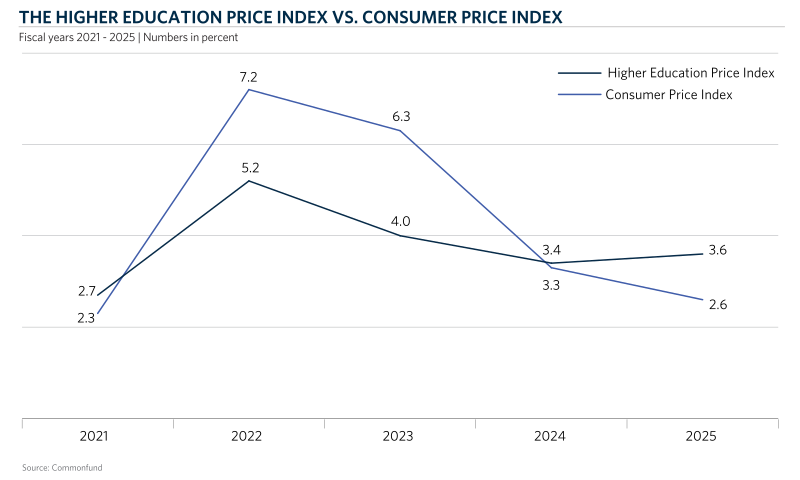
The chart below tracks annual changes in HEPI vs Consumer Price Index (CPI) over the last five fiscal years.
HEPI is an inflation index designed specifically for use by institutions of higher education. Compiled from data reported by government agencies and industry sources, HEPI measures the average relative level in the price of a fixed market basket of goods and services purchased by colleges and universities, excluding research. A more accurate indicator of cost changes for colleges and universities than the CPI, HEPI is used to project budget increases required to preserve purchasing power and can be used to determine investment return targets to meet an institution’s spending needs. With compilations dating back to 1961, HEPI offers more than 60 continuous years of higher education inflation data. It is an essential tool enabling schools to determine increases in funding necessary to maintain both real purchasing power and investment. In 2005, Commonfund Institute assumed responsibility for the index and the proprietary model used to calculate HEPI’s values from Research Associates of Washington, D.C.
Comparing HEPI and the CPI1, while the former showed costs rising 3.6 percent in FY2025, costs rose in the latter by 2.6 percent. HEPI has now exceeded CPI in nine of the past 11 years, continuing the long-standing trend of HEPI exceeding CPI for the majority of years we have been tracking these indices. At the recent height of inflation in the economy in 2022 and 2023, CPI exceeded HEPI. However, while broad-based inflation has fallen, inflation of key HEPI components such as faculty and administrative salaries has persisted.
Learn more about HEPI compared to CPI as an index in our blog, The Case for Using the Higher Education Price Index® (HEPI) to Define Inflation for Colleges.

HEPI Components for FY2025 vs. their 5-Year Average
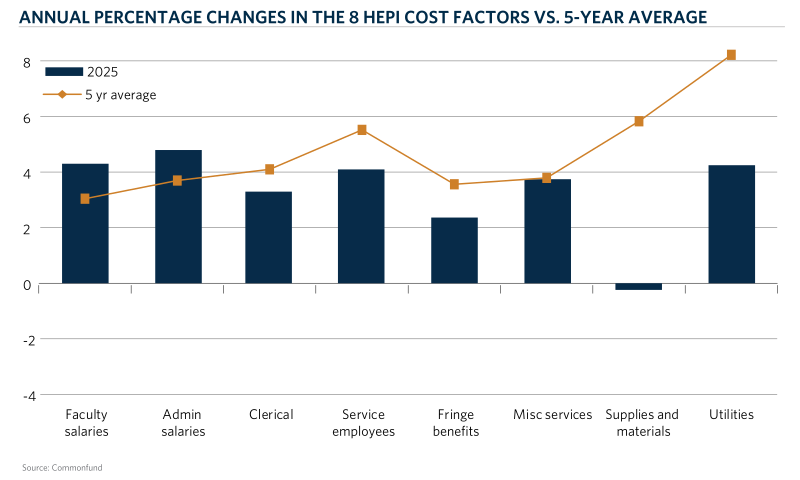
The chart below compares reported rates of change for FY2025 against their historical five-year averages. The key observations follow:
- Cost increases in FY2025 were above the five-year average for the highest weighted HEPI component, faculty salaries, and for the fourth-highest weighted component, administrative salaries. Both had inflation rates in FY2025 that exceeded their five-year average by more than one percentage point.
- Cost increases in FY2025 were below the five-year average for the remaining six cost categories. The biggest gap between the 1-year and 5-year figures were among supplies and materials (0.2 percent deflation in FY2025 compared with a five-year average of 5.8 percent inflation) and utilities (4.2 percent inflation in FY2025 compared with a 5-year average of 8.2 percent).
- Cost increases in FY2025 fell below their five-year average for clerical, service employees, fringe benefits, and miscellaneous services. The difference in 1-year and 5-year figures all fell within 1.4 percentage points.
Nominal Faculty Salaries Rise, Real Salaries Mixed
Faculty salaries, the highest-weighted component of HEPI, rose 4.3 percent nationwide in FY2025 which is the highest rate reported since we began tracking it in 1998. The only other times that faculty salary inflation met or exceeded 4 percent was in 2008, when it was 4.1 percent, and in 2023, at 4.0 percent.
When data are viewed by type of institution, faculty salaries rose at a higher rate among public institutions than they did among their private counterparts—4.7 percent among the former versus 3.6 percent among the latter. This was a reversal from last year in which private faculty salary inflation exceeded that of public institutions on average.
Looking more closely at public institutions, faculty salaries increased 3.1 percent at doctoral institutions, 5.4 percent at master’s degree-granting institutions, and 8.7 percent among two-year colleges. Within private institutions, doctoral institutions saw the highest salary increases at 4.9 percent. Faculty salaries at private master’s degree-granting institutions increased 1.4 percent and at baccalaureate institutions they rose 2.5 percent. (Data for public two-year colleges and private baccalaureate institutions are not directly comparable for several reasons, notably the difference in the period of matriculation.)
Regionally, increases in faculty salaries ranged from a high of 6.9 percent in the Middle Atlantic2 region to a low of 2.1 percent in the West South Central3 region.
Year over year, real faculty salaries—adjusted for CPI inflation—rose for all categories, with the exception of real declines among private comprehensive and baccalaureate institutions. Real inflation-adjusted salaries in FY2025 dollars are well below FY2020 levels for all categories, demonstrating the pressure that heightened inflation puts on faculty and their institutions.
- The Bureau of Labor Statistics (BLS) updates CPI statistics monthly. It also provides a six- and 12-month average change; January-June, July-December and January-December. The CPI values reported on Commonfund’s HEPI web site are based on fiscal year (July 1 through June 30) 12-month averages rather than the monthly (or point-to-point) CPI values usually reported by the BLS.
- Includes New Jersey, New York, Pennsylvania
- Includes Arkansas, Louisiana, Oklahoma, Texas
| Media Contacts | |
Tony Ialeggio |
Emily Roy |