When ChatGPT launched in late 2022 and the AI revolution took off, the central question was about whether the staggering sums being invested would ever fulfill the promise of boosting productivity.
More than three years later, there are signs beginning to show up in the data. At Anthropic, its own Claude Code tool now writes more than 80 percent of the code merged into production, and the typical engineer ships roughly eight times as much code per quarter as the company’s engineers did a few years ago. AI as a technology is moving rapidly from novelty to key infrastructure across the economy, with growing business adoption of AI tools. Most importantly for investors, the productivity gains are reaching the bottom line, with 2026 first quarter S&P 500 earnings far exceeding analyst’s expectations. The AI investment cycle could be starting to pay off, and the returns will accrue across various segments of both public and private markets.
From Novelty to Infrastructure
The clearest early evidence of AI’s impact is the speed at which it has been absorbed into how real work gets done. Software development has been particularly transformed with the introduction of new generative AI tools helping developers write more complex code and significantly accelerate product development lifecycles. According to their 2025 Octoverse report, roughly 36 million new developers joined GitHub from September 2024 to August 2025, which is the world’s largest code repository. This is the fastest growth in the history of the platform and amounts to about one new developer per second. More than 1.1 million public repositories now incorporate a large language model, a 178 percent increase in a single year, with 80 percent of new developers using AI coding assistants within their first week.
This transformation of workflows extends well beyond specific coding applications. In customer service, Bank of America’s virtual assistant resolves most routine queries in under a minute, and Salesforce expects AI to handle half of all service cases by 2027, up from roughly 30 percent in 2025. In financial services, JPMorgan estimates its AI initiatives have generated roughly $1.5 billion in value through fraud prevention, trading, and operational efficiencies, while its internal coding assistant has boosted developer productivity by 10 to 20 percent across tens of thousands of engineers. In life sciences, Insilico Medicine used AI to take a novel drug candidate from target identification to preclinical testing in 18 months, and their drug candidate has since posted positive mid-stage trial results. This is exceptional compared to the three to six years the process traditionally requires. This is a one-off example, but extremely promising, nonetheless.
According to the recent U.S. Census Bureau’s Business Trends and Outlook Survey, roughly 20 percent of all U.S. businesses now use AI in their operations, rising to 37 percent among firms with at least 250 employees, and nearly 40 percent in the information sector. At the individual level, a 2026 survey from the Federal Reserve Bank of St. Louis suggests more than 40 percent of American workers now use generative AI for their jobs. This is unprecedented rapid diffusion for a technology that came to the consumer market just over three years ago. It is even more impressive because leading Frontier Labs, like OpenAI and Anthropic, did not start building their enterprise tools and capabilities much later after initial consumer products launched.
The Payoff Reaches the Bottom Line
For investors, the more consequential signal is corporate profitability. In the first quarter of 2026, the S&P 500 reported a record high profit margin of 14.5 percent for the trailing twelve-month period per Bloomberg data. These record margins were achieved despite oil prices averaging nearly $98 per barrel during the quarter, more than 50 percent above the prior year, representing an environment that has historically compressed profitability, let alone expanded it.
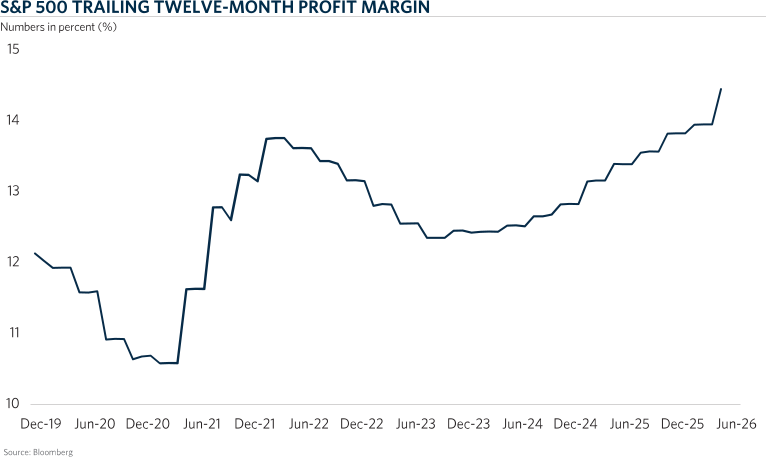
This trend is important as margin expansion, more than headline earnings growth, is what tends to drive durable changes in how investors value companies. Goldman Sachs further estimates generative AI could lift U.S. productivity by roughly 1.5 percentage points annually over the coming decade, and even a fraction of that would carry meaningful implications for margins and equity returns.
Value Creation on Both Sides of the Public-Private Line
A large share of the value being created by the AI buildout is occurring in private markets, out of the reach of public investors. Andreessen Horowitz estimated in 2025 that OpenAI and Anthropic together are adding almost half as much net-new revenue as the entire universe of publicly traded software companies outside the Magnificent Seven. This share has probably grown even larger as Anthropic alone had hit a $47 billion run rate by mid-2026.
Notably, even some public-market exposure to AI now runs through private holdings. Alphabet reported $62.6 billion in net income in the first quarter of 2026, including a $37.7 billion net gain, driven largely by unrealized markups on its private holdings like Anthropic and SpaceX. Microsoft, Amazon, and Nvidia have similarly invested billions in OpenAI and Anthropic, meaning a portion of their shareholders’ returns is now tied to the rising value of private AI labs. The boundary between public and private exposure is blurring quite significantly, and the pace of convergence is only accelerating. Anthropic confidentially filed for an initial public offering on June 1st, OpenAI followed on June 8th, and SpaceX debuted on June 12th as the largest IPO in history.
The opportunity extends to asset classes beyond equities. The physical buildout of AI infrastructure has turned data centers into one of the fastest-growing segments of institutional real estate, generating long-duration, contract-backed cash flows from leases to hyperscalers. Private credit, meanwhile, has become a primary financer of the buildout. Lending to AI infrastructure has grown from near zero to more than $200 billion in a few years, with Morgan Stanley projecting an additional $800 billion in data center financing over the next two years.
What This Means for Investors
The early returns on the AI investment cycle reinforces the principle that durable value creation is rarely confined to one corner of the market during technology cycles. An investor who accesses AI solely through the largest public index constituents captures only part of the opportunity. A diversified program spanning public and private equity, real assets, and credit is built precisely for an environment like this one, where the return opportunities are available across asset classes. The key balance institutional investors must strike is to have exposure to the AI revolution, without making their portfolios one cross-asset class bet on the future of AI.