The June jobs report was one of contradictions. Payrolls grew by a lackluster 57,000 versus consensus expectations of 115,000. However, unemployment dropped slightly to 4.2% compared to May’s 4.3% headline figure. Looking beneath the surface, the drop in the headline unemployment rate was actually driven by 720,000 individuals leaving the labor force entirely. In fact, labor force participation fell to 61.5 percent, the lowest since March 2021 and, excluding the pandemic, the lowest in almost 50 years. A single month of data proves little on its own, but it reflects a broader trend, where the demographic tailwind that once supported the economy could now be fading.
Disinflationary Tailwinds
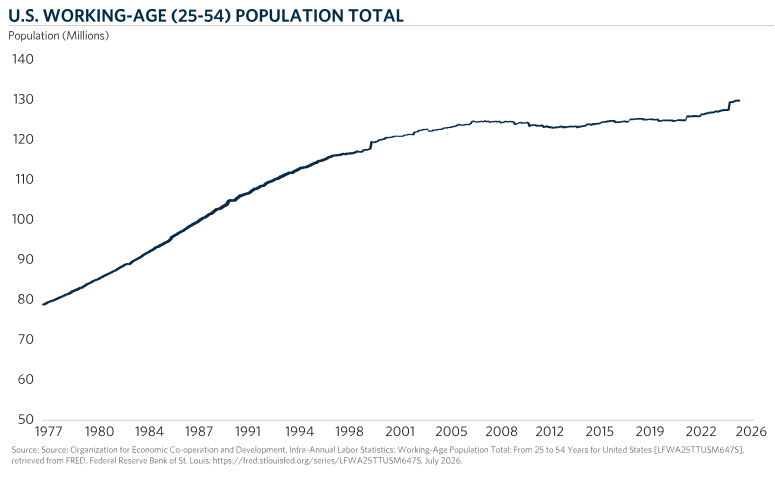
The disinflationary era in the United States that began in the early-to-mid 1980s is often justifiably attributed to skilled central banking, as Former Federal Reserve Chairman Paul Volcker hiked interest rates to historic highs in the early 1980s to curb inflation. A much less appreciated disinflationary force also at work was an unprecedented surge in the domestic supply of labor. In the 1950s, the post-war peacetime environment in the United States was conducive to family formation, leading to a surge in the future supply of working-age individuals, with this generation often being referred to as the “Baby Boomers.” This expansion in the domestic labor pool was further buoyed by a steady rise in female labor force participation across the United States. As a lagged effect of this demographic shift, the working age population of 25–54-year-olds grew robustly at roughly 2% annually from the late 1970s into 1990 according to FRED data.
This flood of workers suppressed wage growth, held down the price of goods, and alongside a related increase in savings rates, pushed interest rates steadily lower. Reinforcing this domestic labor abundance was globalization, as the integration of China and other emerging economies into global trade networks brought down the cost of traded goods. The resulting environment was a remarkably benign backdrop in which a standard stocks and bonds portfolio delivered strong returns from 1990-2020.
This same labor force supply tailwind is now reversing. Birth rates in the U.S. have fallen from their highs and are currently below replacement rate, where the population is expected to decrease over the coming decades if current trends continue. Further pressuring the future supply of workers is the Baby Boomer generation retiring in large numbers, with the June labor force participation data being one minor data point in a much longer arc of a plateauing working-age population.
Push and Pull
This reversal sets up an interesting crosscurrent. On one hand, shifting demographics are creating an aging society that will consume rather than produce as workers retire. Retirees will draw down savings, collect Social Security and require increased health care while fewer active workers remain to pay in and fund these programs. Downstream from medical advancements, longer lifespans compound the strain on a U.S. government balance sheet already stretched by a record debt and a significant budget deficit. With fewer available workers, it is reasonable to expect upward pressure on wages as labor supply contracts relative to demand. Each of these forces is structurally inflationary and could also potentially keep interest rates elevated over the long term.
 On the other side stands a powerful potential counterweight in the form of productivity boosted by the Artificial Intelligence revolution. Productivity has quietly been a bright spot for the U.S. economy, as nonfarm output per hour rose 2.1% in 2025 and has grown at nearly a 2% annual pace during the current business cycle, roughly matching its long-run average since the late 1940s. Artificial intelligence could push that trend further, with the McKinsey Global Institute estimating generative AI could lift U.S. labor productivity growth by 0.5 to 0.9 percentage points a year through 2030. If a shrinking workforce can produce meaningfully more per person, the inflationary pressure from demographics could be partly or wholly offset. Japan, with a working-age population that has been shrinking since the mid-1990s alongside persistently low inflation, is a reminder that demographic decline does not automatically translate into rising prices.
Withstanding a Wider Range of Outcomes
It is a futile effort to forecast in what direction these countervailing forces will take inflation and interest rates, given the web of interconnected variables and feedback loops that govern an economy. However, a portfolio built to perform across various market environments positions investors to benefit regardless of the reigning economic regime.
Over the last half a century, a simple portfolio primarily composed of stocks and bonds worked well because a dominant disinflationary regime made stocks and bonds reliably complementary. That arrangement was, in effect, an affirmation that this economic regime would persist. However, the ever-present slowdown in the growth of the working age population, coupled with new geopolitical risks and fragmenting globalization has widened the range of possible outcomes investors must consider. As the potential distribution of outcomes changes, so do potential risks, increasing the value of a diversified portfolio that does not depend on any single favorable environment to perform.
This is the case for building across scenarios rather than forecasting one. Growth assets, spanning both public and private markets, remain the engine of long-term returns and have historically compounded through inflationary pressures of the past. Real assets and other inflation-sensitive strategies offer a structural hedge should the demographic forces dominate and prices prove stickier. Diversifying allocations such as high-quality fixed income and uncorrelated hedge funds can further anchor the portfolio should growth instead disappoint or a productivity surge keep inflation contained.
For perpetual institutions with obligations measured across generations, resilience across regimes is a necessity rather than maximizing returns each year. With forces as powerful and unpredictable as artificial intelligence and demographic change shaping the path of the economy, the greatest edge lies not in forecasting the outcome but in disciplined portfolio construction and strategic asset allocation.