Gifts are a critical component of the independent school business model: adequate gifts, endowment returns, tuition and student enrollment enable schools to serve students year after year. This reality sets the stakes high for fundraising efforts and the ability to secure annual giving that is robust and consistent. This Viewpoint article from the 2025 Commonfund Benchmarks Study® of Independent Schools (CSIS or "the Study") covers the growing importance of gifts to independent school operations, average gifts to independent school endowments over time, donor trends, and considerations for the future.
Gifts are of Growing Importance, and Concern
One way the Study measures the importance of annual giving is by asking how much a school’s operating budget is funded by annual giving. Over the past three Studies, data have shown that an increasing share of independent school operating budgets are funded by giving, to 6.8 percent in FY2025 from 6.5 percent in FY2023, on average.
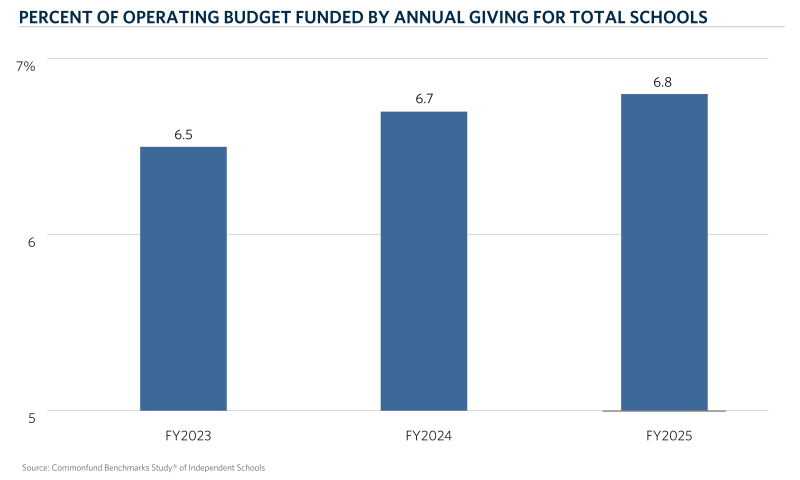
During that time, this figure for the largest schools grew to 8.5 percent from 7.8 percent; for the smallest schools, to 4.9 percent from 4.4 percent; and for mid-sized schools, to 6.0 percent from 6.2 percent (the only cohort that has seen this measure flat or down).
As contribution of gifts to the overall operating budget mix has grown, schools have continued to cite fundraising as a “top concern” (out of a list of 18 options). In FY2024, fundraising was the most cited concern among total schools. In FY2025, it was the second-most cited overall (only surpassed by student enrollment), and the most cited among the largest schools.
Modest Increase in Gifts—With Uneven Results
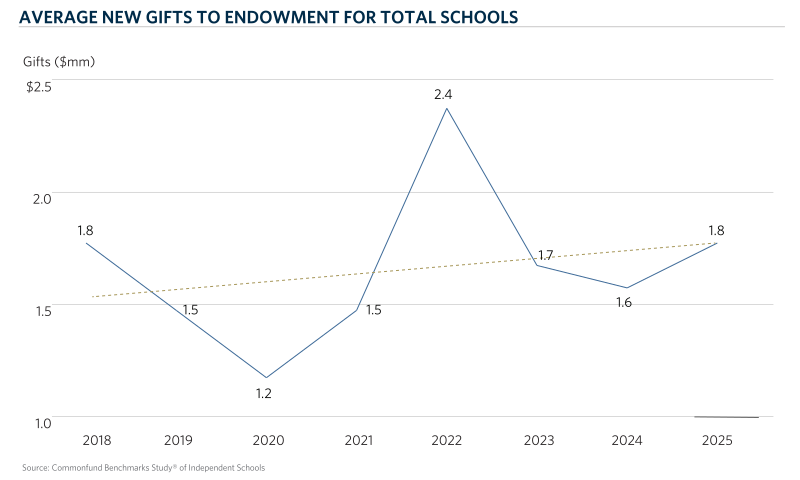
Study data show a trend of new gifts to endowments increasing over time from FY2018 to FY2025, on average for total schools. However, as shown in Figure VP1.2, the slope of the trend is only slightly positive, and schools have faced both growth and declines in annual giving year to year. For example, there was a surge in new gifts in FY2022—likely driven by standout market returns in FY2021—and a subsequent drop in new gifts in FY2023. Average gifts in FY2025 still fell short of that FY2022 high, despite growing from FY2024.
Inflation has been an area of attention over this period, as further explored in Viewpoint II "Inflation Strategies for Independent School Endowments". The real value of $1.8 million in FY2025 is of course lower than that same nominal gift in FY2018, potentially contributing to growing concerns around fundraising and the need to raise more dollars each year. Further, inflation may impact donors directly and therefore constrain fundraising overall.
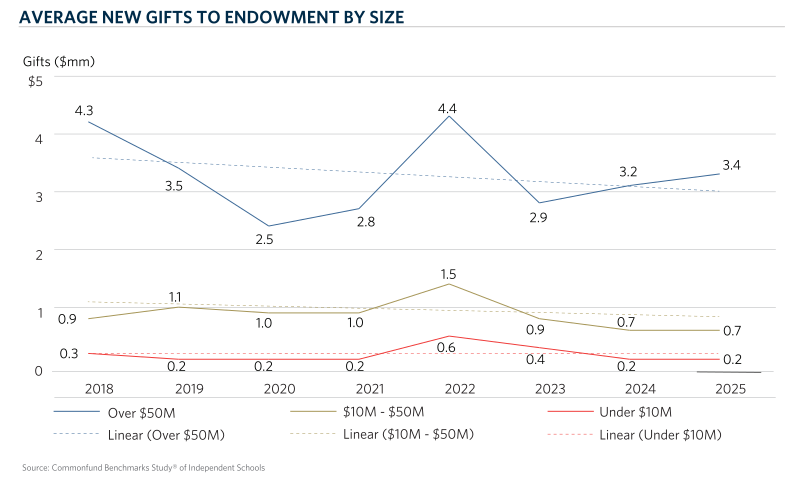
Size cohort data shows the upward trend in average gifts for schools overall has been driven by fundraising among the largest institutions. Schools with assets over $50 million consistently have higher gifts than the other size cohorts, on average. And over the past three fiscal years, gifts for this cohort have climbed, while those for the smaller cohorts have fell or stagnated.
Figure VP1.3 shows that average gifts are bolstered by outliers—a small number of schools with significantly higher gifts. Meanwhile, median gift data can also be illustrative: in FY2025, for example, median gifts for the largest cohort were $1.5 million, compared with $0.3 million for the mid-sized cohort and $0.1 million for the smallest schools.
Donors: Who, and What For?
Understanding donor trends can be instructive for fundraising efforts.
An article from NBOA and the Council for Advancement and Support of Education (CASE), “Shifts in Donor Dollars: Institutional Giving Trends,” provides a fiscal year–based analysis of donor behavior. Here are some highlights for consideration:
- A greater share of total gifts to independent schools now come from fewer donors. For example, a standard was set in prior years that roughly 80 percent of donations came from 20 percent of donors. As of FY2024, that ratio was closer to 90-10.
- There has been a trend towards restricted rather than unrestricted gifts, which is perhaps due in part to a growing orientation toward impact rather than institutional loyalty.
- Data on median gifts per student show relatively stable levels from fiscal years 2021 to 2024, with a slight increase in FY2022 and FY2023, and a slight decrease in FY2024. These data offer a smoother story with more subdued year-over-year changes compared with the total data shown in the charts in this section.
The article offers various tips for successful annual giving campaigns, including but not limited to aligning annual giving with what makes your school distinctive; integrating philanthropy into events that link back to its impact; being transparent; and considering various channels of communicating messages, from volunteers to texting and more.
Looking forward
In sum, gifts are a critical component of independent school endowments and operations. Fundraising is always important, but due to a confluence of factors such as inflation, enrollment, and variances year over year, it has taken center stage as a key concern among survey respondents. Looking forward, understanding shifting donor trends can play a critical role in driving fundraising success. Additionally, it is important to consider the potential effects of recently enacted policies affecting nonprofits and charitable giving—such as changes to the standard deduction and corporate giving incentives—on both fundraising outcomes and donor behavior.

Further Resources:
Commonfund Institute. (2025, July 22). Endowments, nonprofits face major shifts under new federal law. Commonfund. https://www.commonfund.org/blog/endowments-nonprofits-face-major-shifts-under-new-federal-law
National Business Officers Association. (n.d.). Stewarding donor dollars: Financial principles for contributions [Online course]. https://www.nboa.org/programs/online-courses/course/stewarding-donor-dollars-financial-principles-for-contributions
National Business Officers Association (NBOA). (2025, March). Financial state of the industry 2025: BIIS financial and operational indicators (2022–2024). https://www.nboa.org/publications/detail/financial-state-of-the-industry-2025
National Business Officers Association. (2022, February 10). Partnering with advancement: Accounting tips. Net Assets. https://www.nboa.org/net-assets/article/partnering-with-advancement-accounting-tips