Inflation Strategies for Independent School Endowments

April 15, 2026 |
4 minute read
|
Inflation Strategies for Independent School Endowments
7:49

Inflation impacts independent schools in a variety of ways: it puts additional pressure on endowments and operating budgets, makes it more difficult to meet inflation-adjusted target returns, and potentially strains fundraising—as explored in Fundraising and Gifts: A Growing Area of Concern. This article from the 2025 Commonfund Benchmarks Study® of Independent Schools (CSIS or "the Study"), covers the macroeconomic background related to markets and inflation, how inflation adds pressure to independent school endowments, and how endowment stewards can think more critically about inflation by using measures such as the Higher Education Price Index® (HEPI).

This article was originally authored by Commonfund for NBOA's Net Assets blog (originally published November 2025) and has been lightly adapted for this blog.

In recent years, climbing costs have been one of the most pressing challenges for independent school business leaders—and the pressure continues today. Inflation has fallen since the height of COVID-19, when it was driven by supply shocks, but rising prices and the looming effects of the U.S. administration's new tariff regime make it an ongoing concern.

As an asset management firm and research institution, Commonfund provides insights on inflation so that educational institutions can appropriately set and meet budgetary and investment goals. We have a broad view of the context for the current inflationary environment which allows us to assess how it impacts independent schools. In addition, we offer a valuable metric—HEPI—to help school business leaders more accurately account for inflation in their budgeting and investment management.

How Macroeconomic Conditions Impact Independent School Budgeting

After several years of intense price pressures, inflation is finally showing signs of moderation, offering some relief to institutions monitoring their cost structures. After peaking near 9 percent, the rate now hovers around 3 percent. That's still above the Federal Reserve's long-term target but a meaningful improvement, nonetheless. This progress comes despite significant domestic policy shifts that have fueled concerns about a sustained period of higher inflation.

These shifting macroeconomic conditions have direct implications at the institutional level, particularly when it comes to budgeting and financial planning. The current environment does not make budgeting easier. Elevated interest rates and inflation remain, and a once-healthy demographic trend that supported enrollment has reversed.

With so many variables influencing the budgeting process, it is important to use a consistent, broad-based measure of prices that align with an institution's specific cost structure. HEPI, explored in detail below, is a tool for both understanding historical trends and forecasting cost trajectories.

Inflation Is Increasing Pressure on Independent School Endowments

Participants in the 2025 CSIS reported that inflation is a top concern for their school. Endowments and their investment returns are key resources that enable schools to meet intergenerational equity—that is, maintain resources for future generations—as costs and expenses climb. So as inflation has grown in the past few years, it is no surprise that the share of operating budgets funded by the endowment has grown too, according to the Study.

NBOA's Financial State of the Industry 2022-2024 report states that operating costs have outpaced net tuition growth—another cause for concern, and pressure on the endowment to make up the gaps created by tuition and enrollment challenges. According to NBOA data, median net tuition and fees per student increased 3.9 percent between FY2023 and FY2024, but median total operating expenses per student increased 5.4 percent over the same time period. The median gap between net tuition and fees per student and total operating expenses per student increased 13.9 percent between FY2023 and FY2024. This is the gap that the endowment income needs to fill.

How Can We Measure Inflation for Independent Schools?

Independent school investment committees may strategically seek to achieve a higher rate of investment return to cover inflationary pressures. One way to do this would be to incorporate a measure of inflation into investment return targets, which about one third of institutions do, according to CSIS data (34 percent in FY2024 and 33 percent in FY2025).

To adjust return targets as inflation rises, looking at your institution's investment policy statement (IPS) would be a good place to start. This may involve an internal review or collaboration with your investment consultants or outsourced investment advisors to assess spending policy, asset allocation, risk management and more.
The most commonly used inflation benchmark—CPI—may not be the best, or only, measure for independent schools to use to track and benchmark their costs and investment return targets. Considering multiple inflation measures can help you more accurately forecast your budget and investment return needs. Developed in 1961, HEPI was originally designed for higher education institutions, but Commonfund has found it aligns with educational institution budgets more broadly.

A Quick Comparison of the Benchmarks

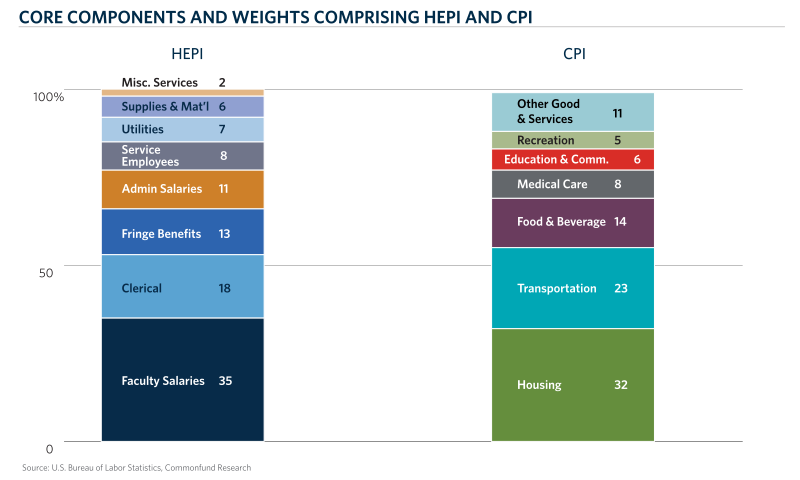
  • CPI is a measure of a bundle of goods for consumers and households in the economy, comprised largely of housing, transportation and food.
  • HEPI is a measure of categories that cover operational costs of educational institutions: faculty salaries, clerical, service and administrative salaries, fringe benefits, along with the relatively smaller components like miscellaneous services, utilities and supplies and materials.
  • Historically, HEPI has exceeded CPI, which was the case in fiscal 2025. This was because wage and fringe benefit pressures persisted despite lower inflation across the economy.

The majority of the HEPI measure is comprised of the people that power educational institutions—the teachers, administrators, clerical and service workers. This is true for both higher education institutions and independent schools. The quarterly HEPI estimates are derived from hundreds of data points based on the educational fiscal year (June 30), which enables business leaders to match the inflation measures they use with the rest of their financial operations.
CH1-HEPI-CPI-Components


Using inflation measures that reflect your institution's cost structure can allow you to set appropriate goals for budgeting and investing, better predict progress towards those goals, and communicate that progress more effectively along the way.

Putting It Into Practice

To put this into practice, we suggest exploring the following questions with your staff, committee or board of trustees:

  • Does your institution's budget look more similar to HEPI or CPI?
  • Does the year-over-year growth of your institution's operating expenses (in other words, your real inflation rate) more closely reflect HEPI or CPI?
  • How can both HEPI and CPI help ensure the inflation metrics used to develop and adjust the school's budget are fit for purpose?

As you work with your finance committee to develop and your school's 2026-27 budget, this may be the ideal time to consider how HEPI might be used to serve your budgeting and investment management.


Commonfund Institute

Author

Commonfund Institute

Disclaimer

Certain information contained herein has been obtained from or is based on third-party sources and, although believed to be reliable, has not been independently verified. Such information is as of the date indicated, if indicated, may not be complete, is subject to change and has not necessarily been updated. No representation or warranty, express or implied, is or will be given by The Common Fund for Nonprofit Organizations, any of its affiliates or any of its or their affiliates, trustees, directors, officers, employees or advisers (collectively referred to herein as “Commonfund”) or any other person as to the accuracy or completeness of the information in any third-party materials. Accordingly, Commonfund shall not be liable for any direct, indirect or consequential loss or damage suffered by any person as a result of relying on any statement in, or omission from, such third-party materials, and any such liability is expressly disclaimed.

All rights to the trademarks, copyrights, logos and other intellectual property listed herein belong to their respective owners and the use of such logos hereof does not imply an affiliation with, or endorsement by, the owners of such trademarks, copyrights, logos and other intellectual property.

To the extent views presented forecast market activity, they may be based on many factors in addition to those explicitly stated herein. Forecasts of experts inevitably differ. Views attributed to third-parties are presented to demonstrate the existence of points of view, not as a basis for recommendations or as investment advice. Market and investment views of third-parties presented herein do not necessarily reflect the views of Commonfund, any manager retained by Commonfund to manage any investments for Commonfund (each, a “Manager”) or any fund managed by any Commonfund entity (each, a “Fund”). Accordingly, the views presented herein may not be relied upon as an indication of trading intent on behalf of Commonfund, any Manager or any Fund.

Statements concerning Commonfund’s views of possible future outcomes in any investment asset class or market, or of possible future economic developments, are not intended, and should not be construed, as forecasts or predictions of the future investment performance of any Fund. Such statements are also not intended as recommendations by any Commonfund entity or any Commonfund employee to the recipient of the presentation. It is Commonfund’s policy that investment recommendations to its clients must be based on the investment objectives and risk tolerances of each individual client. All market outlook and similar statements are based upon information reasonably available as of the date of this presentation (unless an earlier date is stated with regard to particular information), and reasonably believed to be accurate by Commonfund. Commonfund disclaims any responsibility to provide the recipient of this presentation with updated or corrected information or statements. Past performance is not indicative of future results. For more information please refer to Important Disclosures.

Stay connected with the Insights Blog

Popular Blog Posts


Investment Strategy | Insights Blog

Determinants of Portfolio Returns – It Depends…

Asset allocation decisions have traditionally been associated with being the major determinant of portfolio returns. The Brinson, Hood, Beebower study of 19861 estimated that nearly 90 percent of...
Perspectives | Insights Blog

In Memoriam: Mamak Shahbazi

It is with great sadness that we announce the passing of Commonfund Board Member, Mamak Shahbazi. Mamak was a dedicated and talented board member and a great friend to the firm, its clients, and...
Perspectives | Insights Blog

Study of Foundations - Key Highlights [Infographic] 2024

In this infographic, we report the key highlights from the 2024 Council on Foundations-Commonfund Study of Foundations. For the year ended December 31, 2024, participating foundations produced...

Disclaimer

Certain information contained herein has been obtained from or is based on third-party sources and, although believed to be reliable, has not been independently verified. Such information is as of the date indicated, if indicated, may not be complete, is subject to change and has not necessarily been updated. No representation or warranty, express or implied, is or will be given by The Common Fund for Nonprofit Organizations, any of its affiliates or any of its or their affiliates, trustees, directors, officers, employees or advisers (collectively referred to herein as “Commonfund”) or any other person as to the accuracy or completeness of the information in any third-party materials. Accordingly, Commonfund shall not be liable for any direct, indirect or consequential loss or damage suffered by any person as a result of relying on any statement in, or omission from, such third-party materials, and any such liability is expressly disclaimed.

All rights to the trademarks, copyrights, logos and other intellectual property listed herein belong to their respective owners and the use of such logos hereof does not imply an affiliation with, or endorsement by, the owners of such trademarks, copyrights, logos and other intellectual property.

To the extent views presented forecast market activity, they may be based on many factors in addition to those explicitly stated herein. Forecasts of experts inevitably differ. Views attributed to third-parties are presented to demonstrate the existence of points of view, not as a basis for recommendations or as investment advice. Market and investment views of third-parties presented herein do not necessarily reflect the views of Commonfund, any manager retained by Commonfund to manage any investments for Commonfund (each, a “Manager”) or any fund managed by any Commonfund entity (each, a “Fund”). Accordingly, the views presented herein may not be relied upon as an indication of trading intent on behalf of Commonfund, any Manager or any Fund.

Statements concerning Commonfund’s views of possible future outcomes in any investment asset class or market, or of possible future economic developments, are not intended, and should not be construed, as forecasts or predictions of the future investment performance of any Fund. Such statements are also not intended as recommendations by any Commonfund entity or any Commonfund employee to the recipient of the presentation. It is Commonfund’s policy that investment recommendations to its clients must be based on the investment objectives and risk tolerances of each individual client. All market outlook and similar statements are based upon information reasonably available as of the date of this presentation (unless an earlier date is stated with regard to particular information), and reasonably believed to be accurate by Commonfund. Commonfund disclaims any responsibility to provide the recipient of this presentation with updated or corrected information or statements. Past performance is not indicative of future results. For more information please refer to Important Disclosures.