Market Insights: Record Highs and the Rise of Small and Mid-Caps

May 19, 2026 |
3 minute read
|
Market Insights: Record Highs and the Rise of Small and Mid-Caps
5:07

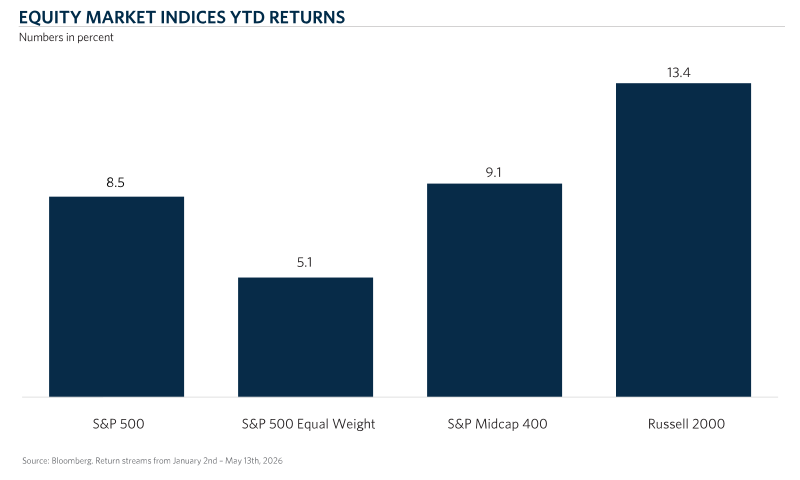
The S&P 500 closed at an all-time high, above 7,400, in early May 2026, up almost 8.5 percent year-to-date as of May 13th. But for the first time in several years, the headline index may not be the most interesting part of the story. Small caps (Russell 2000) are up approximately 13.4 percent over the same period and Mid-caps (S&P Midcap 400) have returned roughly 9 percent. Only the equal-weight version of the S&P 500 index, which treats every constituent the same regardless of size, is lagging its cap-weighted counterpart at 5 percent. Nonetheless, after years of narrow, mega-cap-driven returns, the market seems to be broadening in 2026.
CHT-Equity-Market-Broadening

The Earnings Gap Is Closing

For the past three years, the Magnificent Seven accounted for an outsized share of S&P 500 earnings growth. In the fourth quarter of 2025, that group posted roughly 27 percent year-over-year earnings growth while the remaining 493 companies in the index grew at just under 10 percent.

Preliminary Q1 results from six of the Magnificent Seven, with Nvidia yet to report, show that mega-cap technology remains healthy. All six posted double-digit year-over-year revenue growth for the quarter and beat earnings estimates, led by Alphabet at 22 percent, followed by Amazon and Apple, both at 17 percent.

These results are strong, but so is the broader index. The S&P 500 is on pace to deliver its sixth consecutive quarter of double-digit earnings growth, with more than 80 percent of reporting companies beating estimates. According to FactSet, all eleven S&P 500 sectors are expected to show positive revenue growth this year, a breadth of corporate strength that was largely absent in 2024 and 2025. FactSet also projects 2026 full-year Magnificent Seven earnings growth at approximately 25 percent and roughly 16 percent for the remaining 493 companies, a more balanced distribution of earnings growth than investors have seen in recent years. As earnings leadership broadens, market leadership tends to follow a similar trajectory.

Broadening Across the Capitalization Spectrum

This earnings convergence helps explain why the market's rally in 2026 looks different than prior years. The road has not been smooth. The Russell 2000 surged nearly 9 percent through mid-January, gave back virtually all those gains by late March as the Iran conflict disrupted energy markets and the Federal Reserve held rates steady. The index then mounted a sharp recovery through April and into May, breaking to a new all-time high. Investors who exited during the March selloff missed one of the sharpest small-cap recoveries in recent memory.

Smaller companies do carry structural sensitivities, approximately 32 percent of Russell 2000 debt is tied to floating rates, compared to 6 percent for the S&P 500. Also, small caps derive 70 to 80 percent of their revenue domestically, making them more exposed to the U.S. economic cycle. But these characteristics also mean that small and mid-cap stocks behave differently than large-cap equities, hence provide a diversification benefit.

It is also worth noting that a globally diversified corporate footprint does not eliminate all sources of risk for large-cap names. As we have seen during the U.S.-Iran War, mega-cap companies carry meaningful geopolitical exposure. Amazon data centers in the UAE and Bahrain were damaged by drone strikes in March, taking certain regions offline for what could be several months of repairs.

Why Diversification Matters

Small-cap and mid-cap equities access parts of the economy that the largest companies in the S&P 500 simply do not represent. They are more domestically oriented, more sensitive to the credit cycle, and more exposed to industries like regional banking, specialty manufacturing, and healthcare services that barely register in a cap-weighted index. This differentiation is the source of their diversification value.

The current environment offers a timely reminder of why portfolios are constructed across the capitalization spectrum. Large-cap concentration can drive strong returns for extended periods, but it also introduces risks that are easy to underestimate in real time such as sector-specific drawdowns to the kind of geopolitical disruption that took AWS data centers offline in March.

For allocators with long-term horizons and spending obligations that span decades, it is imprudent to chase the segment of the market which will lead each year. In fact, a well-defined portfolio construction philosophy should orient itself around the goal of constructing an equity portfolio which is built to participate across environments rather than depend on one.


Haider Hassan

Author

Haider Hassan

Analyst

Disclaimer

Certain information contained herein has been obtained from or is based on third-party sources and, although believed to be reliable, has not been independently verified. Such information is as of the date indicated, if indicated, may not be complete, is subject to change and has not necessarily been updated. No representation or warranty, express or implied, is or will be given by The Common Fund for Nonprofit Organizations, any of its affiliates or any of its or their affiliates, trustees, directors, officers, employees or advisers (collectively referred to herein as “Commonfund”) or any other person as to the accuracy or completeness of the information in any third-party materials. Accordingly, Commonfund shall not be liable for any direct, indirect or consequential loss or damage suffered by any person as a result of relying on any statement in, or omission from, such third-party materials, and any such liability is expressly disclaimed.

All rights to the trademarks, copyrights, logos and other intellectual property listed herein belong to their respective owners and the use of such logos hereof does not imply an affiliation with, or endorsement by, the owners of such trademarks, copyrights, logos and other intellectual property.

To the extent views presented forecast market activity, they may be based on many factors in addition to those explicitly stated herein. Forecasts of experts inevitably differ. Views attributed to third-parties are presented to demonstrate the existence of points of view, not as a basis for recommendations or as investment advice. Market and investment views of third-parties presented herein do not necessarily reflect the views of Commonfund, any manager retained by Commonfund to manage any investments for Commonfund (each, a “Manager”) or any fund managed by any Commonfund entity (each, a “Fund”). Accordingly, the views presented herein may not be relied upon as an indication of trading intent on behalf of Commonfund, any Manager or any Fund.

Statements concerning Commonfund’s views of possible future outcomes in any investment asset class or market, or of possible future economic developments, are not intended, and should not be construed, as forecasts or predictions of the future investment performance of any Fund. Such statements are also not intended as recommendations by any Commonfund entity or any Commonfund employee to the recipient of the presentation. It is Commonfund’s policy that investment recommendations to its clients must be based on the investment objectives and risk tolerances of each individual client. All market outlook and similar statements are based upon information reasonably available as of the date of this presentation (unless an earlier date is stated with regard to particular information), and reasonably believed to be accurate by Commonfund. Commonfund disclaims any responsibility to provide the recipient of this presentation with updated or corrected information or statements. Past performance is not indicative of future results. For more information please refer to Important Disclosures.

Stay connected with the Insights Blog

Popular Blog Posts


Investment Strategy | Insights Blog

Determinants of Portfolio Returns – It Depends…

Asset allocation decisions have traditionally been associated with being the major determinant of portfolio returns. The Brinson, Hood, Beebower study of 19861 estimated that nearly 90 percent of...
Perspectives | Insights Blog

In Memoriam: Mamak Shahbazi

It is with great sadness that we announce the passing of Commonfund Board Member, Mamak Shahbazi. Mamak was a dedicated and talented board member and a great friend to the firm, its clients, and...
Perspectives | Insights Blog

Study of Foundations - Key Highlights [Infographic] 2024

In this infographic, we report the key highlights from the 2024 Council on Foundations-Commonfund Study of Foundations. For the year ended December 31, 2024, participating foundations produced...

Disclaimer

Certain information contained herein has been obtained from or is based on third-party sources and, although believed to be reliable, has not been independently verified. Such information is as of the date indicated, if indicated, may not be complete, is subject to change and has not necessarily been updated. No representation or warranty, express or implied, is or will be given by The Common Fund for Nonprofit Organizations, any of its affiliates or any of its or their affiliates, trustees, directors, officers, employees or advisers (collectively referred to herein as “Commonfund”) or any other person as to the accuracy or completeness of the information in any third-party materials. Accordingly, Commonfund shall not be liable for any direct, indirect or consequential loss or damage suffered by any person as a result of relying on any statement in, or omission from, such third-party materials, and any such liability is expressly disclaimed.

All rights to the trademarks, copyrights, logos and other intellectual property listed herein belong to their respective owners and the use of such logos hereof does not imply an affiliation with, or endorsement by, the owners of such trademarks, copyrights, logos and other intellectual property.

To the extent views presented forecast market activity, they may be based on many factors in addition to those explicitly stated herein. Forecasts of experts inevitably differ. Views attributed to third-parties are presented to demonstrate the existence of points of view, not as a basis for recommendations or as investment advice. Market and investment views of third-parties presented herein do not necessarily reflect the views of Commonfund, any manager retained by Commonfund to manage any investments for Commonfund (each, a “Manager”) or any fund managed by any Commonfund entity (each, a “Fund”). Accordingly, the views presented herein may not be relied upon as an indication of trading intent on behalf of Commonfund, any Manager or any Fund.

Statements concerning Commonfund’s views of possible future outcomes in any investment asset class or market, or of possible future economic developments, are not intended, and should not be construed, as forecasts or predictions of the future investment performance of any Fund. Such statements are also not intended as recommendations by any Commonfund entity or any Commonfund employee to the recipient of the presentation. It is Commonfund’s policy that investment recommendations to its clients must be based on the investment objectives and risk tolerances of each individual client. All market outlook and similar statements are based upon information reasonably available as of the date of this presentation (unless an earlier date is stated with regard to particular information), and reasonably believed to be accurate by Commonfund. Commonfund disclaims any responsibility to provide the recipient of this presentation with updated or corrected information or statements. Past performance is not indicative of future results. For more information please refer to Important Disclosures.