The Trillion Dollar Trend: Mega-IPOs and What They Mean for Capital Markets

April 17, 2026 |
3 minute read
|

The era of trillion-dollar private technology companies is within sight. SpaceX is expected to IPO at a $1.75 trillion valuation, the largest IPO in the history of capital markets. They could soon be followed by OpenAI, which recently closed the largest private funding round in Silicon Valley history at a valuation of $852 billion.

Anthropic, one of OpenAI’s closest competitors, raised $30 billion at a $380 billion valuation just weeks earlier. Databricks, valued at $134 billion, has signaled it is IPO-ready. Together, these three companies could potentially bring well over $2 trillion in new market capitalization to public markets.
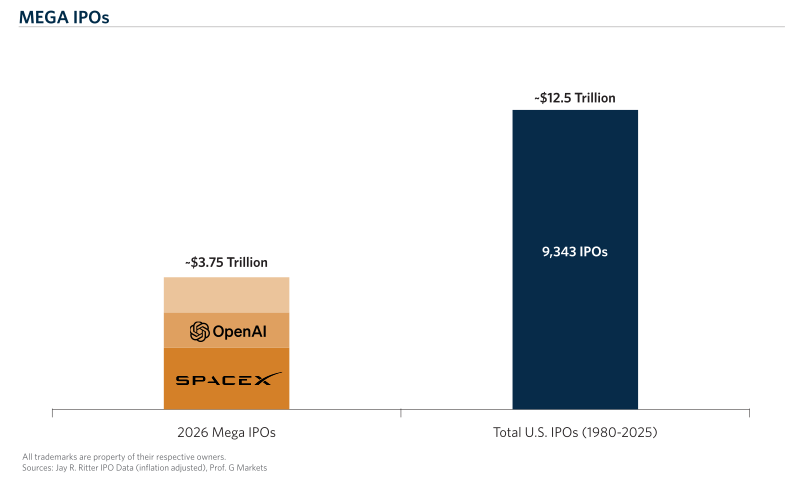
Mega IPOs of 2026 $3.75 Trillion vs Total US IPOs from 1980-2025 $12.5 Trillion

A New Class of Behemoths

The companies preparing to go public today bear little resemblance to prior generations of technology IPOs.

Alibaba’s 2014 IPO at a market capitalization of $231 billion is the largest technology IPO in history, with the company already generating substantial free cash flow. When Facebook listed in 2012, it raised $16 billion at a valuation of $104 billion and was already profitable. Google went public in August 2004 at a $23 billion valuation and was also profitable, having generated $105 million in net income on $1.5 billion in revenue the prior year. Amazon's 1997 debut was even more modest, coming in at a $438 million valuation on $148 million in annual revenue and a $30 million net loss.

Contrast that with OpenAI. The company is reportedly generating $2 billion per month in revenue and is still not profitable, with projected losses of roughly $25 billion in 2026. Anthropic has reached $30 billion in annualized revenue but plans to spend approximately $19 billion on training and inference this year alone. Equally unprecedented are the revenue ramp ups, with Anthropic's annualized revenue growing from $1 billion to $30 billion in roughly fifteen months, a pace of scaling that has no precedent in enterprise technology.

The Market Absorption Problem

Should these companies list at or over their private valuations, the implications for index construction would be quite significant. SpaceX, OpenAI and Anthropic IPOs at over a $1 trillion valuation each would make them three of the ten largest companies in the S&P 500 upon inclusion. This means they would exceed the market capitalization of household names like Costco and JPMorgan Chase.

For passive investors invested in market capitalization-weighted indices, this would create an overnight rebalancing event by forcing passive capital into these companies.

This dynamic is made more complex by the capital structures behind these valuations. A significant portion of OpenAI's recent $122 billion funding round consisted of strategic commercial arrangements rather than plain equity investments. Amazon's $50 billion commitment came bundled with a multi-year cloud spending agreement, and Nvidia's $30 billion was largely in the form of dedicated compute capacity. Analysts have raised questions about whether such arrangements may inflate both revenue and demand figures, a nuance that public market investors will need to parse carefully.

What This Means for Market Concentration

The top 10 companies in the S&P 500 already constitute just under 40 percent of the index by market capitalization as of early 2026. A wave of AI mega-IPOs would deepen this trend, adding a new cohort of companies whose valuations are built on the expectation of transformative, yet unproven, returns on massive capital investment. The risk is not that these companies are without merit. Their products are visibly reshaping how businesses operate, but the risk is that the sheer scale of their entry into public markets further concentrates index-level exposure in a narrow set of technology names.

The Public-Private Boundary Is Shifting

Perhaps the most important takeaway for institutional allocators is that the traditional boundary between public and private markets is becoming increasingly blurred. Several of these companies have already opened access to retail and institutional investors through pre-IPO vehicles and secondary markets. OpenAI extended participation to individual investors through bank channels for the first time and is being included in ETFs managed by ARK Invest. This means that a growing portion of value creation in AI is occurring before these companies ever file for an IPO and public market investors may be left paying the highest valuations in these companies' histories.

For investors maintaining diversified portfolios across asset classes, this evolving landscape underscores the importance of having meaningful exposure to private markets and venture strategies where much of this value is being created. It also reinforces the need for prudent diversification. Concentration risk does not disappear simply because it shifts from one set of large-cap technology names to another. If anything, the arrival of trillion-dollar IPOs makes portfolio construction decisions more important than ever.


Haider Hassan

Author

Haider Hassan

Analyst

Disclaimer

Certain information contained herein has been obtained from or is based on third-party sources and, although believed to be reliable, has not been independently verified. Such information is as of the date indicated, if indicated, may not be complete, is subject to change and has not necessarily been updated. No representation or warranty, express or implied, is or will be given by The Common Fund for Nonprofit Organizations, any of its affiliates or any of its or their affiliates, trustees, directors, officers, employees or advisers (collectively referred to herein as “Commonfund”) or any other person as to the accuracy or completeness of the information in any third-party materials. Accordingly, Commonfund shall not be liable for any direct, indirect or consequential loss or damage suffered by any person as a result of relying on any statement in, or omission from, such third-party materials, and any such liability is expressly disclaimed.

All rights to the trademarks, copyrights, logos and other intellectual property listed herein belong to their respective owners and the use of such logos hereof does not imply an affiliation with, or endorsement by, the owners of such trademarks, copyrights, logos and other intellectual property.

To the extent views presented forecast market activity, they may be based on many factors in addition to those explicitly stated herein. Forecasts of experts inevitably differ. Views attributed to third-parties are presented to demonstrate the existence of points of view, not as a basis for recommendations or as investment advice. Market and investment views of third-parties presented herein do not necessarily reflect the views of Commonfund, any manager retained by Commonfund to manage any investments for Commonfund (each, a “Manager”) or any fund managed by any Commonfund entity (each, a “Fund”). Accordingly, the views presented herein may not be relied upon as an indication of trading intent on behalf of Commonfund, any Manager or any Fund.

Statements concerning Commonfund’s views of possible future outcomes in any investment asset class or market, or of possible future economic developments, are not intended, and should not be construed, as forecasts or predictions of the future investment performance of any Fund. Such statements are also not intended as recommendations by any Commonfund entity or any Commonfund employee to the recipient of the presentation. It is Commonfund’s policy that investment recommendations to its clients must be based on the investment objectives and risk tolerances of each individual client. All market outlook and similar statements are based upon information reasonably available as of the date of this presentation (unless an earlier date is stated with regard to particular information), and reasonably believed to be accurate by Commonfund. Commonfund disclaims any responsibility to provide the recipient of this presentation with updated or corrected information or statements. Past performance is not indicative of future results. For more information please refer to Important Disclosures.

Stay connected with the Insights Blog

Popular Blog Posts


Investment Strategy | Insights Blog

Determinants of Portfolio Returns – It Depends…

Asset allocation decisions have traditionally been associated with being the major determinant of portfolio returns. The Brinson, Hood, Beebower study of 19861 estimated that nearly 90 percent of...
Perspectives | Insights Blog

In Memoriam: Mamak Shahbazi

It is with great sadness that we announce the passing of Commonfund Board Member, Mamak Shahbazi. Mamak was a dedicated and talented board member and a great friend to the firm, its clients, and...
Perspectives | Insights Blog

Study of Foundations - Key Highlights [Infographic] 2024

In this infographic, we report the key highlights from the 2024 Council on Foundations-Commonfund Study of Foundations. For the year ended December 31, 2024, participating foundations produced...

Disclaimer

Certain information contained herein has been obtained from or is based on third-party sources and, although believed to be reliable, has not been independently verified. Such information is as of the date indicated, if indicated, may not be complete, is subject to change and has not necessarily been updated. No representation or warranty, express or implied, is or will be given by The Common Fund for Nonprofit Organizations, any of its affiliates or any of its or their affiliates, trustees, directors, officers, employees or advisers (collectively referred to herein as “Commonfund”) or any other person as to the accuracy or completeness of the information in any third-party materials. Accordingly, Commonfund shall not be liable for any direct, indirect or consequential loss or damage suffered by any person as a result of relying on any statement in, or omission from, such third-party materials, and any such liability is expressly disclaimed.

All rights to the trademarks, copyrights, logos and other intellectual property listed herein belong to their respective owners and the use of such logos hereof does not imply an affiliation with, or endorsement by, the owners of such trademarks, copyrights, logos and other intellectual property.

To the extent views presented forecast market activity, they may be based on many factors in addition to those explicitly stated herein. Forecasts of experts inevitably differ. Views attributed to third-parties are presented to demonstrate the existence of points of view, not as a basis for recommendations or as investment advice. Market and investment views of third-parties presented herein do not necessarily reflect the views of Commonfund, any manager retained by Commonfund to manage any investments for Commonfund (each, a “Manager”) or any fund managed by any Commonfund entity (each, a “Fund”). Accordingly, the views presented herein may not be relied upon as an indication of trading intent on behalf of Commonfund, any Manager or any Fund.

Statements concerning Commonfund’s views of possible future outcomes in any investment asset class or market, or of possible future economic developments, are not intended, and should not be construed, as forecasts or predictions of the future investment performance of any Fund. Such statements are also not intended as recommendations by any Commonfund entity or any Commonfund employee to the recipient of the presentation. It is Commonfund’s policy that investment recommendations to its clients must be based on the investment objectives and risk tolerances of each individual client. All market outlook and similar statements are based upon information reasonably available as of the date of this presentation (unless an earlier date is stated with regard to particular information), and reasonably believed to be accurate by Commonfund. Commonfund disclaims any responsibility to provide the recipient of this presentation with updated or corrected information or statements. Past performance is not indicative of future results. For more information please refer to Important Disclosures.