The End of Asset-Light: How AI Is Accelerating Technology Spending

March 18, 2026 |
2 minute read
|
The End of Asset-Light: How AI Is Accelerating Technology Spending
4:36

For most of their existence, the world's largest technology companies operated on a model that seemed almost too good to be true. Companies like Microsoft, Meta, Alphabet, Amazon, and Oracle generated extraordinary margins without major capital expenditures, returning cash to shareholders through buybacks while sitting atop sizeable cash piles. This trend has shifted completely with billions of dollars being spent by these same companies, now “Hyperscalers”, to chase their AI dreams.

A Historic CapEx Sprint

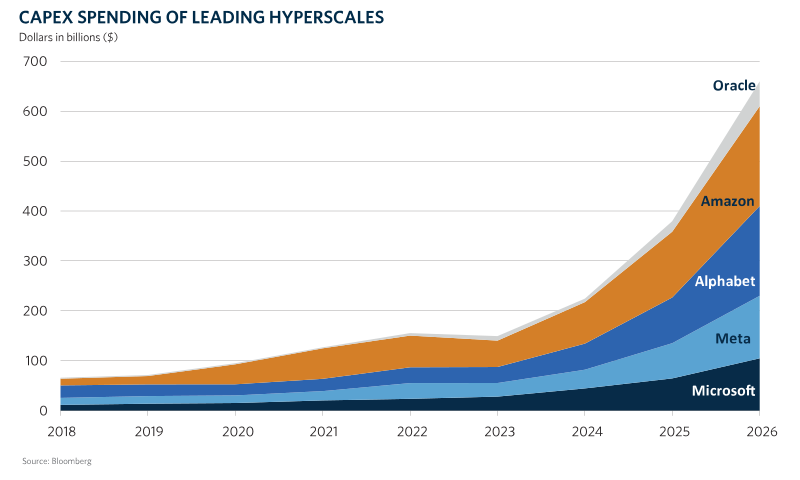
The numbers are staggering. Analysts report that hyperscaler spending on AI-related capital expenditures surged from roughly $250 billion in 2024 to more than $430 billion in 2025, with spending expected to hit $600-$700 billion in 2026. Amazon alone has committed to $200 billion in capex for 2026, Alphabet $175–185 billion, Microsoft to roughly $120 billion, Meta to $115–135 billion, and Oracle to $50 billion. For some of these names, this represents approximately 40%-50% of annual revenues, a level of spending that is unprecedented coming from traditionally investment-light businesses.
CHT-Capex-Spendng

Cash Flow Can't Keep Pace

Further analysis shows that cash simply isn't keeping up. Bank of America estimates that these hyperscalers are positioned to consume roughly 90% of their operating cash flow on capex in 2026, up from 65% in 2025. Analysts have estimated that Amazon is projected to post negative free cash flow of $17–$28 billion this year, a stark reversal of recent trends.

The consequences are that the shareholder return model is now straining under the weight of these new investments. Market research reports outline that combined share buybacks across these five companies plunged to $12.6 billion in Q4 2025, the lowest level since Q1 2018, compared to a peak of $149 billion in 2021.

Turning to the Bond Market

The natural question becomes, where is all the money coming from? The response has been a turn to debt markets.

In 2025, hyperscaler-linked corporate bond issuances totaled $121 billion in the U.S., versus an average of just $28 billion per year from 2020 to 2024. The individual transactions paint an even clearer picture. Meta issued a record-breaking $30 billion in bonds, Alphabet raised $25 billion, Oracle $18 billion, and Amazon $15 billion. This pace shows no signs of slowing down in 2026 either. This group of companies has already issued over $100 billion in U.S. bonds as of March 2026, nearly their total for all of 2025.

A few are getting creative with how they are structuring these debt issuances as well, with Meta using an off-balance-sheet special purpose vehicle to fund a data center in Louisiana. This could be a sign of things to come, with total hyperscaler borrowing showing no signs of slowing down.

A Question of Identity and Valuation

This is a fundamental identity shift for technology companies that have historically commanded premium valuations built on the assumption that software scales without proportional capital investment, leaving room for ever-increasing profits. These reserves of cash have funded buybacks, research expenses and “moonshot” investments like Alphabet’s now successful autonomous vehicle project called Waymo.

The bond market has now taken the place of retained earnings to finance the future of these technology giants. The question isn't necessarily whether these businesses can pay the debt, they very well could. The larger question is whether markets will continue to price them as high-multiple software businesses once balance sheets and cash flow profiles look increasingly different from what investors are used to seeing. The answer largely depends on what the returns are to these massive investments, which remains an interesting question the markets have yet to see definitive evidence for.

Given these potential uncertainties, investors would be well-served to maintain exposure to the possible upside while ensuring they are diversified in their portfolios against downside risk if returns on these significant capital expenditures do not materialize.


Haider Hassan

Author

Haider Hassan

Analyst

Disclaimer

Certain information contained herein has been obtained from or is based on third-party sources and, although believed to be reliable, has not been independently verified. Such information is as of the date indicated, if indicated, may not be complete, is subject to change and has not necessarily been updated. No representation or warranty, express or implied, is or will be given by The Common Fund for Nonprofit Organizations, any of its affiliates or any of its or their affiliates, trustees, directors, officers, employees or advisers (collectively referred to herein as “Commonfund”) or any other person as to the accuracy or completeness of the information in any third-party materials. Accordingly, Commonfund shall not be liable for any direct, indirect or consequential loss or damage suffered by any person as a result of relying on any statement in, or omission from, such third-party materials, and any such liability is expressly disclaimed.

All rights to the trademarks, copyrights, logos and other intellectual property listed herein belong to their respective owners and the use of such logos hereof does not imply an affiliation with, or endorsement by, the owners of such trademarks, copyrights, logos and other intellectual property.

To the extent views presented forecast market activity, they may be based on many factors in addition to those explicitly stated herein. Forecasts of experts inevitably differ. Views attributed to third-parties are presented to demonstrate the existence of points of view, not as a basis for recommendations or as investment advice. Market and investment views of third-parties presented herein do not necessarily reflect the views of Commonfund, any manager retained by Commonfund to manage any investments for Commonfund (each, a “Manager”) or any fund managed by any Commonfund entity (each, a “Fund”). Accordingly, the views presented herein may not be relied upon as an indication of trading intent on behalf of Commonfund, any Manager or any Fund.

Statements concerning Commonfund’s views of possible future outcomes in any investment asset class or market, or of possible future economic developments, are not intended, and should not be construed, as forecasts or predictions of the future investment performance of any Fund. Such statements are also not intended as recommendations by any Commonfund entity or any Commonfund employee to the recipient of the presentation. It is Commonfund’s policy that investment recommendations to its clients must be based on the investment objectives and risk tolerances of each individual client. All market outlook and similar statements are based upon information reasonably available as of the date of this presentation (unless an earlier date is stated with regard to particular information), and reasonably believed to be accurate by Commonfund. Commonfund disclaims any responsibility to provide the recipient of this presentation with updated or corrected information or statements. Past performance is not indicative of future results. For more information please refer to Important Disclosures.

Stay connected with the Insights Blog

Popular Blog Posts


Investment Strategy | Insights Blog

Determinants of Portfolio Returns – It Depends…

Asset allocation decisions have traditionally been associated with being the major determinant of portfolio returns. The Brinson, Hood, Beebower study of 19861 estimated that nearly 90 percent of...
Governance And Policy | Insights Blog

A Closer Look at Historically Black Colleges and Universities

Earlier this year, in partnership with the National Association of College and University Business Officers (NACUBO), Commonfund released the 2024 NACUBO-Commonfund Study of Endowments (NCSE). The...
Perspectives | Insights Blog

In Memoriam: Mamak Shahbazi

It is with great sadness that we announce the passing of Commonfund Board Member, Mamak Shahbazi. Mamak was a dedicated and talented board member and a great friend to the firm, its clients, and...

Disclaimer

Certain information contained herein has been obtained from or is based on third-party sources and, although believed to be reliable, has not been independently verified. Such information is as of the date indicated, if indicated, may not be complete, is subject to change and has not necessarily been updated. No representation or warranty, express or implied, is or will be given by The Common Fund for Nonprofit Organizations, any of its affiliates or any of its or their affiliates, trustees, directors, officers, employees or advisers (collectively referred to herein as “Commonfund”) or any other person as to the accuracy or completeness of the information in any third-party materials. Accordingly, Commonfund shall not be liable for any direct, indirect or consequential loss or damage suffered by any person as a result of relying on any statement in, or omission from, such third-party materials, and any such liability is expressly disclaimed.

All rights to the trademarks, copyrights, logos and other intellectual property listed herein belong to their respective owners and the use of such logos hereof does not imply an affiliation with, or endorsement by, the owners of such trademarks, copyrights, logos and other intellectual property.

To the extent views presented forecast market activity, they may be based on many factors in addition to those explicitly stated herein. Forecasts of experts inevitably differ. Views attributed to third-parties are presented to demonstrate the existence of points of view, not as a basis for recommendations or as investment advice. Market and investment views of third-parties presented herein do not necessarily reflect the views of Commonfund, any manager retained by Commonfund to manage any investments for Commonfund (each, a “Manager”) or any fund managed by any Commonfund entity (each, a “Fund”). Accordingly, the views presented herein may not be relied upon as an indication of trading intent on behalf of Commonfund, any Manager or any Fund.

Statements concerning Commonfund’s views of possible future outcomes in any investment asset class or market, or of possible future economic developments, are not intended, and should not be construed, as forecasts or predictions of the future investment performance of any Fund. Such statements are also not intended as recommendations by any Commonfund entity or any Commonfund employee to the recipient of the presentation. It is Commonfund’s policy that investment recommendations to its clients must be based on the investment objectives and risk tolerances of each individual client. All market outlook and similar statements are based upon information reasonably available as of the date of this presentation (unless an earlier date is stated with regard to particular information), and reasonably believed to be accurate by Commonfund. Commonfund disclaims any responsibility to provide the recipient of this presentation with updated or corrected information or statements. Past performance is not indicative of future results. For more information please refer to Important Disclosures.