The New Era of Market Concentration

January 26, 2026 |
2 minute read
|
The New Era of Market Concentration
3:33

Market concentration has become a key theme, with the top 10 companies constituting more than 40 percent of the S&P 500 Index by market capitalization. This comfortably surpasses market concentration seen even in the Dot‑Com peak of 29 percent. Is this a concerning trend or a familiar pattern observed in market history?
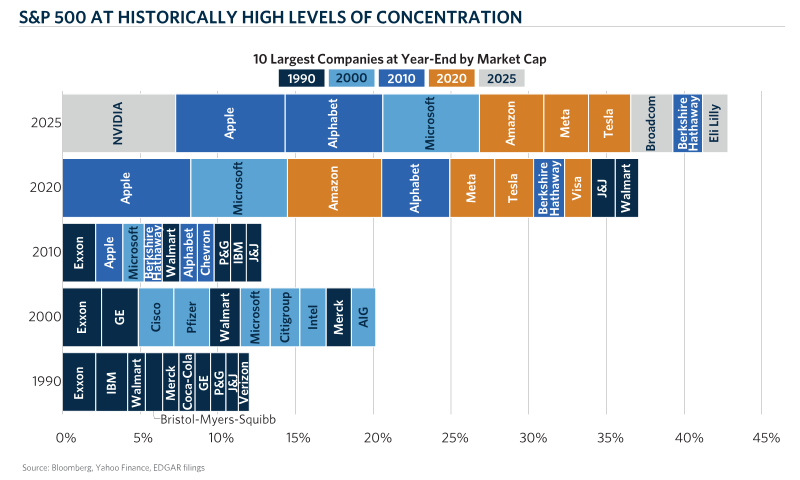
CHT-The-New-Era-Market-Concentration

Concentration Is a Feature, Not a Bug

Periods of high stock market concentration have been a feature of U.S. stock market history, whether it was the “Nifty Fifty” era of the 1960s and 1970s or when a few high‑hype and high growth companies dominated market attention in the Dot‑Com era of the late 1990s.

However, this is not an unusual trend when looking back historically. The top 10 companies were about 30 percent of total market capitalization in the early 1960s, with some research suggesting this number was closer to the current 40 percent level in 1900.

While the level of concentration is striking, it is important to look at the underlying market dynamics causing this: market gains tend to be driven by a small basket of individual companies. These winners grow faster than the average company for extended periods and their market weights continue to expand accordingly. They continue to be rewarded by investors with a higher market capitalization, leading to the eventual concentration we see in markets.

The “Mega Cap” names like Nvidia, Alphabet, Amazon have grown in market capitalization because they have outperformed over a long period due to strong fundamentals and dominance in their respective sectors, not solely due to elevated investor spirits.

The Magnificent Seven and the Earnings Behind the Scale

The top 10 companies driving market concentration currently in the S&P 500 are some of the strongest the market has ever seen. “Magnificent Seven” names like Apple, Amazon, Alphabet, Meta and Microsoft are underpinned by sizeable earnings, free cash flow and established business models equipping them with entrenched competitive advantages that are hard to displace for upstart players. Unlike some of the past periods of concentration driven by generous valuations, today’s leaders are powered by robust fundamentals.

Why Concentration Heightens the Importance of Diversification

This is not to say there are no dangers in the market. While fundamentals are strong, some of these top 10 names enjoy rich multiples with aggressive growth expectations. Tesla, as an example, trades at a trailing P/E ratio of over 200 as of December 2025.

While concentration in a few names does not inherently signal poor future returns, it can magnify portfolio distress in market downturns. Stock market volatility can be especially elevated given the crowding in the top 10 S&P 500 companies if there is a shift in the momentum powering them.

This is precisely why a portfolio built with prudent diversification across asset classes, sectors, and geographies can be better protected in downside scenarios as effects from price movements in the largest individual companies are less magnified.

It is safe to say that concentration is normal. Investors do not necessarily need to avoid the top performers in the S&P 500, but it would be wise to ensure that their portfolios are not one big bet on these companies roaring on.


Haider Hassan

Author

Haider Hassan

Analyst

Disclaimer

Certain information contained herein has been obtained from or is based on third-party sources and, although believed to be reliable, has not been independently verified. Such information is as of the date indicated, if indicated, may not be complete, is subject to change and has not necessarily been updated. No representation or warranty, express or implied, is or will be given by The Common Fund for Nonprofit Organizations, any of its affiliates or any of its or their affiliates, trustees, directors, officers, employees or advisers (collectively referred to herein as “Commonfund”) or any other person as to the accuracy or completeness of the information in any third-party materials. Accordingly, Commonfund shall not be liable for any direct, indirect or consequential loss or damage suffered by any person as a result of relying on any statement in, or omission from, such third-party materials, and any such liability is expressly disclaimed.

All rights to the trademarks, copyrights, logos and other intellectual property listed herein belong to their respective owners and the use of such logos hereof does not imply an affiliation with, or endorsement by, the owners of such trademarks, copyrights, logos and other intellectual property.

To the extent views presented forecast market activity, they may be based on many factors in addition to those explicitly stated herein. Forecasts of experts inevitably differ. Views attributed to third-parties are presented to demonstrate the existence of points of view, not as a basis for recommendations or as investment advice. Market and investment views of third-parties presented herein do not necessarily reflect the views of Commonfund, any manager retained by Commonfund to manage any investments for Commonfund (each, a “Manager”) or any fund managed by any Commonfund entity (each, a “Fund”). Accordingly, the views presented herein may not be relied upon as an indication of trading intent on behalf of Commonfund, any Manager or any Fund.

Statements concerning Commonfund’s views of possible future outcomes in any investment asset class or market, or of possible future economic developments, are not intended, and should not be construed, as forecasts or predictions of the future investment performance of any Fund. Such statements are also not intended as recommendations by any Commonfund entity or any Commonfund employee to the recipient of the presentation. It is Commonfund’s policy that investment recommendations to its clients must be based on the investment objectives and risk tolerances of each individual client. All market outlook and similar statements are based upon information reasonably available as of the date of this presentation (unless an earlier date is stated with regard to particular information), and reasonably believed to be accurate by Commonfund. Commonfund disclaims any responsibility to provide the recipient of this presentation with updated or corrected information or statements. Past performance is not indicative of future results. For more information please refer to Important Disclosures.

Stay connected with the Insights Blog

Popular Blog Posts


Investment Strategy | Insights Blog

Determinants of Portfolio Returns – It Depends…

Asset allocation decisions have traditionally been associated with being the major determinant of portfolio returns. The Brinson, Hood, Beebower study of 19861 estimated that nearly 90 percent of...
Governance And Policy | Insights Blog

A Closer Look at Historically Black Colleges and Universities

Earlier this year, in partnership with the National Association of College and University Business Officers (NACUBO), Commonfund released the 2024 NACUBO-Commonfund Study of Endowments (NCSE). The...
Governance And Policy | Insights Blog

2025 Policy Outlook: What Endowments and Foundations Should Know

On January 30th, Commonfund Institute, in partnership with the National Association of College and University Business Officers (NACUBO), the Council on Foundations (COF), and the Council for...

Disclaimer

Certain information contained herein has been obtained from or is based on third-party sources and, although believed to be reliable, has not been independently verified. Such information is as of the date indicated, if indicated, may not be complete, is subject to change and has not necessarily been updated. No representation or warranty, express or implied, is or will be given by The Common Fund for Nonprofit Organizations, any of its affiliates or any of its or their affiliates, trustees, directors, officers, employees or advisers (collectively referred to herein as “Commonfund”) or any other person as to the accuracy or completeness of the information in any third-party materials. Accordingly, Commonfund shall not be liable for any direct, indirect or consequential loss or damage suffered by any person as a result of relying on any statement in, or omission from, such third-party materials, and any such liability is expressly disclaimed.

All rights to the trademarks, copyrights, logos and other intellectual property listed herein belong to their respective owners and the use of such logos hereof does not imply an affiliation with, or endorsement by, the owners of such trademarks, copyrights, logos and other intellectual property.

To the extent views presented forecast market activity, they may be based on many factors in addition to those explicitly stated herein. Forecasts of experts inevitably differ. Views attributed to third-parties are presented to demonstrate the existence of points of view, not as a basis for recommendations or as investment advice. Market and investment views of third-parties presented herein do not necessarily reflect the views of Commonfund, any manager retained by Commonfund to manage any investments for Commonfund (each, a “Manager”) or any fund managed by any Commonfund entity (each, a “Fund”). Accordingly, the views presented herein may not be relied upon as an indication of trading intent on behalf of Commonfund, any Manager or any Fund.

Statements concerning Commonfund’s views of possible future outcomes in any investment asset class or market, or of possible future economic developments, are not intended, and should not be construed, as forecasts or predictions of the future investment performance of any Fund. Such statements are also not intended as recommendations by any Commonfund entity or any Commonfund employee to the recipient of the presentation. It is Commonfund’s policy that investment recommendations to its clients must be based on the investment objectives and risk tolerances of each individual client. All market outlook and similar statements are based upon information reasonably available as of the date of this presentation (unless an earlier date is stated with regard to particular information), and reasonably believed to be accurate by Commonfund. Commonfund disclaims any responsibility to provide the recipient of this presentation with updated or corrected information or statements. Past performance is not indicative of future results. For more information please refer to Important Disclosures.