Will Oil Supply Shocks Impact Costs to Institutions?

March 10, 2026 |
2 minute read
|
Will Oil Supply Shocks Impact Costs to Institutions?
4:07

The recent attacks in the Middle East have already triggered one of the most severe oil market disruptions in decades, sending shockwaves through global energy supply chains. Joint U.S. and Israeli strikes beginning on February 28th —along with Iran’s retaliatory attacks across the region—have directly targeted energy infrastructure and choked off critical transit routes.

One element of the Iranian response to these attacks has been attempts to limit tanker movements through the Strait of Hormuz, the world’s most important energy chokepoint. Transits through the strait have collapsed by more than 80 percent over the course of days, restricting the flow of nearly one fifth of global oil shipments. These disruptions have already pushed crude prices sharply higher, as markets price in the risk of prolonged shortages and powerful inflationary pressure throughout the economy.1

Commonfund Institute tracks prices that impact educational institutions and nonprofits more broadly, so we explore the potential impacts of these developments below.

Reduced Supply Pushes Energy Prices Higher

If demand for related fuels remains relatively steady, reduced oil supply drives prices up sharply in the short-term. To illustrate, the graph below shows that oil market shocks tend to dramatically increase prices to the tune of double-digit spikes within 30 days.
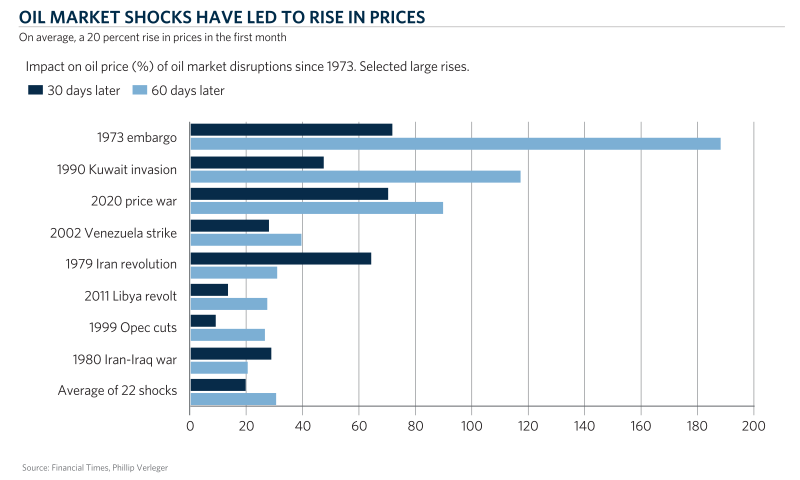
CH1-OilShocks

Rising Energy Costs Increase Expenses for Households, Businesses, and Nonprofits

Consumers typically experience supply-driven price jumps almost immediately. Filling up a gas tank becomes more expensive, and heating costs rise – which will fall on top of years of elevated inflation and energy cost spikes driven by data center energy demand. Because these are typically non‑discretionary expenses, households, businesses, and nonprofits have limited ability to adjust in the short term, directly impacting balance sheets and reducing purchasing power.

Commonfund tracks inflation for the education sector in the Higher Education Price Index (HEPI), which assumes that roughly 7 percent of educational institutions’ budgets are comprised of utilities costs. These direct costs could climb throughout the remainder of fiscal year 2026, which may be reflected in our first fiscal year estimate released in April. HEPI also includes costs related to supplies and materials that institutions purchase, but the broader inflationary impact of these shocks will be determined over a longer period.

If inflation to a relatively small budget item increases for a short period of time, action of Boards and investment committees may not be warranted. However, if inflationary pressure is sustained, there can be implications for investment return targets, asset allocation strategy, and spending. It is with this dynamic in mind that many institutional investors maintain an exposure to natural resources in their private portfolios as a potential hedge against unexpected inflation.

Central Banks Face a Policy Dilemma

Beyond direct energy costs, supply-driven oil price spikes can raise costs across the economy. Transportation and logistics firms face higher fuel bills, manufacturers pay more for energy-intensive processes, and industries reliant on petrochemicals see input costs climb. These expenses often get passed on to customers, broadening the impact and threatening the progress that has been made to bring down inflation in the economy.

This can pose a challenge for monetary policymakers. When the initial source of inflation is supply driven—something higher interest rates cannot fix directly—central banks may still consider tightening policy if they see broader price pressures forming. The goal will be to prevent a temporary energy shock from embedding itself into wages and prices more broadly.

While it is possible that these shocks are short-term in duration, we will continue to track these developments and their potential impacts on nonprofits, policy, and the broader economy.




  1. Conflict in Iran and the Global Oil Market - IER

Amanda Novello

Author

Amanda Novello

Senior Policy and Research Analyst

Disclaimer

Certain information contained herein has been obtained from or is based on third-party sources and, although believed to be reliable, has not been independently verified. Such information is as of the date indicated, if indicated, may not be complete, is subject to change and has not necessarily been updated. No representation or warranty, express or implied, is or will be given by The Common Fund for Nonprofit Organizations, any of its affiliates or any of its or their affiliates, trustees, directors, officers, employees or advisers (collectively referred to herein as “Commonfund”) or any other person as to the accuracy or completeness of the information in any third-party materials. Accordingly, Commonfund shall not be liable for any direct, indirect or consequential loss or damage suffered by any person as a result of relying on any statement in, or omission from, such third-party materials, and any such liability is expressly disclaimed.

All rights to the trademarks, copyrights, logos and other intellectual property listed herein belong to their respective owners and the use of such logos hereof does not imply an affiliation with, or endorsement by, the owners of such trademarks, copyrights, logos and other intellectual property.

To the extent views presented forecast market activity, they may be based on many factors in addition to those explicitly stated herein. Forecasts of experts inevitably differ. Views attributed to third-parties are presented to demonstrate the existence of points of view, not as a basis for recommendations or as investment advice. Market and investment views of third-parties presented herein do not necessarily reflect the views of Commonfund, any manager retained by Commonfund to manage any investments for Commonfund (each, a “Manager”) or any fund managed by any Commonfund entity (each, a “Fund”). Accordingly, the views presented herein may not be relied upon as an indication of trading intent on behalf of Commonfund, any Manager or any Fund.

Statements concerning Commonfund’s views of possible future outcomes in any investment asset class or market, or of possible future economic developments, are not intended, and should not be construed, as forecasts or predictions of the future investment performance of any Fund. Such statements are also not intended as recommendations by any Commonfund entity or any Commonfund employee to the recipient of the presentation. It is Commonfund’s policy that investment recommendations to its clients must be based on the investment objectives and risk tolerances of each individual client. All market outlook and similar statements are based upon information reasonably available as of the date of this presentation (unless an earlier date is stated with regard to particular information), and reasonably believed to be accurate by Commonfund. Commonfund disclaims any responsibility to provide the recipient of this presentation with updated or corrected information or statements. Past performance is not indicative of future results. For more information please refer to Important Disclosures.

Stay connected with the Insights Blog

Popular Blog Posts


Investment Strategy | Insights Blog

Determinants of Portfolio Returns – It Depends…

Asset allocation decisions have traditionally been associated with being the major determinant of portfolio returns. The Brinson, Hood, Beebower study of 19861 estimated that nearly 90 percent of...
Governance And Policy | Insights Blog

A Closer Look at Historically Black Colleges and Universities

Earlier this year, in partnership with the National Association of College and University Business Officers (NACUBO), Commonfund released the 2024 NACUBO-Commonfund Study of Endowments (NCSE). The...
Perspectives | Insights Blog

In Memoriam: Mamak Shahbazi

It is with great sadness that we announce the passing of Commonfund Board Member, Mamak Shahbazi. Mamak was a dedicated and talented board member and a great friend to the firm, its clients, and...

Disclaimer

Certain information contained herein has been obtained from or is based on third-party sources and, although believed to be reliable, has not been independently verified. Such information is as of the date indicated, if indicated, may not be complete, is subject to change and has not necessarily been updated. No representation or warranty, express or implied, is or will be given by The Common Fund for Nonprofit Organizations, any of its affiliates or any of its or their affiliates, trustees, directors, officers, employees or advisers (collectively referred to herein as “Commonfund”) or any other person as to the accuracy or completeness of the information in any third-party materials. Accordingly, Commonfund shall not be liable for any direct, indirect or consequential loss or damage suffered by any person as a result of relying on any statement in, or omission from, such third-party materials, and any such liability is expressly disclaimed.

All rights to the trademarks, copyrights, logos and other intellectual property listed herein belong to their respective owners and the use of such logos hereof does not imply an affiliation with, or endorsement by, the owners of such trademarks, copyrights, logos and other intellectual property.

To the extent views presented forecast market activity, they may be based on many factors in addition to those explicitly stated herein. Forecasts of experts inevitably differ. Views attributed to third-parties are presented to demonstrate the existence of points of view, not as a basis for recommendations or as investment advice. Market and investment views of third-parties presented herein do not necessarily reflect the views of Commonfund, any manager retained by Commonfund to manage any investments for Commonfund (each, a “Manager”) or any fund managed by any Commonfund entity (each, a “Fund”). Accordingly, the views presented herein may not be relied upon as an indication of trading intent on behalf of Commonfund, any Manager or any Fund.

Statements concerning Commonfund’s views of possible future outcomes in any investment asset class or market, or of possible future economic developments, are not intended, and should not be construed, as forecasts or predictions of the future investment performance of any Fund. Such statements are also not intended as recommendations by any Commonfund entity or any Commonfund employee to the recipient of the presentation. It is Commonfund’s policy that investment recommendations to its clients must be based on the investment objectives and risk tolerances of each individual client. All market outlook and similar statements are based upon information reasonably available as of the date of this presentation (unless an earlier date is stated with regard to particular information), and reasonably believed to be accurate by Commonfund. Commonfund disclaims any responsibility to provide the recipient of this presentation with updated or corrected information or statements. Past performance is not indicative of future results. For more information please refer to Important Disclosures.