From Rate Cuts to Hikes: Supply-Driven Inflation’s Resurgence

October 23, 2026 |
3 minute read
|
From Rate Cuts to Hikes: Supply-Driven Inflation’s Resurgence
7:05

Coming into 2026, investors had been positioned for an interest rate easing cycle. Markets are now pricing in multiple rate hikes into 2027, and Federal Reserve Governor Christopher Waller has said additional rate hikes will likely be needed to tame current inflationary pressures. Much of that pressure, however, is supply-driven inflation, which rate hikes are poorly equipped to address. Yields have also been on the rise, with the 10-year at 5.09% and the 30-year at 5.43% as of October 16th.

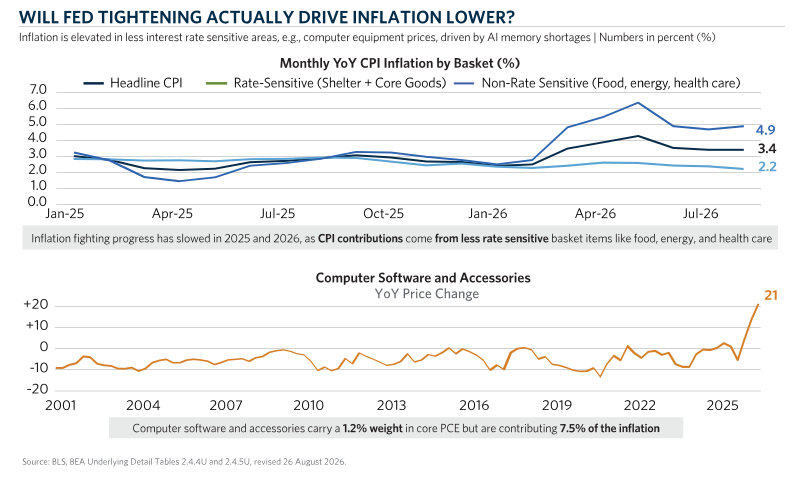
Most of the focus has, understandably, been on the pivot from rate cuts to hikes, but the more important question is whether today's sources of inflation will respond to rising interest rates. A meaningful share of current inflation originates in war-driven supply disruption, layered with unprecedented demand for certain computer and software accessories central to developing and running artificial intelligence models. None of these drivers respond directly to rising interest rates because price increases are the result of sticky supply constraints, over which the Federal Reserve has little control.
CHT-WillFed-Tightening

The Supply-Side Drivers of Inflation

Headline CPI inflation peaked at 4.2 percent year-over-year in May, eased to 3.4 percent in July and August, and rose again to 3.7 percent in September. The composition of price pressure has shifted in ways that complicate the policy response.

Research published in late August by the Federal Reserve Bank of Minneapolis estimates tariffs contributed between 0.2 and 0.4 percentage points to core PCE inflation as of July. The more striking finding is that even excluding tariffs entirely, core PCE would still be running roughly a full percentage point above the Federal Reserve’s 2 percent target.

A second driver has emerged from the unprecedented AI buildout. According to the same analysis, video and information processing equipment, a category carrying a 2.4 percent weight in core PCE, has posted abnormally high inflation driven by demand and constrained supply rather than trade policy, adding approximately another 0.4 percentage points. The Federal Reserve’s own July 2026 Monetary Policy Report cited rapid price gains in software and accessories, computers and other electronics in the early months of the year. While the AI capital expenditure cycle is powering corporate earnings, it is simultaneously bidding up the cost of the equipment it consumes.

Energy has been a consistent undertone in the inflationary picture as PCE energy prices rose 24 percent over the twelve months ending in May, per the Fed’s Monetary Policy Report, and disruption through the Strait of Hormuz has lifted oil and gas, fertilizer and helium prices simultaneously. The limitation for the Federal Reserve is that higher interest rates cannot increase crude oil production, reverse tariff policy or accelerate the manufacture of advanced semiconductors and high bandwidth memory equipment.

Tightening Into Accommodative Conditions

Further complicating the Federal Reserve's inflation mandate is the fact that financial conditions remain broadly accommodative despite climbing long-term yields.

Investment-grade spreads remain tight relative to historical standards, bank lending flows are stable, and the S&P 500 closed above 7,800 for the first time in early October.

Credit markets have absorbed remarkable supply along the way, with bond issuance among the largest investment-grade cloud computing firms nearing $100 billion in the first quarter of 2026 alone, according to the Federal Reserve’s May 2026 Financial Stability Report. Technology borrowers and the U.S. Treasury are competing for the same pool of capital, and investors have absorbed both without a meaningful widening in spreads. This is not the typical behavior of a tight financial system.

Economic growth has also remained stable, with the Bureau of Economic Analysis reporting real GDP growth of 2.5 percent annualized in the first quarter (revised in its September 30 release) and 2.2 percent in the second. Federal Reserve Board research published in July finds that AI-related components, led by software and computer equipment, have been the largest positive contributors to GDP growth since 2025, while the Fed’s July Monetary Policy Report noted only a very modest gain in consumer spending in the first quarter. The consumer-driven segments most sensitive to interest rates are not contributing meaningfully, while the segment driving growth is funded through issuance and equity markets that a policy rate affects only indirectly.

Some commentators argue that markets may be pricing a more aggressive rate hike path than will ultimately materialize, given headline inflation has already fallen from its May peak, and core CPI remains relatively contained at 2.6 percent. This suggests that inflationary pressures monetary policy cannot easily suppress may also fade on their own as markets adjust to supply-demand imbalances.

Positioning Across Regimes

Forecasting the potential path of interest rates is a futile exercise for institutional investors, with the focus being better placed on building a portfolio that can perform across various market cycles.

Within public equities, diversification across regions, styles and strategies matters more when a single capital expenditure cycle accounts for an outsized share of economic growth and an outsized share of index returns. In private markets, venture capital and growth equity provide access to the AI theme at an earlier stage and offer a differentiated opportunity set compared to public markets.

In fixed income, a cycle-aware approach that remains broadly neutral to duration is appropriate when inflation is driven by factors policy influences only partially. Higher all-in yields have made the asset class investable again, though credit selection matters when spreads are this tight. Real assets, including real estate and infrastructure, warrant particular attention, as supply-driven inflation is precisely the kind that financial assets hedge poorly and real assets hedge well.

Expectations are for the Federal Reserve to raise rates again in late 2026 and early 2027. However, it is clear that the Federal Reserve is not capable of resolving the supply constraints behind the key drivers of current inflation. Therefore, a quick resolution to today’s higher prices will likely remain elusive. Investment portfolios built to withstand varied market outcomes amid a rapidly changing landscape are better positioned to weather potential volatility than those relying heavily on short-term tactical positioning.


Haider Hassan

Author

Haider Hassan

Analyst

Disclaimer

Certain information contained herein has been obtained from or is based on third-party sources and, although believed to be reliable, has not been independently verified. Such information is as of the date indicated, if indicated, may not be complete, is subject to change and has not necessarily been updated. No representation or warranty, express or implied, is or will be given by The Common Fund for Nonprofit Organizations, any of its affiliates or any of its or their affiliates, trustees, directors, officers, employees or advisers (collectively referred to herein as “Commonfund”) or any other person as to the accuracy or completeness of the information in any third-party materials. Accordingly, Commonfund shall not be liable for any direct, indirect or consequential loss or damage suffered by any person as a result of relying on any statement in, or omission from, such third-party materials, and any such liability is expressly disclaimed.

All rights to the trademarks, copyrights, logos and other intellectual property listed herein belong to their respective owners and the use of such logos hereof does not imply an affiliation with, or endorsement by, the owners of such trademarks, copyrights, logos and other intellectual property.

To the extent views presented forecast market activity, they may be based on many factors in addition to those explicitly stated herein. Forecasts of experts inevitably differ. Views attributed to third-parties are presented to demonstrate the existence of points of view, not as a basis for recommendations or as investment advice. Market and investment views of third-parties presented herein do not necessarily reflect the views of Commonfund, any manager retained by Commonfund to manage any investments for Commonfund (each, a “Manager”) or any fund managed by any Commonfund entity (each, a “Fund”). Accordingly, the views presented herein may not be relied upon as an indication of trading intent on behalf of Commonfund, any Manager or any Fund.

Statements concerning Commonfund’s views of possible future outcomes in any investment asset class or market, or of possible future economic developments, are not intended, and should not be construed, as forecasts or predictions of the future investment performance of any Fund. Such statements are also not intended as recommendations by any Commonfund entity or any Commonfund employee to the recipient of the presentation. It is Commonfund’s policy that investment recommendations to its clients must be based on the investment objectives and risk tolerances of each individual client. All market outlook and similar statements are based upon information reasonably available as of the date of this presentation (unless an earlier date is stated with regard to particular information), and reasonably believed to be accurate by Commonfund. Commonfund disclaims any responsibility to provide the recipient of this presentation with updated or corrected information or statements. Past performance is not indicative of future results. For more information please refer to Important Disclosures.

Stay connected with the Insights Blog

Popular Blog Posts


Investment Strategy | Insights Blog

Determinants of Portfolio Returns – It Depends…

Asset allocation decisions have traditionally been associated with being the major determinant of portfolio returns. The Brinson, Hood, Beebower study of 19861 estimated that nearly 90 percent of...
Governance And Policy | Insights Blog

Three Fundamental Duties of Nonprofit Boards

It is essential that trustees of endowed portfolios hold themselves accountable to a set of standards in order to maintain sound governance practices. Fiduciary duty is an important part of the...
Market Commentary | Insights Blog

The New Era of Market Concentration

Market concentration has become a key theme, with the top 10 companies constituting more than 40 percent of the S&P 500 Index by market capitalization. This comfortably surpasses market concentration...

Disclaimer

Certain information contained herein has been obtained from or is based on third-party sources and, although believed to be reliable, has not been independently verified. Such information is as of the date indicated, if indicated, may not be complete, is subject to change and has not necessarily been updated. No representation or warranty, express or implied, is or will be given by The Common Fund for Nonprofit Organizations, any of its affiliates or any of its or their affiliates, trustees, directors, officers, employees or advisers (collectively referred to herein as “Commonfund”) or any other person as to the accuracy or completeness of the information in any third-party materials. Accordingly, Commonfund shall not be liable for any direct, indirect or consequential loss or damage suffered by any person as a result of relying on any statement in, or omission from, such third-party materials, and any such liability is expressly disclaimed.

All rights to the trademarks, copyrights, logos and other intellectual property listed herein belong to their respective owners and the use of such logos hereof does not imply an affiliation with, or endorsement by, the owners of such trademarks, copyrights, logos and other intellectual property.

To the extent views presented forecast market activity, they may be based on many factors in addition to those explicitly stated herein. Forecasts of experts inevitably differ. Views attributed to third-parties are presented to demonstrate the existence of points of view, not as a basis for recommendations or as investment advice. Market and investment views of third-parties presented herein do not necessarily reflect the views of Commonfund, any manager retained by Commonfund to manage any investments for Commonfund (each, a “Manager”) or any fund managed by any Commonfund entity (each, a “Fund”). Accordingly, the views presented herein may not be relied upon as an indication of trading intent on behalf of Commonfund, any Manager or any Fund.

Statements concerning Commonfund’s views of possible future outcomes in any investment asset class or market, or of possible future economic developments, are not intended, and should not be construed, as forecasts or predictions of the future investment performance of any Fund. Such statements are also not intended as recommendations by any Commonfund entity or any Commonfund employee to the recipient of the presentation. It is Commonfund’s policy that investment recommendations to its clients must be based on the investment objectives and risk tolerances of each individual client. All market outlook and similar statements are based upon information reasonably available as of the date of this presentation (unless an earlier date is stated with regard to particular information), and reasonably believed to be accurate by Commonfund. Commonfund disclaims any responsibility to provide the recipient of this presentation with updated or corrected information or statements. Past performance is not indicative of future results. For more information please refer to Important Disclosures.