Impact Investing vs. ESG: Defining Mission-Aligned Investing

September 25, 2026 |
2 minute read
|
Impact Investing vs. ESG: Defining Mission-Aligned Investing
3:12

Ask ten investment professionals what "mission-aligned investing" means and you are likely to get ten different answers. Some will say environmental, social and governance (ESG). Others will say impact investing. A few will say socially responsible investing, responsible investing, or sustainable investing. All of them are describing real approaches — but they are not describing the same thing, and treating them as interchangeable creates genuine governance problems for fiduciaries.

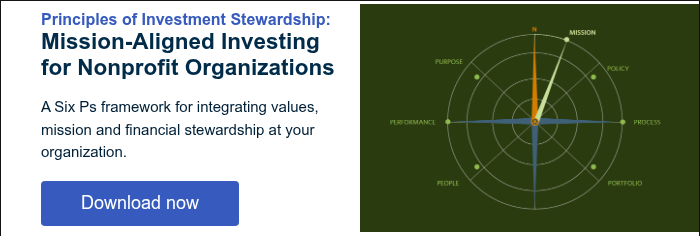
In our new paper, Principles of Investment Stewardship: Mission-Aligned Investing for Nonprofit Organizations, we spend time at the outset getting the terminology right — not because precision is an end in itself, but because vague language in an Investment Policy Statement (IPS) leads to vague implementation, and vague implementation makes it impossible to know whether your institution is doing what it said it would do.

Here is how we define each term:

ESG Integration is the systematic incorporation of environmental, social, and governance factors into investment analysis and portfolio management, primarily as a risk management and return-enhancement tool. ESG integration does not require a specific social or environmental outcome — it is a lens applied to conventional investment decision-making. Notably, 82.5% of higher education endowments now incorporate ESG or sustainability considerations into their IPS, a figure that reflects broad adoption of ESG as standard practice rather than a specialized commitment.

Screened or Socially Responsible Investing (SRI) refers to the exclusion of specific sectors, companies, or issuers from a portfolio based on values or mission criteria — tobacco, weapons, fossil fuels, private prisons, and similar categories. SRI is values-driven but does not typically require measurement of social or environmental outcomes. It is among the oldest and most widely practiced forms of mission-informed investing.

Impact Investing is defined by intentionality and measurement — both the pursuit of a specific social or environmental outcome and the discipline to track whether that outcome is being achieved. It requires a clearly defined Theory of Change, pre-defined outcome metrics, and ongoing reporting against those metrics. It sits at the most intentional end of the spectrum.

Mission-Aligned Investing (MAI) is the umbrella. It encompasses all of the above — ESG integration, SRI screening, impact investing, and hybrid approaches that combine elements of all three. What distinguishes MAI from conventional endowment management is not which tools are used, but whether those tools are deployed with a clear, documented rationale connecting investment decisions to institutional mission.

These approaches exist on a continuum, not in rigid categories. A single institution might apply ESG integration broadly across its public equity portfolio, use negative screening to exclude specific sectors, and allocate a dedicated portion to impact investments in private markets — all under one coherent MAI strategy governed by a single Theory of Change embedded in the IPS.

The practical implication for fiduciaries: your IPS should be explicit about which approaches you are using and why. An IPS that says "we consider ESG factors where appropriate" is not a mission-aligned investing policy — it is an aspiration. The governance frameworks in our new paper are designed to help institutions move from aspiration to commitment.
Commonfund Institute

Author

Commonfund Institute

Disclaimer

Certain information contained herein has been obtained from or is based on third-party sources and, although believed to be reliable, has not been independently verified. Such information is as of the date indicated, if indicated, may not be complete, is subject to change and has not necessarily been updated. No representation or warranty, express or implied, is or will be given by The Common Fund for Nonprofit Organizations, any of its affiliates or any of its or their affiliates, trustees, directors, officers, employees or advisers (collectively referred to herein as “Commonfund”) or any other person as to the accuracy or completeness of the information in any third-party materials. Accordingly, Commonfund shall not be liable for any direct, indirect or consequential loss or damage suffered by any person as a result of relying on any statement in, or omission from, such third-party materials, and any such liability is expressly disclaimed.

All rights to the trademarks, copyrights, logos and other intellectual property listed herein belong to their respective owners and the use of such logos hereof does not imply an affiliation with, or endorsement by, the owners of such trademarks, copyrights, logos and other intellectual property.

To the extent views presented forecast market activity, they may be based on many factors in addition to those explicitly stated herein. Forecasts of experts inevitably differ. Views attributed to third-parties are presented to demonstrate the existence of points of view, not as a basis for recommendations or as investment advice. Market and investment views of third-parties presented herein do not necessarily reflect the views of Commonfund, any manager retained by Commonfund to manage any investments for Commonfund (each, a “Manager”) or any fund managed by any Commonfund entity (each, a “Fund”). Accordingly, the views presented herein may not be relied upon as an indication of trading intent on behalf of Commonfund, any Manager or any Fund.

Statements concerning Commonfund’s views of possible future outcomes in any investment asset class or market, or of possible future economic developments, are not intended, and should not be construed, as forecasts or predictions of the future investment performance of any Fund. Such statements are also not intended as recommendations by any Commonfund entity or any Commonfund employee to the recipient of the presentation. It is Commonfund’s policy that investment recommendations to its clients must be based on the investment objectives and risk tolerances of each individual client. All market outlook and similar statements are based upon information reasonably available as of the date of this presentation (unless an earlier date is stated with regard to particular information), and reasonably believed to be accurate by Commonfund. Commonfund disclaims any responsibility to provide the recipient of this presentation with updated or corrected information or statements. Past performance is not indicative of future results. For more information please refer to Important Disclosures.

Stay connected with the Insights Blog

Popular Blog Posts


Investment Strategy | Insights Blog

Determinants of Portfolio Returns – It Depends…

Asset allocation decisions have traditionally been associated with being the major determinant of portfolio returns. The Brinson, Hood, Beebower study of 19861 estimated that nearly 90 percent of...
Governance And Policy | Insights Blog

Three Fundamental Duties of Nonprofit Boards

It is essential that trustees of endowed portfolios hold themselves accountable to a set of standards in order to maintain sound governance practices. Fiduciary duty is an important part of the...
Perspectives | Insights Blog

A Closer Look at Long-term Returns

In the annual Council on Foundations-Commonfund Study of Investment of Endowments for Private and Community Foundations® (CCSF; the "Study") data was collected on longer-term returns for the first...

Disclaimer

Certain information contained herein has been obtained from or is based on third-party sources and, although believed to be reliable, has not been independently verified. Such information is as of the date indicated, if indicated, may not be complete, is subject to change and has not necessarily been updated. No representation or warranty, express or implied, is or will be given by The Common Fund for Nonprofit Organizations, any of its affiliates or any of its or their affiliates, trustees, directors, officers, employees or advisers (collectively referred to herein as “Commonfund”) or any other person as to the accuracy or completeness of the information in any third-party materials. Accordingly, Commonfund shall not be liable for any direct, indirect or consequential loss or damage suffered by any person as a result of relying on any statement in, or omission from, such third-party materials, and any such liability is expressly disclaimed.

All rights to the trademarks, copyrights, logos and other intellectual property listed herein belong to their respective owners and the use of such logos hereof does not imply an affiliation with, or endorsement by, the owners of such trademarks, copyrights, logos and other intellectual property.

To the extent views presented forecast market activity, they may be based on many factors in addition to those explicitly stated herein. Forecasts of experts inevitably differ. Views attributed to third-parties are presented to demonstrate the existence of points of view, not as a basis for recommendations or as investment advice. Market and investment views of third-parties presented herein do not necessarily reflect the views of Commonfund, any manager retained by Commonfund to manage any investments for Commonfund (each, a “Manager”) or any fund managed by any Commonfund entity (each, a “Fund”). Accordingly, the views presented herein may not be relied upon as an indication of trading intent on behalf of Commonfund, any Manager or any Fund.

Statements concerning Commonfund’s views of possible future outcomes in any investment asset class or market, or of possible future economic developments, are not intended, and should not be construed, as forecasts or predictions of the future investment performance of any Fund. Such statements are also not intended as recommendations by any Commonfund entity or any Commonfund employee to the recipient of the presentation. It is Commonfund’s policy that investment recommendations to its clients must be based on the investment objectives and risk tolerances of each individual client. All market outlook and similar statements are based upon information reasonably available as of the date of this presentation (unless an earlier date is stated with regard to particular information), and reasonably believed to be accurate by Commonfund. Commonfund disclaims any responsibility to provide the recipient of this presentation with updated or corrected information or statements. Past performance is not indicative of future results. For more information please refer to Important Disclosures.