The State as a Shareholder: Government Equity Stakes

September 21, 2026 |
3 minute read
|
The State as a Shareholder: Government Equity Stakes
7:12

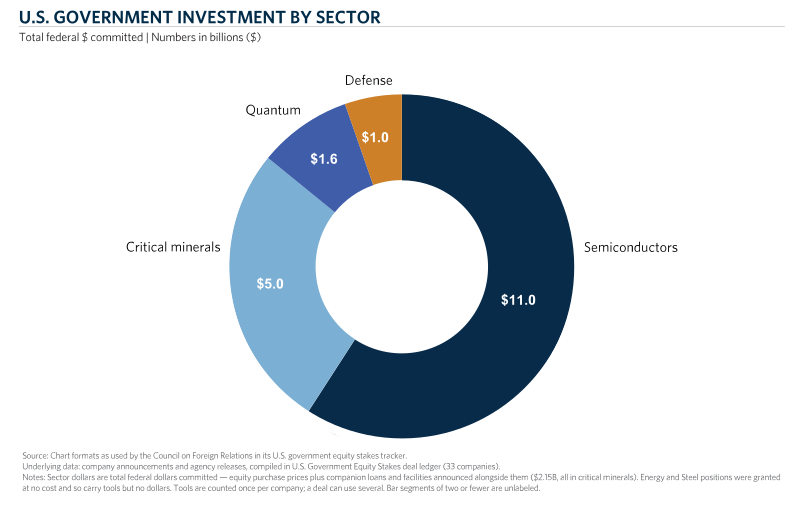
The U.S. government has historically exerted its influence on private industry through several mechanisms including grants, loans, regulatory frameworks and tax incentives. Now seems to be the dawn of a new paradigm, with federal agencies accumulating government equity stakes, along with using other instruments, to become a line item on a capitalization table. Since January 2025, Washington has announced $27.7 billion in investments across thirty-nine deals, according to the Council on Foreign Relations’ U.S. Government Deal Tracker as of July 2026.

The Department of Commerce has been the most active with a string of twenty-four announced deals, which include a notable 10 percent ownership stake in Intel purchased for roughly $9 billion in August 2025. This stake has since grown to be worth approximately $45 billion as of September 2026. The Department of Defense also disclosed nine strategic investments concentrated in critical minerals, with additional positions in defense manufacturing and energy. These include an approximately 15 percent as-converted stake in MP Materials, 10 percent of Trilogy Metals with warrants for a further 7.5 percent, and 40 percent of a joint venture with Korea Zinc to finance domestic zinc refining. Not far behind, the Development Finance Corporation has announced six equity transactions across critical minerals, energy, and infrastructure.

This activity arrives amid reports of potential government equity stakes in leading artificial intelligence companies. OpenAI has reportedly proposed ceding a 5 percent interest to a federal investment vehicle, an arrangement its chief executive suggested could extend to other leading developers. Administration officials have characterized these sweeping strategic investment efforts as an early step toward a funding mechanism that resembles a more traditional sovereign wealth fund.
CHT-Tools-Used-Across-DealsCHT-US-Gov-Inv-by-Sec

More Nuanced Than Ownership

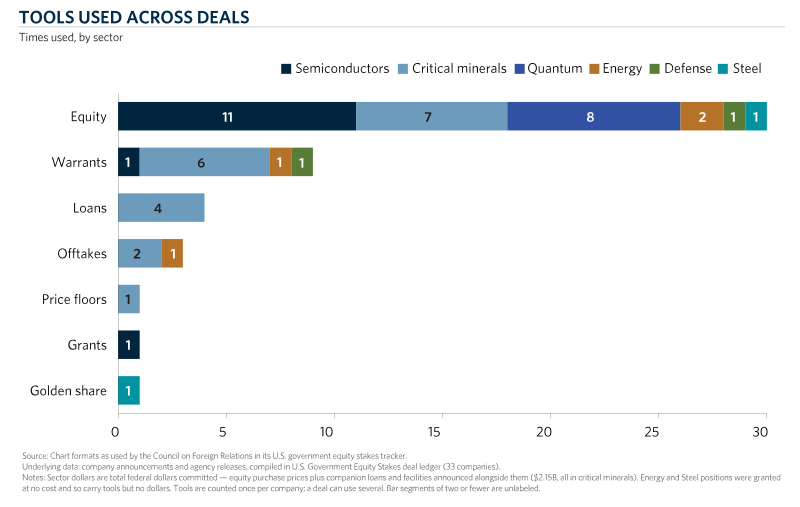
The underlying agreements are more nuanced than simple equity ownership. Equity is one pathway within a broader mandate which includes debt instruments such as new loans and the restructuring of existing obligations. Such structures feature roughly half of these deals, with warrants also being a preferred structure as offering terms can be more precisely tailored to a given transaction. There are examples of other bespoke arrangements that go considerably further in terms of their complexity.

The government received a “golden share” upon its agreement with U.S. Steel in June 2025, bestowing the power to veto key corporate decisions. The July 2025 agreement with rare-earth producer MP Materials uses not only equity and debt, but an offtake agreement binding the Department of Defense to purchase all the company’s magnets for ten years above a fixed price floor. This provision acts as a significant risk transfer for other investors, effectively substituting a government guarantee for exposure to the underlying commodity cycle. The Department of Commerce’s activity has also moved aggressively into emerging technology, announcing a cluster of eight quantum computing agreements on a single day in May 2026. 

The Pentagon may also soon have access to acquiring their own minority equity positions in companies focusing on critical minerals, chemicals and battery technology, with provision in the Senate's Fiscal Year 2027 defense authorization bill establishing a dedicated Treasury account for this purpose.

The sectors receiving this capital such as critical minerals, energy and semiconductors share the common characteristic that they are considered strategically important for national security and economic sovereignty. This is a much different set of incentives compared to investors that invest in these sectors based primarily on economic interests.

New Variables for Investors to Underwrite

All this activity brings in new variables that investors must now incorporate into their investment theses.
Capital is now being directed into specific industries by policy decision rather than perceived economic upside. This alters the return dynamics of the industries and their constituents in ways that conventional analysis may not readily capture. A ten-year purchase commitment with a price floor is a materially different proposition than a standard commodity business, arguably a better one, but through a mechanism largely disconnected from corporate fundamentals.

There is additional uncertainty regarding the durability of these arrangements. In the absence of a publicly articulated framework governing how certain agreements will be terminated or positions sold, there could be the potential for more interim volatility. Researchers at the Council on Foreign Relations have noted that federal accounting and budgetary rules were never designed to hold corporate equity and are still being adopted.

The least appreciated factor is that many investors already hold this exposure without having selected it. Intel sits in every fund tracking the S&P 500. An institution with broad passive equity exposure owns a company whose largest single shareholder is the federal government, whether or not that risk was ever deliberately underwritten. Broader government investment influence could likely trigger investors to re-underwrite current portfolio investments and future positioning.

Why Diversification Becomes Important

The sectors attracting government capital are largely the same that institutions have been building exposure to through various channels, whether passive or linked to active investments across public equities, private equity, fixed income and real assets. Exposure that appears well diversified on first examination may in fact rest on a narrower set of underlying drivers. It is also worth noting that pricing state ownership of assets was historically a discipline reserved for emerging markets investors. It has now become a consideration for U.S. investors as well. 

Diversification across geographies through strategies capable of navigating various policies and economic environments can serve as a key safeguard to idiosyncratic risks arising from government investments. The argument is not for institutions to steer clear of sectors where there is increased uncertainty, as many are reasonably expected to have compelling long-term fundamentals. Rather, the approach demands isolating the drivers of return in an investment program and ensuring they are distributed across asset classes, geographies, and underlying strategies.

For perpetual institutions, this is a familiar discipline. The specific themes that attract capital will change, as they always have, and the portfolios that meet their objectives over decades will be built to benefit from changing market dynamics instead of being dictated by them.


Haider Hassan

Author

Haider Hassan

Analyst

Disclaimer

Certain information contained herein has been obtained from or is based on third-party sources and, although believed to be reliable, has not been independently verified. Such information is as of the date indicated, if indicated, may not be complete, is subject to change and has not necessarily been updated. No representation or warranty, express or implied, is or will be given by The Common Fund for Nonprofit Organizations, any of its affiliates or any of its or their affiliates, trustees, directors, officers, employees or advisers (collectively referred to herein as “Commonfund”) or any other person as to the accuracy or completeness of the information in any third-party materials. Accordingly, Commonfund shall not be liable for any direct, indirect or consequential loss or damage suffered by any person as a result of relying on any statement in, or omission from, such third-party materials, and any such liability is expressly disclaimed.

All rights to the trademarks, copyrights, logos and other intellectual property listed herein belong to their respective owners and the use of such logos hereof does not imply an affiliation with, or endorsement by, the owners of such trademarks, copyrights, logos and other intellectual property.

To the extent views presented forecast market activity, they may be based on many factors in addition to those explicitly stated herein. Forecasts of experts inevitably differ. Views attributed to third-parties are presented to demonstrate the existence of points of view, not as a basis for recommendations or as investment advice. Market and investment views of third-parties presented herein do not necessarily reflect the views of Commonfund, any manager retained by Commonfund to manage any investments for Commonfund (each, a “Manager”) or any fund managed by any Commonfund entity (each, a “Fund”). Accordingly, the views presented herein may not be relied upon as an indication of trading intent on behalf of Commonfund, any Manager or any Fund.

Statements concerning Commonfund’s views of possible future outcomes in any investment asset class or market, or of possible future economic developments, are not intended, and should not be construed, as forecasts or predictions of the future investment performance of any Fund. Such statements are also not intended as recommendations by any Commonfund entity or any Commonfund employee to the recipient of the presentation. It is Commonfund’s policy that investment recommendations to its clients must be based on the investment objectives and risk tolerances of each individual client. All market outlook and similar statements are based upon information reasonably available as of the date of this presentation (unless an earlier date is stated with regard to particular information), and reasonably believed to be accurate by Commonfund. Commonfund disclaims any responsibility to provide the recipient of this presentation with updated or corrected information or statements. Past performance is not indicative of future results. For more information please refer to Important Disclosures.

Stay connected with the Insights Blog

Popular Blog Posts


Investment Strategy | Insights Blog

Determinants of Portfolio Returns – It Depends…

Asset allocation decisions have traditionally been associated with being the major determinant of portfolio returns. The Brinson, Hood, Beebower study of 19861 estimated that nearly 90 percent of...
Governance And Policy | Insights Blog

Three Fundamental Duties of Nonprofit Boards

It is essential that trustees of endowed portfolios hold themselves accountable to a set of standards in order to maintain sound governance practices. Fiduciary duty is an important part of the...
Perspectives | Insights Blog

A Closer Look at Long-term Returns

In the annual Council on Foundations-Commonfund Study of Investment of Endowments for Private and Community Foundations® (CCSF; the "Study") data was collected on longer-term returns for the first...

Disclaimer

Certain information contained herein has been obtained from or is based on third-party sources and, although believed to be reliable, has not been independently verified. Such information is as of the date indicated, if indicated, may not be complete, is subject to change and has not necessarily been updated. No representation or warranty, express or implied, is or will be given by The Common Fund for Nonprofit Organizations, any of its affiliates or any of its or their affiliates, trustees, directors, officers, employees or advisers (collectively referred to herein as “Commonfund”) or any other person as to the accuracy or completeness of the information in any third-party materials. Accordingly, Commonfund shall not be liable for any direct, indirect or consequential loss or damage suffered by any person as a result of relying on any statement in, or omission from, such third-party materials, and any such liability is expressly disclaimed.

All rights to the trademarks, copyrights, logos and other intellectual property listed herein belong to their respective owners and the use of such logos hereof does not imply an affiliation with, or endorsement by, the owners of such trademarks, copyrights, logos and other intellectual property.

To the extent views presented forecast market activity, they may be based on many factors in addition to those explicitly stated herein. Forecasts of experts inevitably differ. Views attributed to third-parties are presented to demonstrate the existence of points of view, not as a basis for recommendations or as investment advice. Market and investment views of third-parties presented herein do not necessarily reflect the views of Commonfund, any manager retained by Commonfund to manage any investments for Commonfund (each, a “Manager”) or any fund managed by any Commonfund entity (each, a “Fund”). Accordingly, the views presented herein may not be relied upon as an indication of trading intent on behalf of Commonfund, any Manager or any Fund.

Statements concerning Commonfund’s views of possible future outcomes in any investment asset class or market, or of possible future economic developments, are not intended, and should not be construed, as forecasts or predictions of the future investment performance of any Fund. Such statements are also not intended as recommendations by any Commonfund entity or any Commonfund employee to the recipient of the presentation. It is Commonfund’s policy that investment recommendations to its clients must be based on the investment objectives and risk tolerances of each individual client. All market outlook and similar statements are based upon information reasonably available as of the date of this presentation (unless an earlier date is stated with regard to particular information), and reasonably believed to be accurate by Commonfund. Commonfund disclaims any responsibility to provide the recipient of this presentation with updated or corrected information or statements. Past performance is not indicative of future results. For more information please refer to Important Disclosures.