Three Considerations for Evaluating Your Exposure
The ultimate goal for endowment portfolios is to achieve intergenerational equity, meaning the portfolio should provide a similar level of support to future generations as it does to the present. In practical terms, it means that the longer-term investment returns (typically 10+ years) need to meet or exceed the spending rate plus an appropriate inflation measurement.
Historical data shows that achieving this objective is very difficult. One of the key determinants of whether an endowed portfolio achieved intergenerational equity over the past 25 years was the level of private investments in the portfolio, which offers the potential for higher returns than their public market equivalents, in addition to diversification and volatility dampening.
We examine why private capital can be a viable component of an institution’s investment program, how to size an allocation appropriately, and what governance and implementation considerations matter most.
The Return Challenge for Endowments
While larger endowments are more often in the spotlight, institutions with smaller endowments (under $250M in assets) comprise roughly half of higher education institutions, according to NACUBO-Commonfund Study of Endowments (NCSE) data.
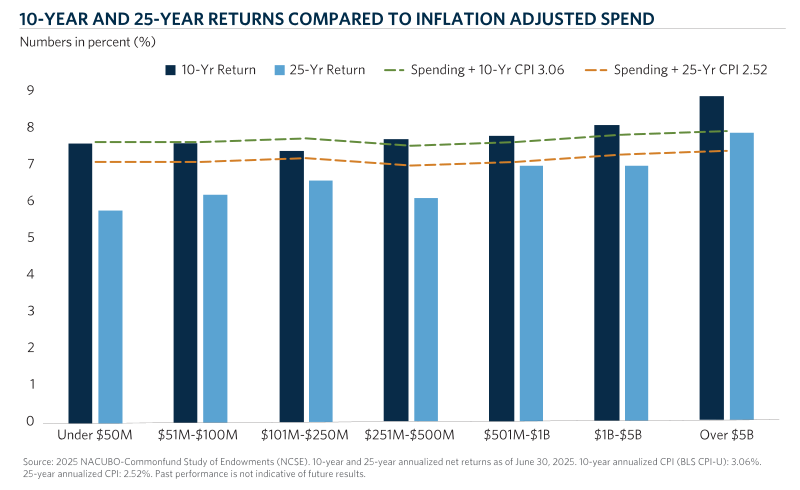
As seen in the chart below, endowments under $50 million reported a 10-year average annual net return of 7.5 percent and a 25-year average annual net return of 5.7 percent, against average spending rates of approximately 4.6 percent as of June 30, 2025. When long-term inflation of approximately 2.5–3.1 percent is added to spending rates, many smaller institutions face a meaningful gap between required total returns and actual performance. When using the Higher Education Price Index (HEPI) as a benchmark – which historically trends higher than CPI – the gap is even larger.
A key driver of this gap can be portfolio composition. Larger endowments have historically allocated a greater share of assets to private markets—private equity, private credit, venture capital, and real assets—and have benefited from the illiquidity premium those asset classes can provide. Smaller endowments, by contrast, tend to maintain higher concentrations in public equities and fixed income, limiting access to potential return enhancement over full market cycles. For example, FY2025 data shows that the largest endowments allocated 32 percent to private asset classes, compared with 3.4 percent for the smallest.
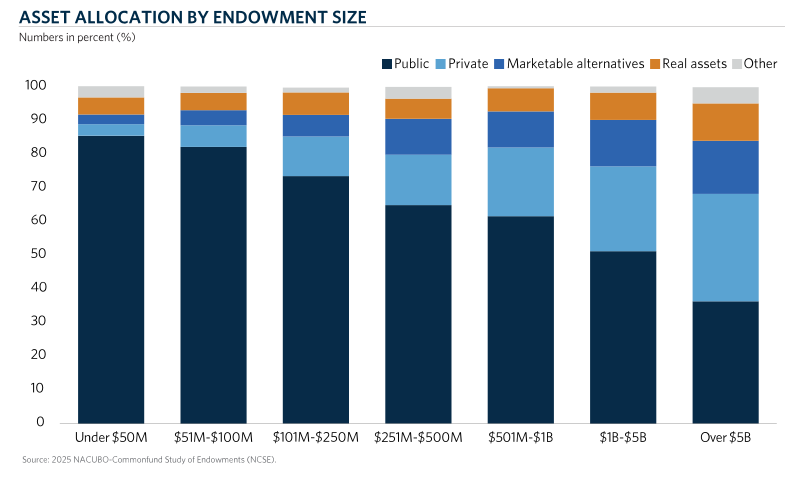
The 2025 Commonfund Study of Independent Schools and the 2024 Council on Foundations-Commonfund Study of Foundations document similar patterns: smaller institutions across these segments are systematically underweight private markets relative to their larger peers.
The Role of Private Capital in a Long-Term Portfolio
Private capital—encompassing private equity, private credit, venture capital, secondaries, and real assets—can serve multiple portfolio construction objectives:
- Enhanced long-term return potential through the illiquidity premium, which has historically ranged from approximately 2–4 percent over comparable public market equivalents, though returns are highly manager-dependent and not guaranteed.
- Diversification and reduced correlation to public equity markets over full market cycles.
- Income generation and inflation sensitivity through real assets and private credit.
- Reduced short-term mark-to-market volatility, which can support governance stability.
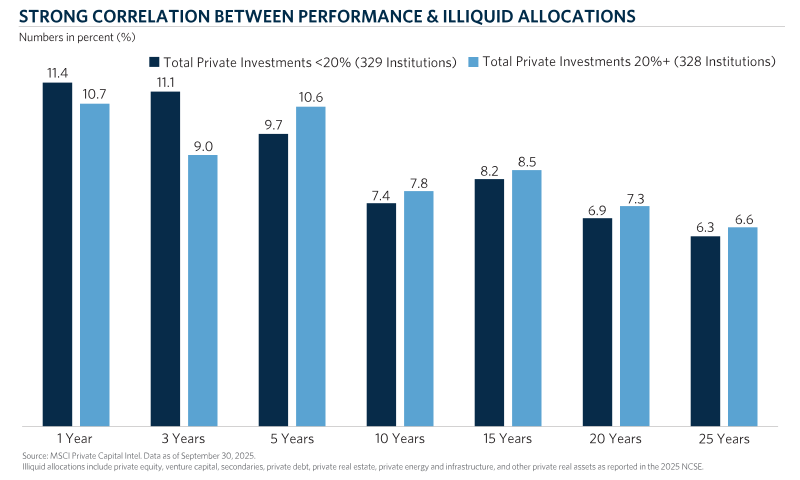
Even modest target allocations—typically in the range of 15–20 percent of the total portfolio—can provide meaningful benefits over time, provided the allocation is sized appropriately relative to each institution’s specific liquidity profile. Below, we highlight the excess return captured over the long run by institutions with over 20 percent allocation to private investments.
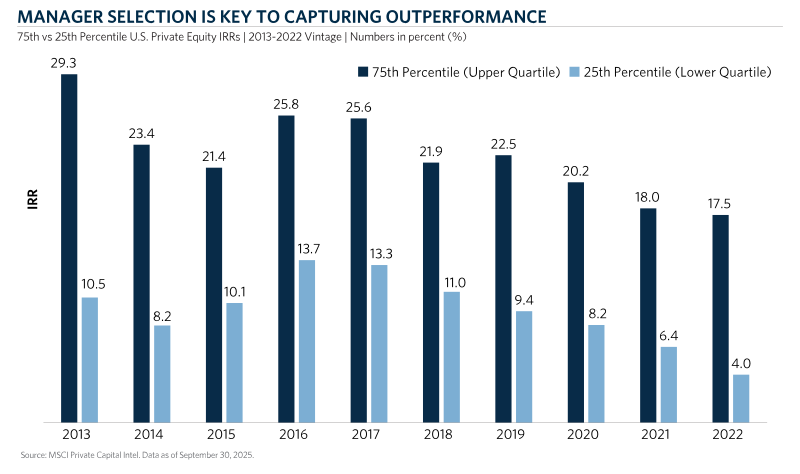
It is important to note that private market returns are highly dispersed. Top-quartile managers have historically generated a disproportionate share of total private market outperformance. Manager selection and consistent access to high-quality managers are therefore critical determinants of outcomes—a factor that meaningfully affects the implementation approach smaller institutions should consider. As the chart below illustrates, top-quartile managers delivered IRRs 10.9%–18.8% higher than bottom-quartile managers across 2013–2022 vintage years.
Determining the Optimal Allocation: Need, Ability, and Willingness
For all endowments and foundations evaluating private capital, we recommend working through three key questions. These assessments go beyond the portfolio size.
|
Need How much additional return do you require beyond what public markets are expected to deliver? Quantify the gap between your return target and forward-looking public market assumptions. |
Ability How much illiquidity can your institution realistically absorb? Assess spending requirements, cash reserves, and capital call obligations under stress scenarios. |
Willingness Does your board or investment committee have the conviction and patience to build a diversified, multi-vintage private program? Education and transparent reporting are essential. |
Need
Start by quantifying the gap between your long-term return target and forward-looking public market return expectations. If your spending policy, inflation assumptions, growth and fee drag collectively require a net return of, for example, 6.5–7.0 percent, and your public market portfolio is expected to deliver approximately 6.0 percent over the long run, the difference represents a quantifiable shortfall that private capital may help address.
Ability
An honest evaluation of spending requirements, cash reserves, gift flow patterns, and potential exposure to simultaneous market drawdown, elevated spending, and capital call activity. The goal of this stress-testing exercise is to determine what level of illiquidity the institution can absorb without becoming a forced seller of assets at inopportune times.
Willingness
Even where the need is clear and the ability is present, private capital requires genuine, sustained conviction from a board or investment committee. Building a diversified, multi-vintage private program typically takes seven to ten years. A committee that lacks full commitment increases the risk of inconsistent decision-making at precisely the wrong moments in the cycle. Education, transparent reporting, and a clearly articulated private markets philosophy are essential to building and sustaining that conviction over time.
Implementation Considerations for Smaller Institutions
Institutions commonly raise several valid concerns when evaluating private capital, including manager access, fee structures, operational complexity, internal resource and staffing constraints, and cash-flow management. These are legitimate considerations and addressing them thoughtfully is part of sound implementation.
Partnering with an outsourced provider can mitigate many of the challenges institutions face. Providers can deliver support across manager due diligence, fee negotiation, commitment pacing and cash-flow planning, operational and reporting infrastructure, and investment committee education — helping institutions build and sustain a private capital program with institutional-grade discipline.
Conclusion
Private capital is no longer an asset class accessible only to the largest institutional investors. For all endowments and foundations, it represents a strategic tool that can help bridge the gap between required spending rates and constrained public market return expectations.
The decision to allocate to private markets should be grounded in a rigorous assessment of need, ability, and willingness—with careful attention to manager selection, portfolio construction, and liquidity management. Implemented with discipline and appropriate governance, a private capital program can expand long-term growth opportunities and help institutions better support their missions.
To learn more about Commonfund’s approach to private capital for endowments and foundations, please fill in the form below.
Further Resources:
Insights on Private Equity and Market Trends
Private Markets Year in Review and 2026 Outlook
Mind the Gap: The Strategic Risk of Skipping a Vintage in Private Equity