Why 30-Year Treasury Yields Are at 2007 Highs — And What It Means for Your Portfolio

August 17, 2026 |
3 minute read
|
Why 30-Year Treasury Yields Are at 2007 Highs — And What It Means for Your Portfolio
6:50

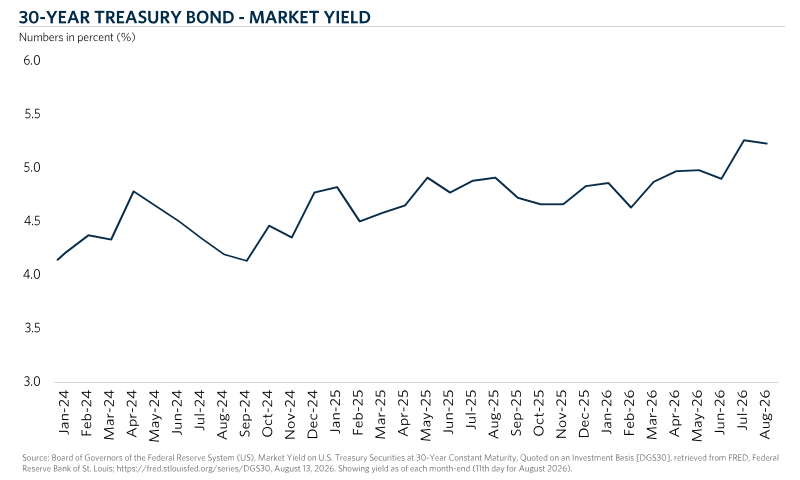
Amidst all the headlines of a new $500 billion financing partnership Nvidia struck with six of Wall Street’s largest investors to fund the buildout of AI infrastructure, the same borrowing wave is reshaping the bond market. The 30-year Treasury bond yield has now held above 5 percent for the longest stretch since 2007. A recent auction priced the 30-year at 5.058 percent, the highest auction yield since 2007.

The headline yield number underlines a broader trend of the 30-year bond’s yield, climbing about 1.2 percentage points since the Federal Reserve began cutting short-term rates in September 2024. This marks the largest increase during a Fed easing cycle since at least the 1980s. The central bank is easing the front end, and the long end is moving the other way, which suggests the bond market is pricing something structural.
CHT-30Yr-TreasuryBond

The Increasing Debt Burden

The Federal Reserve most directly impacts short-term interest rates, while long-term rates are more influenced by the market’s judgment regarding a variety of factors from inflation, government debt, and other risks playing out over decades. Only a modest part of the recent rise in long-term yields reflects higher inflation expectations, which remain broadly anchored. The five-year breakeven rate implied by Treasury Inflation-Protected Securities climbed above 2.5 percent earlier this year before easing back to roughly 2.2 percent, as the Iran-driven energy spike faded. 

However, the larger driver has been an increase in the term premium, representing the extra compensation investors demand for lending to the government over long-term periods. This term premium, as typically measured on the 10-year Treasury, has climbed from near zero before the Fed’s cuts to roughly 0.8 percentage points in 2026. This reflects concern about a widening federal deficit and a wave of Treasury issuance competing with a deluge of corporate borrowing to fund AI infrastructure. The five largest hyperscalers alone issued roughly $121 billion of bonds in 2025 and had already surpassed that with about $159 billion by mid-2026. This comes against a 2020-to-2024 average of just $28 billion per year. AI infrastructure investments have pushed mega-cap technology issuance to roughly 25 percent of the net Treasury coupon issuance absorbed by private investors, up from about 5 percent in 2025. 

Adding to these concerns is the rise in deficit-fueled borrowing by the United States government. Federal debt has climbed to roughly $38 trillion, with net interest expense reaching about $970 billion in fiscal year 2025. This was enough to surpass the roughly $917 billion spent on national defense, making debt service one of the largest single line items in the federal budget. There look to be no signs of this dynamic slowing down, as the Congressional Budget Office projects that these interest payments will cross $1 trillion in fiscal year 2026. Each additional increment of term premium the market demands feeds straight back into a wider deficit, potentially creating a hazardous spiral if the federal debt burden continues its current trajectory.

The Structural Case for Stickier Inflation

Despite the market’s current benign outlook, it is important to consider the factors that may keep long-term inflation above the Federal Reserve’s 2% target.

The decades-long globalization trend that gave the global economy abundant access to cheap goods and labor could now be reversing with the rising fragmentation of global trade. This is not surprising given increased American and global efforts to re-shore supply chains and critical infrastructure, particularly considering increased geopolitical volatility and national security concerns. The imposition of U.S. tariffs on global imports has further bolstered these trends, forcing the global economy to re-evaluate trade networks and partnerships.
Rising United States domestic defense spending and NATO commitments in a more multi-polar geopolitical environment are mostly deficit-funded claims on resources. These increased defense commitments come at a time when the investment capacity of governments around the world is limited due to their debt loads.
Another key variable is the transition to sustainable forms of energy generation. The build-out of renewable energy generation infrastructure is still in its early innings globally, requiring considerable amounts of capital. This comes in a landscape where artificial intelligence infrastructure has created surging power demand in the form of data centers, creating persistent need for raw materials, electrical equipment, and skilled labor, all inflationary in nature.

All of these make a return to the benign environment coming out of the 2008 Global Financial Crisis less likely. Productivity gains from artificial intelligence could be a genuine counterweight and offset part of the pressure. However, those benefits may not accrue as quickly to capital intensive industries requiring considerable manual labor as opposed to software-enabled workflows. 

Positioning for a Higher-Rate World

The Treasury market so far seems to be taking the view that the distribution of future outcomes has widened, therefore demanding to be paid for that uncertainty.

For long-term institutions, a meaningful tilt toward growth assets is among the most effective defenses against rising rates and potential inflation. Traditional fixed-rate bonds are exposed to steady erosion as prices rise, but productive growth assets across public and private markets can grow their earnings and cash flows over and above inflation, preserving real purchasing power.

On the contrary, higher yields have made fixed income genuinely investable again after a decade of depressed rates during the 2010s. However, capturing the full benefits of the opportunity calls for a cycle-aware strategy across both public and private credit. This requires a disciplined approach to managing duration when the term premium is rising and being selective on credit quality when high-yield spreads are historically tight. 

The multi-decade tailwind of falling rates that buoyed investment portfolios look less likely to make a resurgence. Building a portfolio for the future means owning the growth that can outrun inflation and fixed income that, at last, pays investors to be patient.


Haider Hassan

Author

Haider Hassan

Analyst

Disclaimer

Certain information contained herein has been obtained from or is based on third-party sources and, although believed to be reliable, has not been independently verified. Such information is as of the date indicated, if indicated, may not be complete, is subject to change and has not necessarily been updated. No representation or warranty, express or implied, is or will be given by The Common Fund for Nonprofit Organizations, any of its affiliates or any of its or their affiliates, trustees, directors, officers, employees or advisers (collectively referred to herein as “Commonfund”) or any other person as to the accuracy or completeness of the information in any third-party materials. Accordingly, Commonfund shall not be liable for any direct, indirect or consequential loss or damage suffered by any person as a result of relying on any statement in, or omission from, such third-party materials, and any such liability is expressly disclaimed.

All rights to the trademarks, copyrights, logos and other intellectual property listed herein belong to their respective owners and the use of such logos hereof does not imply an affiliation with, or endorsement by, the owners of such trademarks, copyrights, logos and other intellectual property.

To the extent views presented forecast market activity, they may be based on many factors in addition to those explicitly stated herein. Forecasts of experts inevitably differ. Views attributed to third-parties are presented to demonstrate the existence of points of view, not as a basis for recommendations or as investment advice. Market and investment views of third-parties presented herein do not necessarily reflect the views of Commonfund, any manager retained by Commonfund to manage any investments for Commonfund (each, a “Manager”) or any fund managed by any Commonfund entity (each, a “Fund”). Accordingly, the views presented herein may not be relied upon as an indication of trading intent on behalf of Commonfund, any Manager or any Fund.

Statements concerning Commonfund’s views of possible future outcomes in any investment asset class or market, or of possible future economic developments, are not intended, and should not be construed, as forecasts or predictions of the future investment performance of any Fund. Such statements are also not intended as recommendations by any Commonfund entity or any Commonfund employee to the recipient of the presentation. It is Commonfund’s policy that investment recommendations to its clients must be based on the investment objectives and risk tolerances of each individual client. All market outlook and similar statements are based upon information reasonably available as of the date of this presentation (unless an earlier date is stated with regard to particular information), and reasonably believed to be accurate by Commonfund. Commonfund disclaims any responsibility to provide the recipient of this presentation with updated or corrected information or statements. Past performance is not indicative of future results. For more information please refer to Important Disclosures.

Stay connected with the Insights Blog

Popular Blog Posts


Investment Strategy | Insights Blog

Determinants of Portfolio Returns – It Depends…

Asset allocation decisions have traditionally been associated with being the major determinant of portfolio returns. The Brinson, Hood, Beebower study of 19861 estimated that nearly 90 percent of...
Perspectives | Insights Blog

Study of Foundations - Key Highlights [Infographic] 2024

In this infographic, we report the key highlights from the 2024 Council on Foundations-Commonfund Study of Foundations. For the year ended December 31, 2024, participating foundations produced...
Governance And Policy | Insights Blog

Three Fundamental Duties of Nonprofit Boards

It is essential that trustees of endowed portfolios hold themselves accountable to a set of standards in order to maintain sound governance practices. Fiduciary duty is an important part of the...

Disclaimer

Certain information contained herein has been obtained from or is based on third-party sources and, although believed to be reliable, has not been independently verified. Such information is as of the date indicated, if indicated, may not be complete, is subject to change and has not necessarily been updated. No representation or warranty, express or implied, is or will be given by The Common Fund for Nonprofit Organizations, any of its affiliates or any of its or their affiliates, trustees, directors, officers, employees or advisers (collectively referred to herein as “Commonfund”) or any other person as to the accuracy or completeness of the information in any third-party materials. Accordingly, Commonfund shall not be liable for any direct, indirect or consequential loss or damage suffered by any person as a result of relying on any statement in, or omission from, such third-party materials, and any such liability is expressly disclaimed.

All rights to the trademarks, copyrights, logos and other intellectual property listed herein belong to their respective owners and the use of such logos hereof does not imply an affiliation with, or endorsement by, the owners of such trademarks, copyrights, logos and other intellectual property.

To the extent views presented forecast market activity, they may be based on many factors in addition to those explicitly stated herein. Forecasts of experts inevitably differ. Views attributed to third-parties are presented to demonstrate the existence of points of view, not as a basis for recommendations or as investment advice. Market and investment views of third-parties presented herein do not necessarily reflect the views of Commonfund, any manager retained by Commonfund to manage any investments for Commonfund (each, a “Manager”) or any fund managed by any Commonfund entity (each, a “Fund”). Accordingly, the views presented herein may not be relied upon as an indication of trading intent on behalf of Commonfund, any Manager or any Fund.

Statements concerning Commonfund’s views of possible future outcomes in any investment asset class or market, or of possible future economic developments, are not intended, and should not be construed, as forecasts or predictions of the future investment performance of any Fund. Such statements are also not intended as recommendations by any Commonfund entity or any Commonfund employee to the recipient of the presentation. It is Commonfund’s policy that investment recommendations to its clients must be based on the investment objectives and risk tolerances of each individual client. All market outlook and similar statements are based upon information reasonably available as of the date of this presentation (unless an earlier date is stated with regard to particular information), and reasonably believed to be accurate by Commonfund. Commonfund disclaims any responsibility to provide the recipient of this presentation with updated or corrected information or statements. Past performance is not indicative of future results. For more information please refer to Important Disclosures.