As we near the end of the performance reporting season for larger higher ed institutions this year, I am once again struck by the focus the media and others place on a single fiscal year return.
At least 60 colleges and universities have publicly reported returns for fiscal year 2025 (the twelve months ending June 30, 2025) and there is again relatively wide dispersion among endowments with returns ranging from mid-single digits to mid-double digits. We will have greater clarity on the drivers of that dispersion once the NACUBO-Commonfund Study of Endowments is released in early calendar year 2026, but it is likely that asset allocation and manager selection had something to do with it. For example, with public equities clocking another strong year (the MSCI All Country World Index, or “ACWI,” returned 16.2%), institutions with higher allocations to global stocks likely were at the upper end of the league table. As institutional investors review annual performance, it’s critical to understand not just the numbers, but how those numbers are calculated. This post explores why methodology matters—especially for private investments—and how it can shape perceptions and decisions.
We have known for decades that measuring private investments using Time-Weighted Return (TWR) calculations is not ideal but necessary to calculate a total portfolio return. TWR is commonly used for total portfolio reporting, but for private investments, Internal Rate of Return (IRR), Multiple of Invested Capital (MOIC), and Public Market Equivalent (PME) often provide a more accurate picture.
Putting that concept aside for a moment, though, there is another challenge when it comes to the timing of private investment returns. Because of the reality that reporting from private investments is often delayed, institutional investors with exposure to such investment are typically forced to do one of three things when calculating their total portfolio performance:
- Lag the returns by a quarter; take the quarterly returns from March-to-March and calculate the June annual return using those numbers (1-year March).
- Use only three quarters of returns; calculate the June annual return by taking the first three quarters’ actual returns and use 0% for the final quarter (3-quarter).
- Wait until the information is available and then calculate a June-to-June return (1-year June) which means those returns won’t be able to be calculated until well into the future (in this case mid-to-late fall).
To illustrate why this choice matters, we looked at the median returns from MSCI Private i® for venture capital and private equity for vintage year funds 2000-2025 and calculated TWR using all three methodologies.
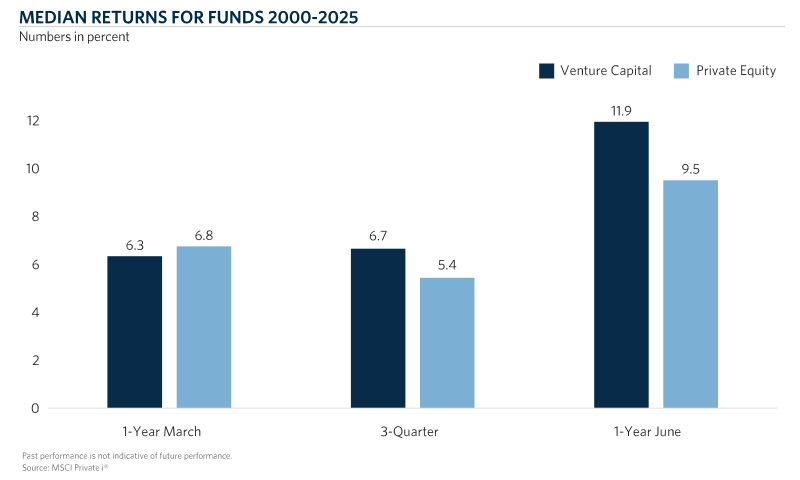
This data reveals that the return dispersion of the same investments calculated in different ways is meaningful for no other reason than the way they are calculated. When applied to a total portfolio, the different calculation methodologies could account for a difference of more than 100 basis points. For the sake of simplicity, we looked at a hypothetical 70/30 portfolio with 70% allocated to equities and 30% allocated to fixed income. The 70% in equities is comprised of 50% ACWI, 10% private equity, and 10% venture capital. The 30% in fixed income is comprised of the Bloomberg Aggregate Index.
| Calculation Methodology | Total Portfolio Annual Return |
| VC/PE calculated 1-year through March | 11.2% |
| VC/PE calculated 3-quarters through March | 11.1% |
| VC/PE calculated 1-year through June | 12.1% |
The natural conclusion of this analysis is that those institutions that waited for June numbers to calculate their private returns likely experienced higher returns from their privates than those institutions that either reported them on a lag (through March) or used the approach of a 0% return for the final quarter.
Of course, we also know that manager selection matters a great deal in private markets and we looked at the upper quartile, instead of median, returns in all three calculation scenarios. Bottom line - if you were able to wait for June numbers AND generate upper quartile returns, you saw pretty close to, if not ahead of, public market performance from your private equity and venture capital portfolios.
There are many reasons for those who manage or oversee the management of endowments to resist the short termism that has crept into so much of the information we receive and analyze, not the least of which is the reality that endowments are, by nature, structured for the long term. Before comparing your institution’s results to peers this year, and celebrating or bemoaning the results, add one more reason to the list: the way the numbers are counted really matters.
Resources:
- For a refresher on the difference between TWRs and IRRs, we published a primer many years ago that remains one of our most downloaded pieces of research today.
- For prior blogs on the challenges of evaluating one year returns please visit the following: