Why your governance needs stress-testing before the market does it for you
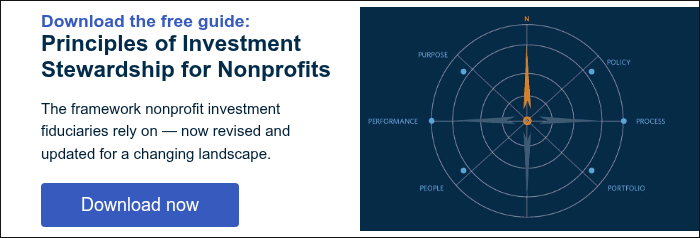
A Crisis Playbook is a road map: It guides a committee through how to respond when a crisis hits, lays out what questions to work through, what triggers call for escalation to the full board versus a committee-level decision, how and when to communicate with stakeholders. But a road map only gets an institution where it's going if the vehicle can actually stay on the road when conditions take a turn. That's what governance does. Commonfund Institute's Principles of Investment Stewardship for Nonprofit Organizations, the "6 Ps": Purpose, Policy, Process, Portfolio, People, and Performance, functions as the guardrails that keep an institution on the route a playbook lays out, precisely when the road ahead isn’t clear.
A playbook can be well-designed and still fail in practice if the governance supporting it isn't built to execute what the playbook calls for. Every investment committee has experienced a version of the same thing: governance practices that looked disciplined when returns were strong suddenly get tested the moment the market turns. It's not that the policy changed, it's that a down market reveals whether the guardrails were strong enough in the first place.
| In a Good Market | In a Down Market | The Governance Question to Ask | |
|---|---|---|---|
| Purpose | Mission and purpose referenced occasionally, typically in annual reviews. Strong returns give impression that purpose is being fulfilled by default. | Pressure mounts to cut distributions, draw down reserves, or deviate from mission-aligned spending to preserve capital. Purpose potentially sacrificed. | Can the committee articulate, in writing, what the endowment exists to do before a crisis — so that trade-off isn't decided in the moment, under pressure, by whoever is in the room? |
| Policy | The Investment Policy Statement (IPS) sits mostly unopened. Asset allocation targets are easy to hold because nothing is forcing a deviation. | Rebalancing bands get tested for real. Committees face pressure to abandon target allocations “just this once” or freeze private market commitments. | Does the IPS specify, in advance, what happens when allocations drift in a downturn — or is that decision being made for the first time under stress? |
| Process | Meetings follow a set schedule and cadence. Decisions are made with time to deliberate amongst committee members. Documentation is treated as a formality. | Decision-making time is compressed. Ad hoc calls and emergency meetings replace normal cadence. Documentation often gets thinner exactly when it matters most. | Is there a defined process for decisions made outside the regular meeting cycle — who can authorize what, and how is that documented after the fact? |
| Portfolio | Diversification benefits are easy to underappreciate when most asset classes are performing well. | Correlations often rise precisely when diversification is needed most, and illiquid private market positions can't be sold to fund distributions on a timeline that matches urgency. | Has the committee gone through scenario planning —specifically, modeling how the portfolio behaves in times of market decline and/or constrained liquidity? |
| People | Committee composition and manager relationships are rarely evaluated—stability is comfortable. | Turnover accelerates — trustees rotate off, staff leave, managers underperform and get scrutinized — right as institutional memory becomes most valuable. | Does the committee have a succession and onboarding plan for both trustees and key staff, or does expertise walk out the door exactly when it's needed? |
| Performance | Performance review consists mostly of celebrating strong absolute returns relative to a simple benchmark. | Performance review gets adversarial — the temptation is to fire managers or change strategy based on short-term results that may not reflect a manager's actual process or skill. | Does the committee have a written standard for evaluating a manager through a down period that is set before the down period, not invented during it? |
Why the comparison matters more than either column alone
Reading down either column is only half the exercise. The point of looking at them side by side is that most governance failures aren't failures of the "up market" behavior, they're failures to have decided, in advance, what the "down market" behavior should be. A committee that only ever discusses Purpose, Policy, and Process when things are going well has, in effect, deferred the hardest governance decisions to the exact moment they'll be hardest to make: under time constraints, with incomplete information, and with real financial consequences riding on the outcome.
The committees that navigate a down cycle with the least disruption are rarely the ones with the best market call. They're the ones who had already answered the right-hand column's questions in writing, before they needed the answers. In road-map terms: they didn't just have the route planned. They'd checked that the guardrails were installed along it.
Using the guardrails to test the road map
If your institution has already worked through Crisis Playbook guidelines, this table serves as a safety check underneath the response your committee formulates. Commonfund's Crisis Playbook framework offers guidelines for thinking through two distinct kinds of crises: a market event that erodes portfolio value, and an organization-specific event, like a decline in a key revenue source, tuition being the clearest example in higher education, with the hardest scenarios being the ones where both occur together and reinforce each other. The committee's job is to use those guidelines to formulate its own response, suited to its own institution.
The framework also offers guidelines for how to think through a crisis and the questions your committee should be answering, the kinds of triggers worth watching for, considerations around timing and communications. The 6 Ps table above answers a prior question: are the committee's governance practices and policies actually built to carry out the response it formulates? This is the practical test of the road map and guardrails: a committee that plans to make rapid, well-documented decisions under Process, or that counts on a stable, informed group under People, is only as prepared as the governance underneath those assumptions actually is.
Simply, that means the two exercises should be used together rather than sequentially. When a committee reviews Crisis Playbook guidelines and works through how it would respond to a given scenario, the down-market column of this table is a useful check. For each type of crisis the guidelines raise, does the committee's Purpose, Policy, Process, Portfolio, People, and Performance framework actually support the response it has in mind, or does that response quietly assume a level of governance readiness that hasn't actually been tested?
The guardrails need Progression too
Commonfund Institute has proposed a seventh principle to sit alongside the original 6 Ps: Progression — the discipline of proactively evolving each principle as the landscape changes, rather than treating governance as a structure to check off once and leave in place. The idea applies directly to the guardrail metaphor here. The road doesn't stay the same forever. A guardrail built for one kind of curve, like a liquidity freeze, doesn't automatically protect against a different kind, like a rapid drawdown or funding cut. A committee that built strong governance around the risks most visible five years ago may find those same guardrails are already out of date, not because the committee failed, but because the road has moved since they were installed.
Under this framing, the down-market self-assessment above isn't a one-time exercise, it's a recurring one. It's worth revisiting not only after a downturn, but on a fixed schedule, alongside review of the Investment Policy Statement itself, asking the same six questions again: not "did we answer this once," but "is our answer to this still the right one for the institution and the environment it operates in now." Purpose may need reassessing as mission evolves. Policy may need updating as new strategies, like impact investing, become mainstream. People may need refreshing as committee composition and staff turnover. Progression is what keeps the Ps from quietly calcifying into guardrails for a road the institution no longer travels.
A practical next step
None of this works as a one-time reading exercise. Used as a self-assessment the table gives each "P" a concrete test: can the committee point to a specific document, policy, or prior decision that answers the down-market question, or would the answer be improvised for the first time if markets turned tomorrow?
A Crisis Playbook and a set of governance principles are often treated as two separate exercises, filed under different tabs and revisited on different schedules. Read together, they're a single question asked twice: does the institution know what it will do, and can it actually do it? Committees that can answer both halves with confidence are the ones least likely to be surprised by which one gives way first.