Endowment Management: Building a Portfolio for Generations

November 5, 2026 |
3 minute read
|
Endowment Management: Building a Portfolio for Generations -Commonfund
6:26

Portfolio | Principle IV | Commonfund Institute | Principles of Investment Stewardship

Constructing and overseeing an investment portfolio is, as the Principles brochure puts it, the nucleus around which endowment management revolves. Everything else in the governance framework — purpose, policy, process, people, and performance — ultimately connects back to this: are the assets positioned to sustain the institution's mission over the long term?

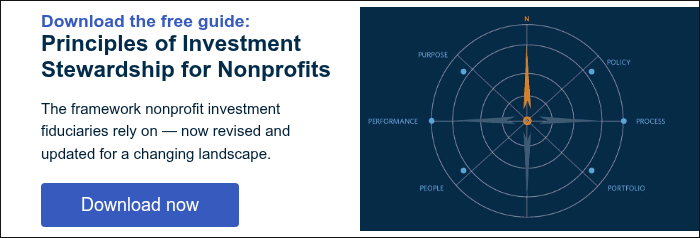
Principle IV in Commonfund Institute's Principles of Investment Stewardship for Nonprofit Organizations whitepaper addresses Portfolio, and it covers more terrain than most investment committees visit in any single year.

Asset Allocation: Still the Most Consequential Decision

A landmark study attributed more than 90 percent of the variability of investment return not to manager selection or market timing, but to asset allocation. Despite the frequency with which this finding is cited, many institutions treat asset allocation as a settled question — something reviewed in depth when the IPS was drafted and adjusted only at the margins since.

The Principles whitepaper frames asset allocation not as a one-time decision but as a recurring governance responsibility. The investment committee should review the policy portfolio at every meeting — not necessarily to make changes, but to assess whether actual allocations have drifted from targets and whether the policy itself still reflects current risk tolerance, return objectives, and institutional circumstances.

The Endowment Model: Still Relevant, Newly Tested

Academic institutions shaped what is now called the endowment model, whose key tenets include a bias toward equities, exploitation of market inefficiencies through active management, and substantial commitments to illiquid or semi-liquid alternative strategies. For many nonprofits today, the largest single allocation is to alternative investment strategies — private capital, real assets, and marketable alternatives.

The current environment has tested some of the endowment model's assumptions. The return to a higher-rate environment has reshuffled the relative attractiveness of asset classes. Inflation — particularly as measured by Commonfund's Higher Education Price Index® (HEPI) for educational institutions — has made return targets that support intergenerational equity more challenging to achieve. Geopolitical uncertainty has introduced portfolio risks that are difficult to model and not well-captured by historical distributions.

None of this suggests abandoning the endowment model. It does suggest revisiting how it is implemented for your institution's specific circumstances.

Mission-Aligned Investing: Beyond the Policy Statement

Terms such as responsible investing, ESG (Environmental, Social, and Governance), and mission-aligned investing have moved from the margins to the mainstream of institutional investment management. The Principles whitepaper is clear that this is not a passing trend: at minimum, institutions should understand what these approaches mean in the context of their specific mission, stakeholder relationships, and fiduciary obligations.

Mission-aligned investing is not one-size-fits-all. Some institutions have integrated it deeply into manager selection and due diligence. Others have developed formal policy positions without yet implementing them consistently. Still others are earlier in the process. The Principles whitepaper offers a framework for thinking through where your institution sits — and what a more deliberate approach might look like.

Costs and AI: Two Areas Committees Don't Discuss Often Enough

Two areas of portfolio management that tend to receive less committee attention than they warrant: costs and emerging technology.

On costs: portfolio construction and management costs, activity-related fees, fund servicing costs, and investment oversight costs all compound against long-term performance. Evaluating performance net of all fees is a sound discipline that keeps the focus on bottom-line results.

On AI and machine learning: artificial intelligence is transforming investment management at every level — from portfolio construction and manager selection to risk management and reporting. Investment committees need not be technical experts, but they should be conversant enough to ask informed questions of their investment managers and advisors about how these tools are being employed and what risks they introduce.

Stress Testing: A Discipline, Not an Exercise

The Principles whitepaper is direct on stress testing: institutions should model their portfolios against adverse scenarios regularly, including:

  • A sustained equity bear market of 30 to 40 percent followed by a slow recovery
  • A prolonged inflationary environment where HEPI exceeds 5 percent annually
  • A scenario in which new gifts to the endowment decline meaningfully for five or more years
  • Combination shocks — simultaneous market decline and institutional revenue disruption

This is not a once-per-cycle exercise. It is an ongoing governance discipline, and the institutions that do it well are better positioned to hold their allocation plan through difficult periods rather than being forced into reactive adjustments.

Progression and Portfolio

Portfolio management is never static. Progression encourages ongoing evaluation of strategic policies, asset allocation, and diversification strategies. New leadership or changes in governance may introduce fresh ideas for enhancing portfolio outcomes.

Whether through a more deliberate approach to mission-aligned investing, exploration of impact strategies, or the adoption of AI-driven analytics, an institution committed to Progression continually reassesses how its portfolio can better serve long-term goals and align with mission. Periodic stress testing against scenarios such as enrollment decline, pandemic-level disruptions, or sustained inflationary environments is a hallmark of institutions that are building for the future, not just managing the present.

The series: Purpose · Policy · Process · Portfolio · People · Performance · Progression
 

Commonfund Institute

Author

Commonfund Institute

Disclaimer

Certain information contained herein has been obtained from or is based on third-party sources and, although believed to be reliable, has not been independently verified. Such information is as of the date indicated, if indicated, may not be complete, is subject to change and has not necessarily been updated. No representation or warranty, express or implied, is or will be given by The Common Fund for Nonprofit Organizations, any of its affiliates or any of its or their affiliates, trustees, directors, officers, employees or advisers (collectively referred to herein as “Commonfund”) or any other person as to the accuracy or completeness of the information in any third-party materials. Accordingly, Commonfund shall not be liable for any direct, indirect or consequential loss or damage suffered by any person as a result of relying on any statement in, or omission from, such third-party materials, and any such liability is expressly disclaimed.

All rights to the trademarks, copyrights, logos and other intellectual property listed herein belong to their respective owners and the use of such logos hereof does not imply an affiliation with, or endorsement by, the owners of such trademarks, copyrights, logos and other intellectual property.

To the extent views presented forecast market activity, they may be based on many factors in addition to those explicitly stated herein. Forecasts of experts inevitably differ. Views attributed to third-parties are presented to demonstrate the existence of points of view, not as a basis for recommendations or as investment advice. Market and investment views of third-parties presented herein do not necessarily reflect the views of Commonfund, any manager retained by Commonfund to manage any investments for Commonfund (each, a “Manager”) or any fund managed by any Commonfund entity (each, a “Fund”). Accordingly, the views presented herein may not be relied upon as an indication of trading intent on behalf of Commonfund, any Manager or any Fund.

Statements concerning Commonfund’s views of possible future outcomes in any investment asset class or market, or of possible future economic developments, are not intended, and should not be construed, as forecasts or predictions of the future investment performance of any Fund. Such statements are also not intended as recommendations by any Commonfund entity or any Commonfund employee to the recipient of the presentation. It is Commonfund’s policy that investment recommendations to its clients must be based on the investment objectives and risk tolerances of each individual client. All market outlook and similar statements are based upon information reasonably available as of the date of this presentation (unless an earlier date is stated with regard to particular information), and reasonably believed to be accurate by Commonfund. Commonfund disclaims any responsibility to provide the recipient of this presentation with updated or corrected information or statements. Past performance is not indicative of future results. For more information please refer to Important Disclosures.

Stay connected with the Insights Blog

Popular Blog Posts


Investment Strategy | Insights Blog

Determinants of Portfolio Returns – It Depends…

Asset allocation decisions have traditionally been associated with being the major determinant of portfolio returns. The Brinson, Hood, Beebower study of 19861 estimated that nearly 90 percent of...
Governance And Policy | Insights Blog

Three Fundamental Duties of Nonprofit Boards

It is essential that trustees of endowed portfolios hold themselves accountable to a set of standards in order to maintain sound governance practices. Fiduciary duty is an important part of the...
Market Commentary | Insights Blog

The New Era of Market Concentration

Market concentration has become a key theme, with the top 10 companies constituting more than 40 percent of the S&P 500 Index by market capitalization. This comfortably surpasses market concentration...

Disclaimer

Certain information contained herein has been obtained from or is based on third-party sources and, although believed to be reliable, has not been independently verified. Such information is as of the date indicated, if indicated, may not be complete, is subject to change and has not necessarily been updated. No representation or warranty, express or implied, is or will be given by The Common Fund for Nonprofit Organizations, any of its affiliates or any of its or their affiliates, trustees, directors, officers, employees or advisers (collectively referred to herein as “Commonfund”) or any other person as to the accuracy or completeness of the information in any third-party materials. Accordingly, Commonfund shall not be liable for any direct, indirect or consequential loss or damage suffered by any person as a result of relying on any statement in, or omission from, such third-party materials, and any such liability is expressly disclaimed.

All rights to the trademarks, copyrights, logos and other intellectual property listed herein belong to their respective owners and the use of such logos hereof does not imply an affiliation with, or endorsement by, the owners of such trademarks, copyrights, logos and other intellectual property.

To the extent views presented forecast market activity, they may be based on many factors in addition to those explicitly stated herein. Forecasts of experts inevitably differ. Views attributed to third-parties are presented to demonstrate the existence of points of view, not as a basis for recommendations or as investment advice. Market and investment views of third-parties presented herein do not necessarily reflect the views of Commonfund, any manager retained by Commonfund to manage any investments for Commonfund (each, a “Manager”) or any fund managed by any Commonfund entity (each, a “Fund”). Accordingly, the views presented herein may not be relied upon as an indication of trading intent on behalf of Commonfund, any Manager or any Fund.

Statements concerning Commonfund’s views of possible future outcomes in any investment asset class or market, or of possible future economic developments, are not intended, and should not be construed, as forecasts or predictions of the future investment performance of any Fund. Such statements are also not intended as recommendations by any Commonfund entity or any Commonfund employee to the recipient of the presentation. It is Commonfund’s policy that investment recommendations to its clients must be based on the investment objectives and risk tolerances of each individual client. All market outlook and similar statements are based upon information reasonably available as of the date of this presentation (unless an earlier date is stated with regard to particular information), and reasonably believed to be accurate by Commonfund. Commonfund disclaims any responsibility to provide the recipient of this presentation with updated or corrected information or statements. Past performance is not indicative of future results. For more information please refer to Important Disclosures.