As private markets mature and liquidity needs evolve, secondaries have moved from an opportunistic trade to a standing allocation and an important portfolio construction tool for many institutional investors. In this article, we examine what secondaries are and three ways they can be used within a portfolio.
Private market secondaries involve purchases of pre-existing interests in private vehicles, or in the underlying assets they hold, before the original fund reaches its natural end. Two structures dominate the market.
- In a Limited Partner ("LP”)-led transaction, an existing limited partner sells a fund stake (or a portfolio of stakes) to a new buyer. The general partner consents to the transfer, but the fund itself is unchanged.
- In a General Partner (“GP”)-led transaction, the general partner moves one or more portfolio assets into a new vehicle, typically called a continuation fund. Existing LPs choose between cashing out at a defined price or rolling their exposure into the new vehicle alongside fresh capital from incoming investors.
What was once a niche cleanup tool for over-allocated investors has become one of the most strategically important segments of private markets. Global secondary volume reached an estimated record of $240 billion in 2025, up roughly 48 percent year over year, with LP-led and GP-led activity now roughly equal in volume.1 As of June 30, 2026, dedicated capital sat at $290 billion according to Jefferies2, and Lazard projects market volumes could reach over $300 billion annually as early as 2027.3
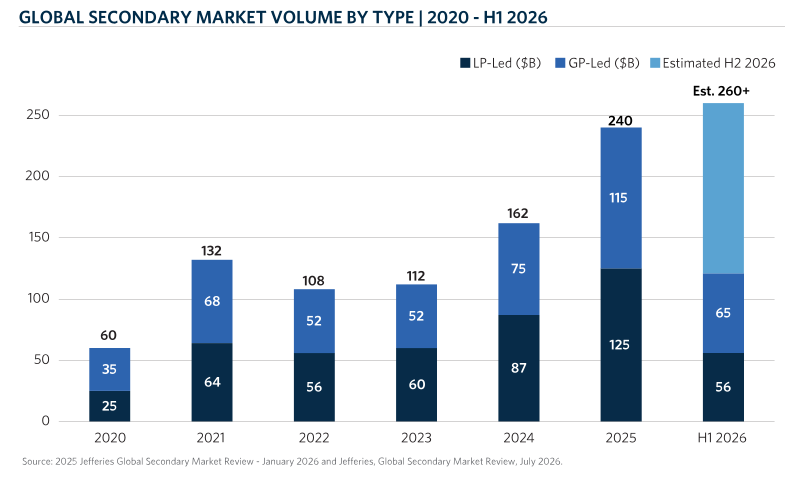
This growth reflects a structural shift in the private markets and no longer a passing cycle. With roughly 30,000 private portfolio companies globally awaiting exit and an estimated $3.7 trillion in unrealized value sitting behind a slower IPO and M&A market,4 secondaries have moved from being an optional liquidity outlet to a core portfolio management tool. Below we discuss three ways investors can potentially benefit from using LP secondaries as a portfolio management tool.
1. Ramping up private markets exposure
For investors building or expanding private market allocations, secondaries can solve one of the most stubborn problems in the asset class: time. A primary fund commitment typically takes three to five years to deploy capital and another five to seven years before meaningful distributions begin. For investors who desire exposure today, whether due to an under-allocated portfolio, a recent inflow, or a strategic shift in policy, secondaries can collapse that timeline dramatically.
The mechanism is straightforward. By acquiring stakes in funds that are already five to seven years old (the weighted average age of a fund stake sold in 2025 and H1 2026 was approximately seven years),2 buyers step into portfolios where capital is largely deployed and assets are approaching exit. The traditional J-curve, the period when fees and unrealized losses depress returns before value creation takes hold, is typically mitigated, though not removed. This effect tends to be more pronounced as discounts are often steeper in secondaries funds that focus on the LP-led tail-end segment of the market. Tail-end secondaries refer to transactions involving private equity funds that are typically at least 10 years old but still hold unrealized assets that haven't been fully exited. Distributions generally begin sooner, and tend to be more frequent with LP-led focused funds, and the internal rate of return (IRR) profile potentially increases.
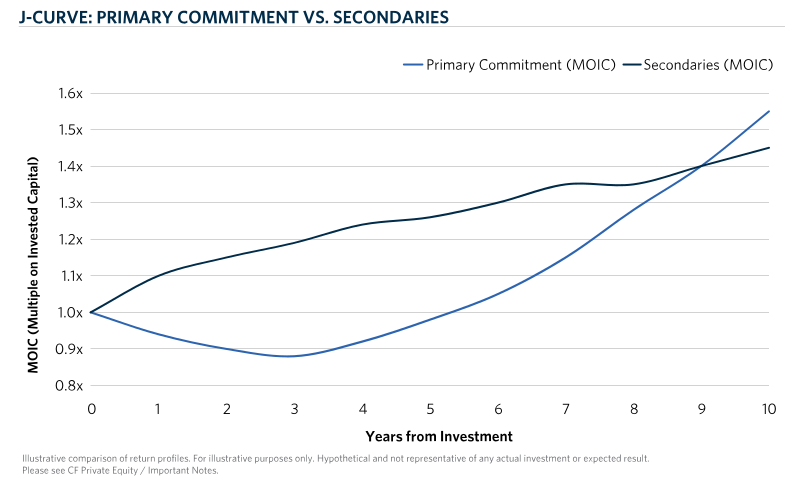
Speed of deployment is only half of the story. Vintage year diversification matters meaningfully in private markets because outcomes vary significantly by entry year, even within the same strategy and geography. A 2007 buyout fund and a 2010 buyout fund delivered different results despite having identical mandates. The challenge for investors building exposure through primary commitments is that vintage year diversification is built one fund at a time, often spanning many years. A single LP-led secondary purchase, by contrast, can include dozens of funds spread across multiple vintages, geographies, and sectors. New programs can achieve immediate diversification across vintage years, geographies, and sectors in one transaction that would otherwise potentially require multiple years of disciplined pacing.
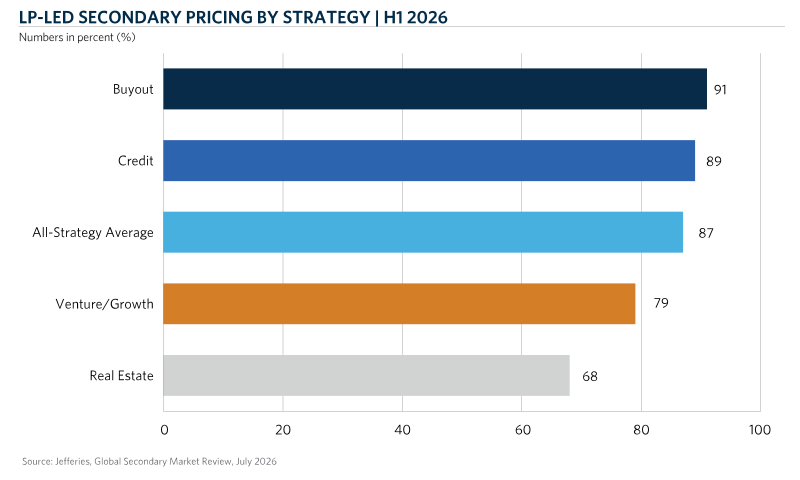
Secondaries can also enable investors to enter at known prices on known assets. Most secondary buyers underwrite identifiable portfolio companies with audited operating histories and visible paths to exit, rather than committing to a blind pool strategy. In the first half of 2026, the average price for purchasing LP stakes was roughly 87 percent of NAV, with buyout portfolios trading near 91 percent and credit stakes at 89 percent of NAV2. Aggregate pricing data also masks meaningful dispersion underneath. Headline averages are heavily influenced by large, broadly marketed deals that attract competitive bidding from the major secondaries funds.5 Smaller transactions have historically cleared at deeper discounts as many buyers have moved up market, leaving fewer buyers to participate in less efficient processes with a larger number of sellers. Similarly, transfers that GPs restrict, whether by limiting the buyer list to existing investors or by exercising tight discretion over new LPs, are inherently less competitive, and, as a result, tend to price at deeper discounts. For buyers with the relationships and underwriting capacity to access these less-trafficked corners of the market, the available entry points can be considerably more attractive than headline figures suggest.5 The combined result is typically mature, vintage-diversified exposure at potentially attractive entry points, with a level of underwriting transparency that primary commitments rarely offer.
For new programs, this combination matters. Secondaries can be the tool that helps accelerate an investor from zero to substantially invested in two to three years rather than five to ten years.
2. Liquidity management and portfolio management
Closed-end private funds were never designed to be liquid, but circumstances and investors’ needs have changed. Strategic allocation targets drift, denominator effects emerge during public market drawdowns, CIO transitions trigger fresh strategic reviews, and corporate or family liquidity events arrive on their own schedule. Roughly 40 percent of public pension plans were overallocated to private equity entering 2025,6 and the secondaries market provided a structured way to act.
For sellers, that means the ability to trim, reweight, or exit manager relationships without waiting a decade for natural fund wind-down. For institutions considering investing in secondaries funds focused on the LP market, secondaries can provide investors the ability to rebalance portfolios closer to strategic targets, invest tactically, and fund large allocation shifts in a more diversified and efficient way.
The cash efficiency advantage
Beyond liquidity, secondaries funds are structurally more cash-efficient than primary commitments, in three ways:
- First, they can reduce the drag from uncalled capital. Primary funds typically call capital over five years, forcing LPs to hold liquid reserves earmarked for those calls. Secondaries funds focused on LP-led transactions typically call capital over a three-year period and invest in LP interests that are generally funded and have visibility to underlying portfolio companies. Similarly, GP-led focused funds are funded largely upfront on already-deployed assets. Typically, in both scenarios if an investor does not invest its uncalled commitment there is less capital sitting idle in anticipation of future capital calls.
- Second, secondaries funds can generate a quicker velocity of distribution per unit of time invested. Secondaries funds generally purchase interests at later stages, where capital is at work for fewer years before producing returns. The same dollar may generate meaningful gains over a shorter holding period. The Internal Rate of Return (“IRR”) which is the annualized rate of return that accounts for both the size and timing of cash inflows and outflows compounds favorably even when absolute multiples may be similar to primary commitments.
- Third, secondaries funds can benefit from the recycling of distributions. Specifically, funds that invest in mature secondary positions like tail-end LP interests might begin to receive capital almost immediately, freeing dollars to be reinvested into new commitments, additional secondary opportunities, or other portfolio needs. Additionally, secondaries funds that focus on the tail-end segment of the market tend to have a quicker path to Distributions to Paid-in Capital (“DPI”) to investors.
Taken together, these three effects mean a dollar allocated to secondaries funds may work faster and more efficiently than the same dollar committed to a primary fund. For investors who measure success in cash returned rather than multiple alone, the difference compounds meaningfully across a multi-fund program.
3. Diversification and concentration: two complementary tools
The most underappreciated feature of the secondaries market is that it can serve two opposite needs at once. The same investment that delivers diversification through LP-led portfolio purchases also can deliver concentration through GP-led continuation vehicles. Sophisticated investors tend to use both intentionally.
LP-led: broad diversification across managers, sectors, and geographies
While vintage diversification is one core benefit, LP-led secondaries also generally deliver diversification across the dimensions investors typically struggle to achieve through primaries alone: manager rosters, sector exposures, and geographic mix. Building broad manager diversification through primaries is slow and may be limited by access to closed or oversubscribed funds. A single LP portfolio secondary purchase can deliver exposure to dozens of managers in one transaction, including names that might otherwise be unavailable as stated earlier. The same is true for sector and geographic spread. For investors rebalancing an existing portfolio, smoothing pacing risk, or seeking to add manager diversification, LP-led deals often are the most efficient route. A well-constructed secondaries fund that focuses on LP interests can provide exposure to well over 1,000 underlying companies—offering a level of diversification that a primary-only private markets program takes many years to achieve.
GP-led: concentrated, high-conviction exposure
At the opposite end of the spectrum, GP-led secondaries offer more concentrated exposure. A GP identifies one or several "trophy" assets, meaning those it considers having further upside or simply too good to sell into a soft exit market, and moves them into a new Continuation Vehicle (“CV”) with fresh capital and an extended hold period. Existing LPs can either cash out or stay in, new LPs step in, and the GP stays aligned, often rolling 100 percent of available proceeds into the new structure.
General Partners may also offer tail-end multi-asset continuation vehicles (“MACVs”), which bundle a fund's remaining assets that they are unable to monetize near the end of a fund’s lifecycle.
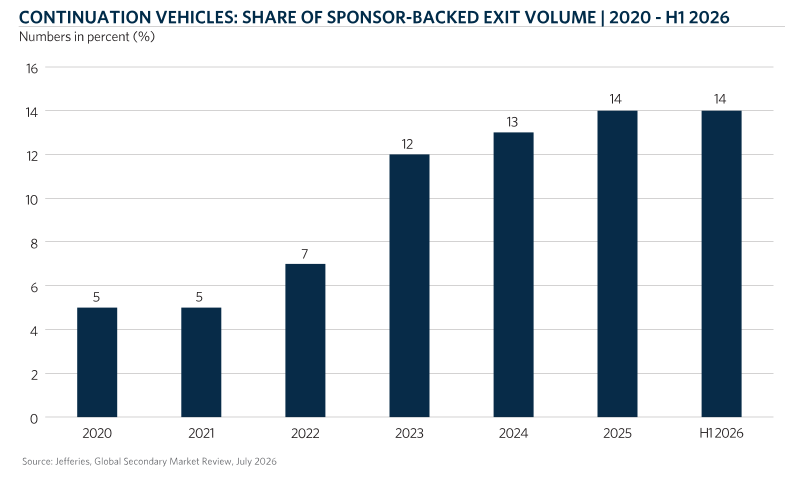
Today the data increasingly shows the market has shifted toward extending the life of “trophy” assets, which argues against CVs being used only as a clean-up tool. However, CVs remain a real motivation for a subset of deals, particularly older, harder-to-monetize fund tails.
The GP-led market has matured rapidly. In H1 2026, single-asset continuation vehicles accounted for 68 percent of GP-led volume, and 82 percent of the top 100 sponsors by AUM had completed at least one CV transaction.2 For investors, this offers something unusual in private markets: pre-selected, fully diligenced exposure to specific named companies, with the GP that knows them best already in place. This structure aligns much more closely to a co-investment fund than to traditional fund investing. Funds that focus on GP-led secondaries tend to offer a more concentrated portfolio compared to secondaries funds focused on LP transactions.
Using both intentionally
The two tools are not substitutes; they are complements. Funds that are focused on LP-led secondaries can provide breadth, dampen idiosyncratic manager risk, and form the core of a mature private markets program, while GP-led CVs and GP-led funds can provide depth and allow for conviction-weighted positions in specific companies. That concentration cuts both ways: it raises the potential contribution from a single asset and equally raises the potential impact of a single disappointing outcome. Investors who use only one of the two tools may forgo structural advantages available from the other.
Why secondaries merit consideration as a standing allocation
The case for treating secondaries as a standing allocation, rather than an opportunistic trade, rests on three points:
- First, the growth of the market has put secondaries on closer or more equal footing with primary buyouts and venture in scale, capital availability, and operational sophistication. This is no longer a tactical opportunity that disappears when conditions improve.
- Second, the structural drivers behind that growth, including slower exit markets, expanding private markets’ AUM, and broad adoption of continuation vehicles by blue-chip GPs, are more durable rather than cyclical. Even as IPO and M&A activity recovers, the logic of using secondaries or secondaries funds for portfolio construction and management remains intact.
- Third, secondaries are uniquely flexible. The same investment can accelerate the ramp up into private markets with built-in vintage diversification, manage liquidity with structurally better cash efficiency, and deliver both broad diversification and concentrated high-conviction exposure. LP-led focused secondaries funds tend to exhibit a more diversified, J-curve-mitigated risk-return profile through broad multi-manager, multi-vintage exposure at a discount to NAV, whereas GP-led focused secondaries and funds are more concentrated by design and may offer higher return potential but with less diversification benefit and a much greater reliance on manager/asset-specific outcomes.
Whether an investor is an endowment building a 30-year private program, a wealth manager constructing private markets exposure for clients, or an individual entering private markets for the first time, secondaries have moved from a satellite holding toward a core portfolio tool. For investors whose objectives, time horizon, and liquidity needs align, they can be an efficient way to build, maintain, and rebalance private market exposure. Suitability will vary by investor, and any allocation should be sized in the context of an overall portfolio and risk tolerance.
Footnotes
-
Jefferies, 2025 Global Secondary Market Review, February 2026 ($240 billion).
-
Jefferies, Global Secondary Market Review, July 2026
-
Lazard, Secondary Market Report 2025, February 2026;
-
J.P. Morgan, Private Market Secondaries Are Booming Amid an IPO Slowdown, April 2026, citing UBS Securities Services data.
-
Ethan Levine, What Factors Influence Pricing in the LP-led Secondaries Market?, Commonfund, February 17, 2026. Available at: https://www.commonfund.org/cf-private-equity/what-factors-influence-pricing-in-the-lp-led-secondaries-market.
-
Preqin, Secondaries in 2025, April 2025 Investor Survey data.