Drawn from the 2025 Council on Foundations–Commonfund Study of Investment of Endowments for Private and Community Foundations® (CCSF) | Calendar Year 2025
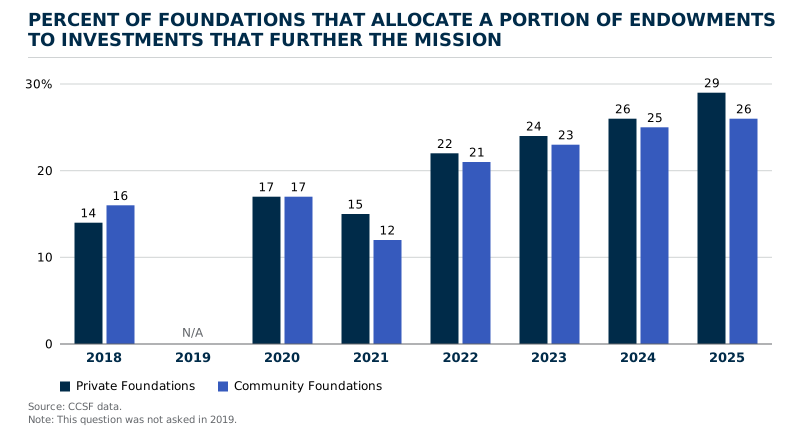
Interest in aligning investment portfolios with mission has been building among private and community foundations for years, and the CCSF's own data trace that arc. When the Study began asking questions related to responsible investing, 14 percent of participating private foundations and 16 percent of community foundations reported allocating a portion of the endowment to investments that further their mission (or, “impact,” for short in this Viewpoint). As of the latest 2025 data, those figures rose to 29 percent and 26 percent of private and community foundations, respectively.
Rates of affirmative responses were consistently high across size/type categories, with 28-32 percent of all cohorts responding that they allocate in this way, with the one exception of the smallest community foundations (21 percent). This shows that foundations of every size and type are increasingly asking a version of the same question: if our mission drives our grantmaking, why shouldn't it also inform how we invest the capital that funds that mission?
What Impact Investing Actually Is
Commonfund draws a useful distinction between the broader universe of “mission-aligned” or “responsible” investing—screening, divestment, shareholder advocacy, diverse-manager allocation—and impact investing itself: thematic investing that pursues financial and social goals at once, guided by an explicit thesis about the intended outcome alongside a genuine business case for the capital deployed. The Global Impact Investing Network (GIIN) defines it similarly: investing made with the intention to generate measurable, positive impact alongside a financial return.¹ The key word in both is intentional—a deliberate strategy with a thesis and a way to measure whether it's being realized.
Impact investing is also not confined to one corner of the portfolio. Market data show capital deployed across public equities and fixed income, private equity and venture capital, private credit, and real assets like affordable housing and renewable infrastructure.² That breadth matters for a foundation applying the endowment model: impact strategies can be layered into an already diversified allocation rather than requiring a separate “impact bucket,” with the same discipline around risk, liquidity, and return extended to all investments.
Why Foundations Are Drawn to It
For a foundation, this speaks to institutional coherence. Grantmaking is one channel through which a foundation pursues its mission; the endowment—typically many multiples the size of the annual grant budget—is another, often larger, one. A foundation funding housing stability through its grants while its endowment sits invested with no attention to how capital is deployed is leaving one of its two largest levers for impact untouched.
Commonfund’s view is that every investment has consequences, and the task for a fiduciary is not to scrutinize impact investments more intensely than traditional ones, but to bring the same intentionality to the whole portfolio.³ Fiduciary duty at a mission-driven institution is not solely about maximizing return in isolation—it is about serving the purpose the institution exists to serve. Approached this way, impact investing is an extension of the institutional logic that already governs the foundation's grantmaking.
Top of Mind: Where Impact Investing Ranks Among Foundation Concerns
Impact investing has been near the top of the list of concerns cited by participants in the Study since the question was first asked in 2023, when “impact investing considerations” was the 3rd and 4th most cited top concern among community and private foundations, respectively. Those rankings gave way slightly over the past two years to more imminent concerns such as potential policy changes (e.g. tax rules, donor-advised fund (DAF) regulations) and inflation. However, Study data shows impact is consistently on the short list of seemingly existential concerns and considerations among foundation leaders.
| Year | Top two concerns cited | Impact investing ranking | ||
|---|---|---|---|---|
| Private foundations | Community foundations | Private foundations | Community foundations | |
| 2023 | Long-term volatility in the financial markets; Not meeting target returns | Proposed regulations on DAFs and their effect on the philanthropic sector; Inflation | 4th | 3rd |
| 2024 | Long-term volatility in the financial markets; Not meeting target returns | Long-term volatility in the financial markets; Proposed regulations on DAFs and their effect on the philanthropic sector | 6th | 4th |
| 2025 | Long-term volatility in the financial markets; Not meeting target returns | Long-term volatility in the financial markets; Fundraising/Donations | 5th | 5th |
Source: CCSF data.
The Return Question—and Why It's the Wrong Frame
The most persistent misconception is that impact investing means accepting a financial discount—that “doing good” and “doing well” sit at opposite ends of a trade-off. Commonfund describes this as a “perception gap”: the belief that impact investing exists on the fringes, leading some committees to scrutinize it more intensely than a conventional investment even when the financial case is comparable.⁴
Yet in GIIN's most recent Impact Investor Survey, roughly three-quarters of impact investors reported targeting risk-adjusted, market-rate returns rather than a below-market objective, and 85 to 90 percent said portfolio performance met or exceeded expectations.⁵ The field spans a spectrum, from finance-first strategies underwriting full market returns to a smaller set of impact-first strategies that intentionally accept below-market returns for outcomes commercial capital alone wouldn't fund—but most of the market is not choosing between mission and return. It is underwriting both, with the same rigor applied to any other allocation in a diversified endowment.
Getting Started Without Overreaching
None of this requires reinventing the portfolio overnight; Commonfund's guidance is explicit that the depth of implementation is something each institution determines for itself.⁶ Many foundations begin with familiar tools—negative screening, proxy voting, manager due diligence and diversity criteria—before building toward dedicated thematic allocations tied to their mission. While interest in and concern about impact has grown in recent years, Study data shows that the percentage of portfolios guided by impact principles is still marginal,⁷ and there is room to learn and grow.
For those that need direction, questions for discussion may be a good launching point: What are the institution's core values? Do current investments support or undermine those values? Who are the foundation's beneficiaries, and where does the institution need outside expertise—an OCIO, a specialist manager, peer networks—to implement responsibly rather than symbolically? Foundations that work through these questions deliberately, rather than adopting an impact label without a thesis, tend to be the ones for whom the practice sticks.
Conclusion
Impact investing gives foundations a way to extend their mission beyond the grants committee and into the investment committee, using the full weight of the endowment—not just the payout—to advance the outcomes the institution exists to pursue. The evidence from GIIN and from the CCSF's own multi-year data indicates this is achievable without sacrificing the returns a foundation needs to sustain its mission: the vast majority of impact investors are targeting, and largely achieving, market-rate results. For foundations weighing whether to bring more intentionality to how their endowment is invested, the honest answer is that the choice is rarely mission versus return. With the right thesis, the right measurement framework, and the same fiduciary discipline applied to the rest of the portfolio, it can be mission and return—deployed together, in service of the same long-term purpose the endowment was built to serve.

Notes
1. GIIN, “What You Need to Know About Impact Investing,” January 2025.
2. GIIN, “State of the Market 2024/2025: Trends, Performance and Allocations,” October 2025.
3. Commonfund, “Aligning Capital with Mission: Insights for Nonprofit Institutional Investors,” July 2025.
4. Ibid.
5. GIIN, “State of the Market 2024/2025: Trends, Performance and Allocations,” October 2025.
6. Commonfund, “Fiduciaries Guide to Mission-Aligned Investing,” April 2025.
7. Out of 40 private foundations that responded, impact investments accounted for 21 percent of their portfolios (equal-weighted). For the 14 responding community foundations, that share was only 2 percent.