The midterm elections delivered a “blue wave,” giving Democrats control of both chambers of Congress. Markets seemed to digest the news positively, as uncertainty around the elections dissipated. The S&P 500 and Nasdaq Composite gained, along with the 10-year U.S. Treasury yield notably easing to 4.9% from a September peak of 5.3% the day after the results were announced. However, this initial market euphoria was short-lived as an unexpected leadership change at Nvidia weighed on the AI trade later in the month.
Despite the initially positive market reaction, there was underlying dispersion. AI infrastructure names reacted negatively to the news, as several memory and storage suppliers dropped 7 percent or more. This suggests concern that pushback on data center construction may arrive from statehouses rather than Washington itself. Democrats flipped governorships in key data center markets, including Texas, Ohio and Georgia, where winning candidates campaigned on reining in new buildouts. These policy changes could potentially weigh down on demand for chips, memory and other critical data center infrastructure.
It is easy to get lost in a complicated web of variables and how they translate into market movements, but this remains a largely unfruitful exercise for long-term investors, much like any other form of market timing. Markets can react to elections swiftly, often in unexpected ways.
What History Says About Midterms
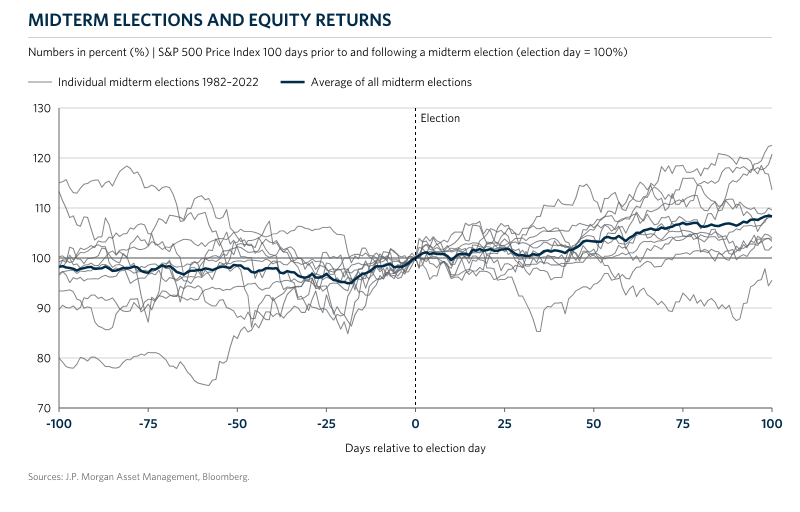 J.P. Morgan Asset Management notes that since 1950, the S&P 500 has posted positive returns in the twelve months after every midterm election, averaging roughly 15 percent. More tellingly, the index returned an annualized total return of approximately 16 percent over both of President Obama's terms and President Trump's first term, despite opposing political configurations.
Why Policy Matters
There has been understandable interest in the implications of the election on the AI data center buildout. However, it is important to note that much of the pressure predates the results of the election. Data from Wood Mackenzie shows that there have been more than 400 state and local data center moratoriums since January 2026, affecting over 100 gigawatts of planned capacity.
With the election now behind us, Bloomberg estimates that roughly 40 percent of planned U.S. capacity is now situated in states less inclined to approve buildouts, including Virginia, Pennsylvania and Arizona. At the federal level, a divided government will likely result in a policy deadlock rather than sweeping legislation from either side of the political aisle. Despite a Democratic majority in Congress, a Presidential veto can overrule proposed legislation. Other impediments to data centers revolve around further negative public perception, which would increase with more hearings on electricity prices, data center tax treatment and closer scrutiny of permitting shortcuts.
None of this means the data center buildout will stop, but timelines could lengthen, with the market starting to price that possibility soon after the election.
The Danger of Tactical Tilts
Regardless of how the data center buildout is affected and how the AI trade plays out, politics is among the hardest risks to underwrite because market timing through a portfolio tilt requires being correct on four decisions, instead of one. Investors must correctly forecast the political outcome, correctly forecast the market’s reaction, size a portfolio tilt appropriately to benefit, and finally decide the optimal time to exit. Getting one of these decisions right is difficult, and being on the right side of all four is an extremely tall order.
Liberation Day illustrates how unpredictable outcomes can be. An investor who correctly anticipated that the April 2, 2025, tariff announcement would negatively impact stocks and exited after the S&P 500 fell 12 percent over the next four trading days, would have taken a loss immediately. A ninety-day tariff pause meant the index gained 9.5 percent on April 9th, its largest one-day return since 2008. Missing that one-day alone, even while remaining fully invested throughout the year, would have cut an S&P 500 investor's calendar year 2025 return from 17.9 percent to roughly 7.6 percent.
Similarly, there were expectations that the market would experience a continued selloff if Donald Trump won the Presidential election in November 2016. S&P 500 futures fell as much as 5 percent overnight, triggering their limit-down circuit breaker, yet the index closed the next day up 1.1 percent. The S&P 500 went on to return 21.8 percent in 2017, his first year in office, and delivered a 16 percent annualized return over the course of his first term from 2017 to 2020.
More specialized, sector-specific tilts fare little better. Clean energy (proxied using the iShares Global Clean Energy ETF), seen as a casualty of the first Trump administration, returned over 300 percent from January 2017 to January 2021. It then fell approximately 60 percent through from February 2017 through December 2024 despite the passage of the 2022 Inflation Reduction Act, which committed an estimated $369 billion to climate and energy programs, largely through tax credits for renewable power and U.S.-made clean energy components. Investors who were right about the political outcomes were still wrong about the returns due to other macroeconomic factors affecting returns.
What It Means for Long-Term Portfolios
For institutions with perpetual horizons, the cost of a mistimed tilt can outweigh any edge provided by a potentially well-executed tactical allocation decision.
The fundamental mismatch comes from the inherent difference in time horizons, as political changes revolve around two-to-four-year election cycles while perpetually endowed institutions are planning for decades.
The real risk the market’s reaction to political events exposes is concentration. When one theme dominates index returns, as we have seen with AI, a single policy shift can significantly impact a portfolio. Through diversification within and across asset classes, including exposure across regions, styles and strategies, helps to reduce dependence on any one driver of return.
Elections very well may continue to cause market movements, but they rarely change the case for a thoughtful approach to portfolio construction that can help long-term institutions serve their unique missions across varied market cycles.